While major integrase strand transfer inhibitor (INSTI) resistance mutations have been identified, the effect of mutation combinations on phenotypic resistance are less clear. We identified a clinical HIV sequence with four major integrase resistance mutations, and characterized in vitro INSTI phenotypic susceptibility of all combinations thereof to deconstruct their individual and combined effects.
Routine clinical testing identified an integrase sequence harboring T97A, E138K, G140S and Q148H. We constructed chimeric NL4-3 viruses harboring i) all 15 combinations of these mutations in the autologous integrase backbone, ii) the autologous sequence with these four sites ‘reverted’ to consensus B residues and iii) NL4-3 with all four mutations. Chimeric viruses were grown in a reporter CD4+ T-cell line in the presence of 0.01-1,000nM raltegravir (RAL), elvitegravir (EVG), dolutegravir (DTG), cabotegravir (CAB), and bictegravir (BIC), where infection was measured by imaging cytometry.
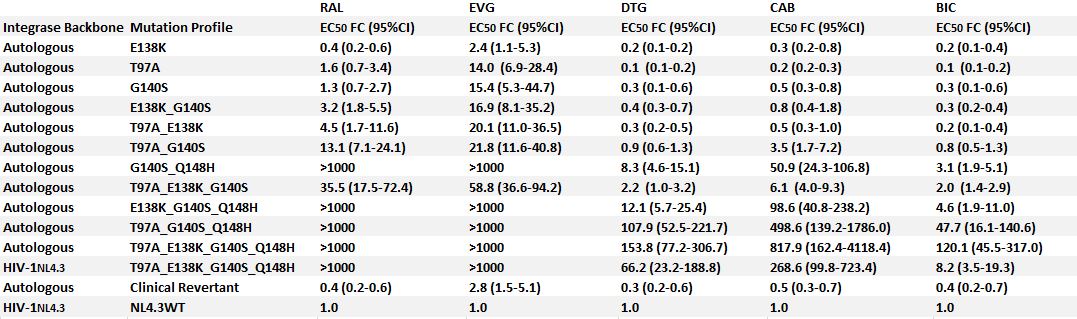
Consistent with the known fitness impact of Q148H and its compensation by G140S, viruses engineered with Q148H without G140S either failed to propagate, or propagated only after in vitro mutation; these were excluded from analysis. In the autologous viral backbone, T97A, E138K, or G140S alone conferred 2.4 to 15.4-fold decreased susceptibility to EVG but not to other INSTI (Table 1). Two-mutation combinations conferred low to moderate resistance, except G140S/Q148H which eliminated RAL and EVG activity and conferred 8.3-, 50.9-, and 3.1-fold reduced susceptibility to DTG, CAB, and BIC respectively. Addition of E138K to G140S/Q148H conferred 12.1, 98.6 and 4.6-fold less susceptibility to DTG, CAB, and BIC respectively, while addition of T97A to G140S/Q148H conferred >100, >100 and 47.7-fold reduced susceptibility to these drugs. The T97A/E138K/G140S/Q148H clinical sequence displayed >100-fold reduced susceptibility to all INSTIs. The quadruple NL4.3 mutant displayed >100-fold less susceptibility to RAL, EVG and CAB but only 66.2-, and 8.2-fold less to DTG, and BIC respectively, while the clinical revertant retained 2.8-fold decreased susceptibility to EVG. Together this suggests that the autologous clinical backbone also contributed to resistance. Measured EC50s correlated strongly with Stanford HIVdB resistance scores (Spearman r>0.87; p<0.0001 for all INSTIs).
High-level resistance to DTG, CAB and BIC requires multiple integrase substitutions including compensatory mutations.