The World Health Organization (WHO) guidelines on antiretroviral therapy (ART) define the HIV-1 viral load (VL) threshold for treatment failure as 1,000 copies/mL. The SESOTHO trial, conducted in Lesotho, found that patients with persistent viremia below this threshold on first-line ART benefitted from switching to second-line ART. This pre-planned nested study assessed the prevalence of resistance-associated mutations (RAMs) in SESOTHO trial participants.
From August 1, 2017 until August 7, 2019, the SESOTHO trial enrolled 80 persons taking non-nucleoside reverse transcriptase inhibitor (NNRTI; efavirenz or nevirapine)-based first-line ART with low-level HIV-1 viremia (100-999 copies/mL). Participants were randomised (1:1) to either switch to a protease inhibitor (PI)-based second-line regimen (switch) or continue on first-line therapy as per the WHO standard of care (control). We sequenced relevant regions of the viral pol gene using plasma samples obtained at enrolment and the 36-week follow-up. RAMs and levels of drug resistance were classified according to the Stanford HIV drug resistance database.
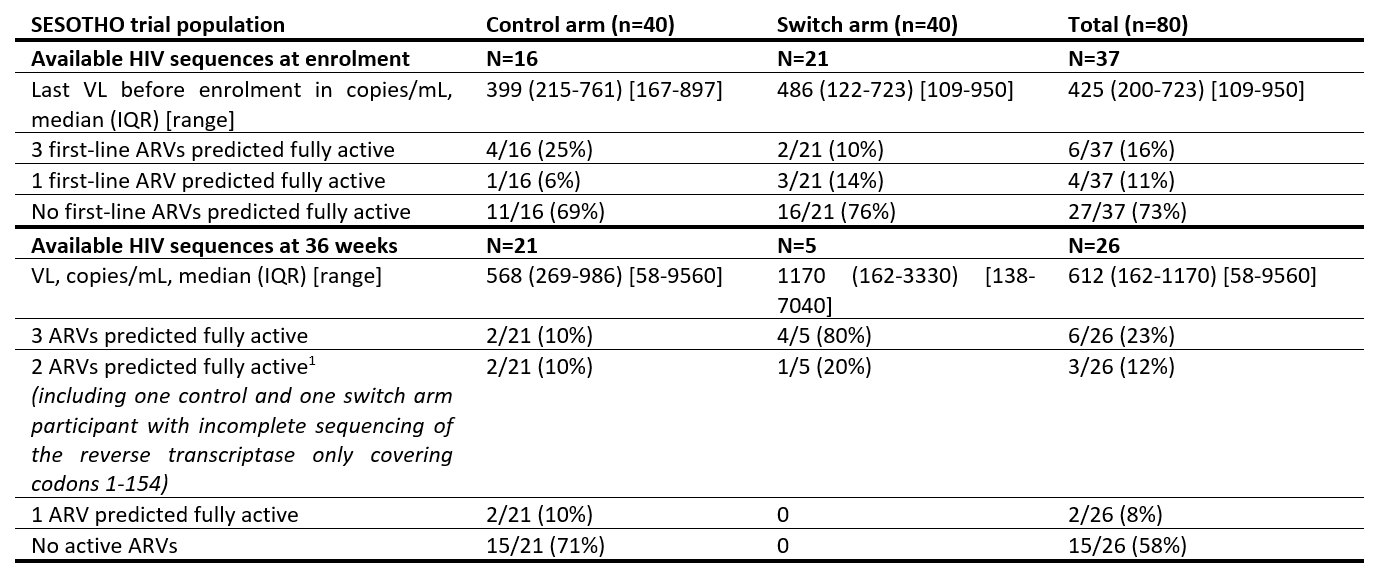
Overall, 49/80 (61%) participants had resistance data available at enrolment and/or 36 weeks. 34/49 (69%) were female, the median age was 41 years (IQR 32-50), and median time on ART was 7.3 years (IQR 4.4-8.9). The proportion of participants harbouring nucleoside reverse transcriptase inhibitor (NRTI) and NNRTI resistance (at one or both time points) was 41/49 (84%) and 42/49 (86%), respectively. Considering each time point individually, sequencing was successful for 37/80 (46%) participants at baseline and 26/48 (54%) participants without viral suppression to <50 copies/mL at 36 weeks (21 control; 5 switch). At baseline, 31/37 (84%) participants harboured HIV with high-level resistance to ?2 drugs of their pre-enrolment regimen. At 36 weeks, 17/21 (81%) control arm participants harboured HIV with resistance to ?2 drugs of their current (first-line) regimen, while no PI-associated resistance was detected in the five switch (second-line) participants.
Among persons with low-level viremia while taking NNRTI-based first-line ART enrolled in the SESOTHO trial, the majority harboured HIV-1 with RAMs that necessitated ART modification. These findings support lowering the VL threshold that triggers a switch to second-line ART in future WHO guidelines.