Newer antiretroviral drugs and dosing formulations have expanded treatment options for people with HIV (PWH) in recent years. In a previous study, we found that the prevalence of PWH with limited antiretroviral treatment (ART) options declined dramatically to <2% after the introduction of the integrase strand transfer inhibitor (INSTI) class. Newer INSTIs, including dolutegravir (DTG) and bictegravir (BIC), have improved viral suppression and become the recommended 'core' components in initial ART regimens. However, information regarding the uptake of newer drugs and current ART use patterns is lacking.
We studied all PWH aged 18 or older in routine clinical care 01/2018-12/2019 across the US in the CFAR Network of Integrated Clinical Systems (CNICS) cohort. We examined current ART use, defined as the most recent multi-drug ART regimen, by core class (INSTI, non-nucleoside reverse transcriptase inhibitor (NNRTI), protease inhibitor (PI)), and by individual drugs in the overall cohort and among ART-naïve PWH initiating ART 2018-2019.
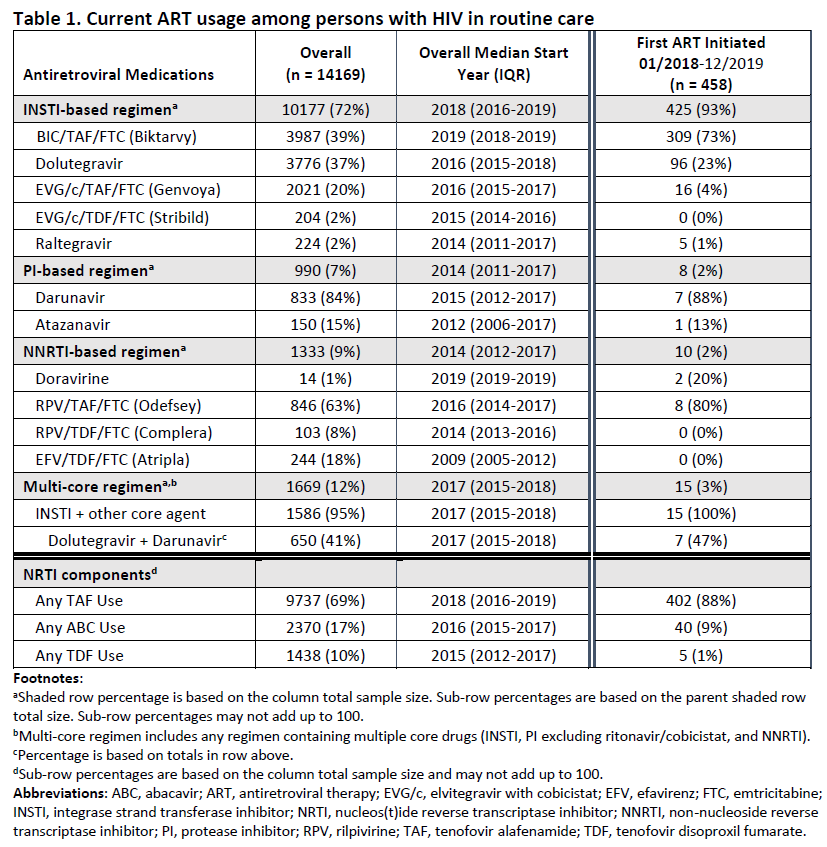
Among 14,727 PWH in care, 96% were on ART, median age was 51 years, 20% were female, 61% non-white, and 55% men who had sex with men as a risk factor for HIV. Among PWH on ART, the majority were receiving INSTI-based regimens (72%) of which 39% were anchored by BIC and 37% by DTG. A small proportion of PWH were on PI- (7%) and NNRTI- (9%) based regimens which on average were started 4 years prior to the study period (2014), with NNRTI use limited to single-tablet regimens (STRs, 99%). Sixty-nine percent of all regimens included tenofovir alafenamide (TAF) while only 10% used tenofovir disoproxil fumarate (TDF). Among 458 ART-naïve PWH initiating treatment in 2018-2019, 93% were on INSTI-based regimens of which 73% were anchored by BIC and 23% by DTG.
The results of this study suggest high current uptake of ART nationally among PWH in care, predominance of newer INSTI-based regimens, and the emergence of BIC/TAF/FTC as the preferred regimen for both ART-experienced and naïve individuals initiating ART. Few PWH remain on core agents with a lower barrier to resistance formulated as STRs. In addition, TAF has replaced TDF as the preferred form of tenofovir across all regimens. Further study of ART utilization patterns among specific subgroups of PWH is needed to guide development of targeted approaches to improve uptake and clinical outcomes for all PWH as the ART landscape continues to evolve rapidly.