Patients with pre-existing multimorbidity and liver dysfunction (LD) are more likely to develop severe COVID-19 and have a higher risk of mortality. In severe COVID-19 patients who are mechanically ventilated or require supplemental oxygen, the administration of dexamethasone (DEX) may be life-saving, however the impact of LD on the pharmacokinetics (PK) of DEX is unknown. The aim of the study was to apply PBPK modelling to predict the effect of LD on the PK of DEX in the treatment of COVID-19.
A whole-body PBPK model was designed in Simbiology v. 9.6.0 (MATLAB R2019a) and used to simulate 100 adult individuals. First the model was qualified against reported clinical data for oral (PO) and intravenous (IV) DEX in healthy adults. Physiological changes and portal vein shunt were incorporated into the model to provide a mathematical description of LD that was classified by Child-Pugh (CP) scores A, B and C. The LD model was qualified against IV and PO reported clinical data for both propranolol (healthy adults and CP-A, -B and -C patients) and midazolam (healthy adult and cirrhosis patients). The model was assumed to be verified if the simulated values were within 2-fold of the reported clinical values and if the absolute average-fold error (AAFE) was below 2. The qualified model was then used to simulate the administration of DEX 6 mg (COVID-19 protocol) in patients with LD (CP-A, -B and -C) with and without shunting. The mean shunt index (%) considered in the model was 40 ± 18.
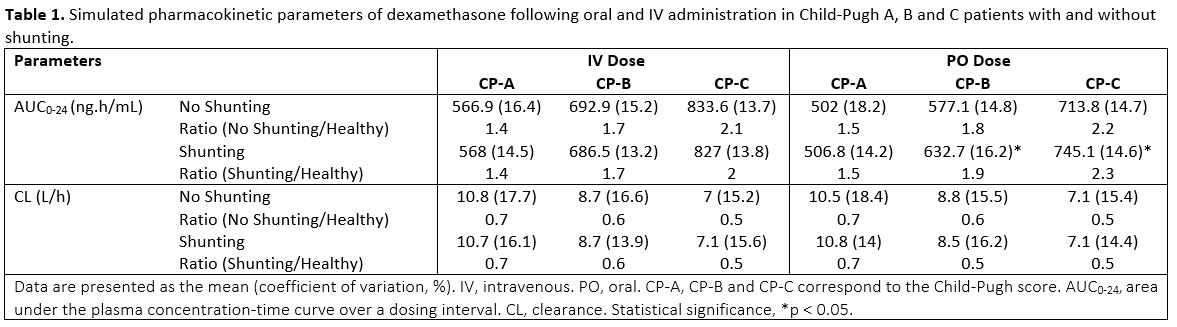
The PBPK model was successfully qualified across DEX, midazolam and propranolol with an AUC0-24 average fold of 1.1 and 0.95; AAFE value of 1.1 and 1.2 for healthy and LD individuals, respectively. When compared to healthy adults, the simulated systemic clearance of DEX decreased and the plasma concentrations increased in all patients with LD, as shown in Table 1. Moreover, a significant difference was observed between the AUC0-24 of DEX PO when comparing no shunting and shunting in patients with CP-B and -C.
The increased exposure of DEX in different stages of LD was predicted through PBPK modelling, providing a rational framework to predict PK in complex clinical scenarios related to COVID-19. Although DEX exposure was predicted to be more than 2 times higher in CP-C individuals, no dose adjustments seem necessary in patients with LD considering DEX’s low hepatic extraction, the low dose administered in the COVID-19 protocol and the therapeutic index of DEX.