Microneedle array patches (MAPs) comprise of multiple micron-scale needles that can provide painless administration of long-acting nanoformulated drug, producing effective drug plasma concentrations over extended periods of time. The current study used physiologically-based pharmacokinetic (PBPK) modelling to predict optimal dosing strategies of bictegravir (BIC) via MAP administration.
A whole-body PBPK model was designed in Simbiology v.9.4 (MATLAB R2018a) and used to simulate 100 healthy individuals aged 18-60 years. Transdermal MAP administration was verified previously using cabotegravir and rilpivirine and was implemented into the BIC PBPK model. The BIC model was verified against reported clinical data for the oral administration of 5mg-100mg BIC once daily (QD). The PBPK model was assumed to be verified if the simulated values were within 0.8-1.55-fold of the reported clinical values and if the absolute average-fold error (AAFE) was below 1.55. The verified BIC model was used to simulate three once-monthly (QMT) MAP administrations following four weeks of 50mg BIC QD oral administration as oral lead in. Two dosing strategies were assessed, three MAPs with the same dose and one MAP with a higher loading dose followed by two MAPs with a lower maintenance dose. The protein adjusted (PA)-IC95 of BIC (162 ng/ml) was considered as the minimum target plasma concentration. A range of MAP doses with varying release rates were simulated to determine the most efficient dosing strategy that achieved the target concentration.
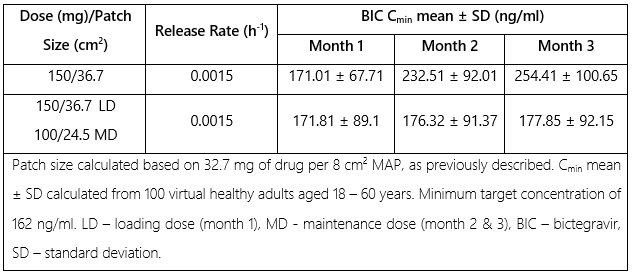
The BIC PBPK model was successfully verified according to the criteria. MAP doses between 140-180 mg were simulated for the administration of three identical MAPs, with release rates between 0.0005-0.0025 h-1 being assessed. The optimised dose and release rate from these simulations were then applied as the loading dose with a range of MAP doses between 90-130 mg being simulated for the maintenance dose. The simulated minimum concentration (Cmin) of BIC at the end of each MAP dosing interval for the optimised strategies are summarised in the table, including their estimated patch sizes.
The PBPK model identified suitable dose and release rate strategies with practical patch sizes for QMT MAP administration of BIC. These simulations support the case for long-acting BIC MAPs and the data can inform strategies to address the technological challenges in the development of this alternative drug delivery system for antiretroviral therapy.