In individuals with acute HIV-1 infection (AHI) in Bangkok, Thailand, overt depression symptoms are common but improve by 6 months after prompt initiation of antiretroviral therapy (ART). It is unclear if this improvement in mood symptoms is durable up to six years following ART started during AHI.
RV254 cohort participants initiated ART at a median=0[IQR 0-1] days after AHI diagnosis (Fiebig I-V) and completed the 9-item Patient Health Questionnaire (PHQ-9, score 0-27) for depression symptoms and the Distress Thermometer (DT) for anxiety/stress (score 0-10) at untreated AHI (baseline), weeks 12, 24, 96 and every 48 weeks thereafter. This analysis included participants who maintained suppressive ART over 288 weeks of follow-up, defined by the absence of plasma HIV RNA >400 cps/ml. Week 288 PHQ-9 scores, CD4+ T cell counts, and CD4/CD8 levels were compared based on baseline PHQ-9 scores (No depression: ?9; moderate depression: 10-14; moderate-severe depression: ?15).
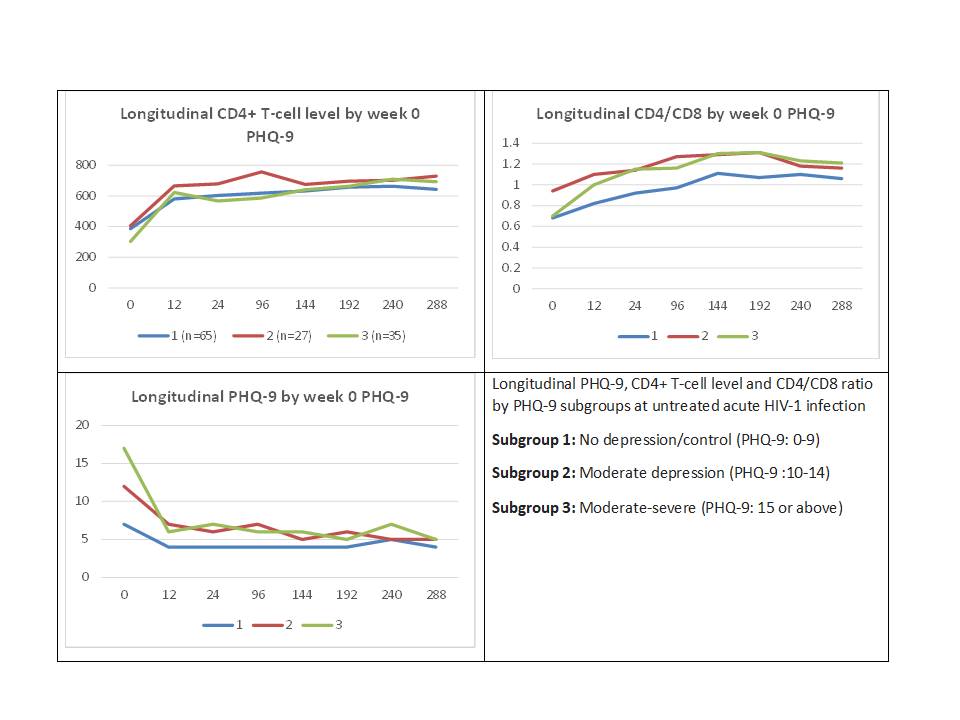
By Sep 2020, 243 participants reached week 288 post-ART. 15 withdrew from the cohort; 17 failed HIV control criteria; 54 were co-enrolled into analytical treatment interruption studies; 30 did not have paired baseline and week 288 records. Of the remaining 127 participants (95% male, median age 28 years), the median PHQ-9 and DT scores at baseline were 9[IQR 7-16] and 6[IQR 3.2-7.5] respectively. The rates of moderate and moderate-severe depression symptoms at baseline were 21% and 27%, respectively. Median PHQ-9 and DT scores improved post-ART to subclinical levels by week 24. The rates of moderate and moderate-severe depression symptoms were stable at ?10% and ?4% after week 96. Baseline PHQ-9 score correlated with the score at week 288 (p<0.001). At baseline, participants with PHQ-9?15 had higher plasma HIV RNA (p=0.011) and frequency of acute retroviral syndrome (p=0.043) than the rest of the group (PHQ-9<15). Participants with PHQ-9?15 at baseline trended towards higher PHQ-9 scores than no depression group at week 288 (5[IQR2-8] vs. 4[IQR1-6], p=0.083), but had a non-inferior immune recovery in CD4+ T-cell and CD4/CD8 levels (Figure 1).
in those who maintain viral suppression after ART initiation during AHI, depression symptoms remain stably improved at 6 years. While overall, PHQ-9 score at 6 years correlates with baseline score during AHI, moderate-severe depression symptoms during AHI do not portend durable depression symptoms or impaired immunologic recovery after long-term ART.