Evidence supports switching DTG/3TC/ABC in patients complaining about insomnia. However, there is unknown if the benefit observed could also apply to non-complaining patients displaying sleep disturbances in self-reported questionnaires used as screening tools, such as the Pittsburg sleep quality index (PSQI).
We designed the DETOX study, as an open label, randomized (1:1), multicenter, pilot clinical trial, to evaluate the reversibility of sleep disturbances detected with the PSQI in well-suppressed patients on DTG/3TC/ABC (>12 weeks) not complaining of insomnia. Participants with a PSQI >5 were randomized either to switch to DRV/c/FTC/TAF for 8 weeks (arm 1) or either to continue 4 weeks on DTG/3TC/ABC and then switch to DRV/c/FTC/TAF for 8 weeks (arm 2). Every 4 weeks, participants self-reported using the PSQI, the Hospital Anxiety & Depression Scale (HADS) and a questionnaire exploring about 11 neuropsychiatric adverse events (AE). Raw scores on PSQI and HADS, along with an average score from adding the grade of each neuropsychiatric AE, were normalized (0-100). Then we compared changes at week 4 (between study arms) and after participants completed 4 and 8 weeks on DRV/c/FTC/TAF. Additional analyses included virological outcomes.
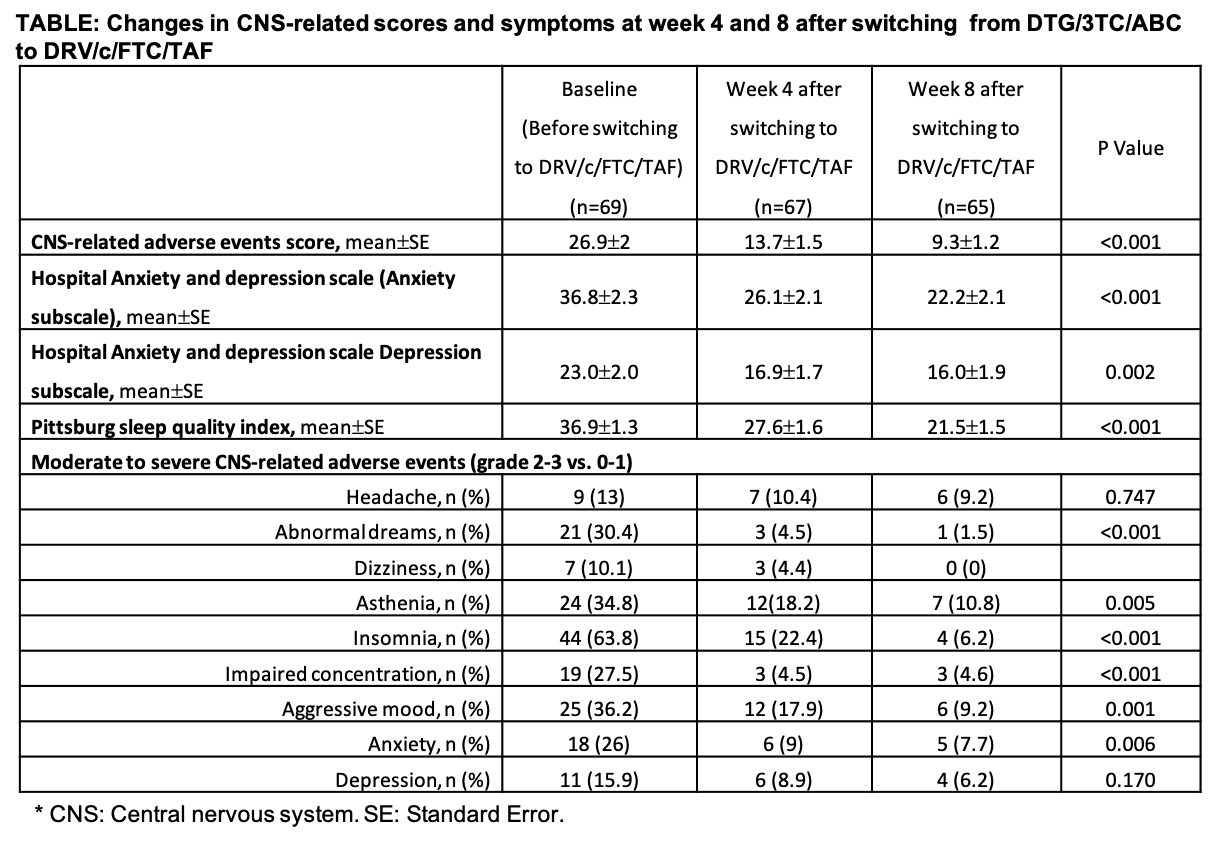
The study included 72 participants (arm 1: n=37; arm 2: n=35). Both arms had similar baseline characteristics. Three discontinued prematurely before week 4 (arm 1: none; arm 2: 1 COVID-19, 1 loss of follow up (LFU) and 1 consent withdrawal). At week 4, we observed significant improvements (arm 1 vs. arm 2) in PSQI (mean change±SD: 11.5±10.2 vs. 0.6±8.9; p<0.001), HADs anxiety scale (14±16.9 vs. 1.9±15.6; p=0.003) and AE (13.7±13.3 vs. 1.3±8.6; p<0.001) scores. Sixty-nine participants switched to DRV/c/FTC/TAF: 37 at baseline (arm 1) and 32 at week 4 (arm 2). All except 3 who discontinued prematurely (2 LFU and 1 due to AE nausea) completed 8 weeks of follow up. Pooled analysis showed significant improvements in most neuropsychiatric scores and symptoms (table), with no virologic failures reported. After switching to DRV/c/FTC/TAF, 26 participants (37.7%) reported any AE (all grade 1-2). Most common AE were headache (7.2%) and dyslipidemia (7.2%).
Sleep disturbances detected through self-reported screening tools seem to be associated with patients on DTG/3TC/ABC not complaining of insomnia. These disturbances, among other neuropsychiatric symptoms such as anxiety or depression, could improve after switching to DRV/c/FTC/TAF.