EFV has been associated with neuropsychiatric side effects and sleep disorders, while association with neurocognitive impairment (NCI) remains controversial. Our aim was to investigate whether a treatment switch from EFV/F/TDF to B/F/TAF may improve psychiatric symptoms, sleep function and if it has an impact on neurocognition.
EBONY is a pilot, single arm, open label, prospective study of HIV suppressed patients (pts) on the efficacy and safety of switching from EFV/F/TDF to B/F/TAF. All pts underwent neuropsychological assessment (NPA) at the switch (T0) and after 48 weeks (T1). NPA was carried out through a standardized battery of 12 tests (5 domains). Participants were classified as having NCI if they scored >1 standard deviation (SD) below the normal mean in at least 2 tests, or >2 SD below in 1 test. Individual z-scores were determined, and NPZ-12 was calculated as the average of the 12 test z-scores; changes of NPZ-12 were analyzed as outcome. HAND was classified by Frascati’s criteria. Beck Anxiety Inventory (BAI), Beck Depression Inventory (BDI) and Pittsburgh Sleep Quality Index (PSQI) were administered. Paired Wilcoxon and McNemar tests were used for statistical comparisons. Multivariable linear regression was used to find factors associated with changes in tests.
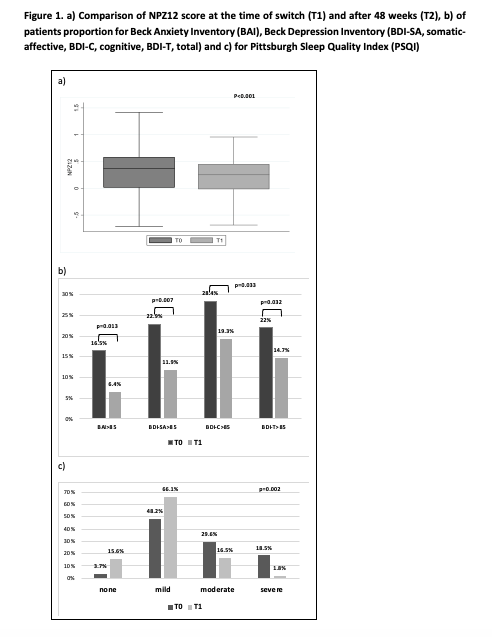
109 participants: mostly Caucasian male with a median age of 53 yrs (IQR 46-58), 30% MSM, median education 13yrs, 8% with at least 1 comorbidity and median CD4 count of 604 cells/mm3 (500-810). The median time of EFV/F/TDF therapy was 8.4 yrs (7.1-10.1). NPA revealed a NCI in 36/109(33%) pts at T0 and 37/109(34%) at T1 (p=0.866). Specifically: 67.9% pts did not change at T1, 16.5% worsened and 15.6% improved. At T1 we observed a slight worsening in the NC function (mean±SD NPZ12 change:-0.21;+0.36; p<0.001;Figure 1a) and in mental flexibility (-0.16;+0.63;p=0.003), working memory (-0.47;+0.75);p<0.001) and memory (-0.28; +0.85;p<0.001) domains. We observed an ANI in 3.7% at T0 and 7.3% at T1. No pts with MND or HAD were found. Self-reported BAI and BDI-II questionnaires revealed an improvement at T1 (Figure 1b). Also sleep disorders significantly improved (Figure 1c). No factor associated with test score changes was found.
Our results suggest that switch from EFV/F/TDF to B/F/TAF significantly improves psychiatric symptoms and sleep disorders. Neurocognitive performance remained substantially stable, even though a decline on NPZ-12 and in specific domains was observed.