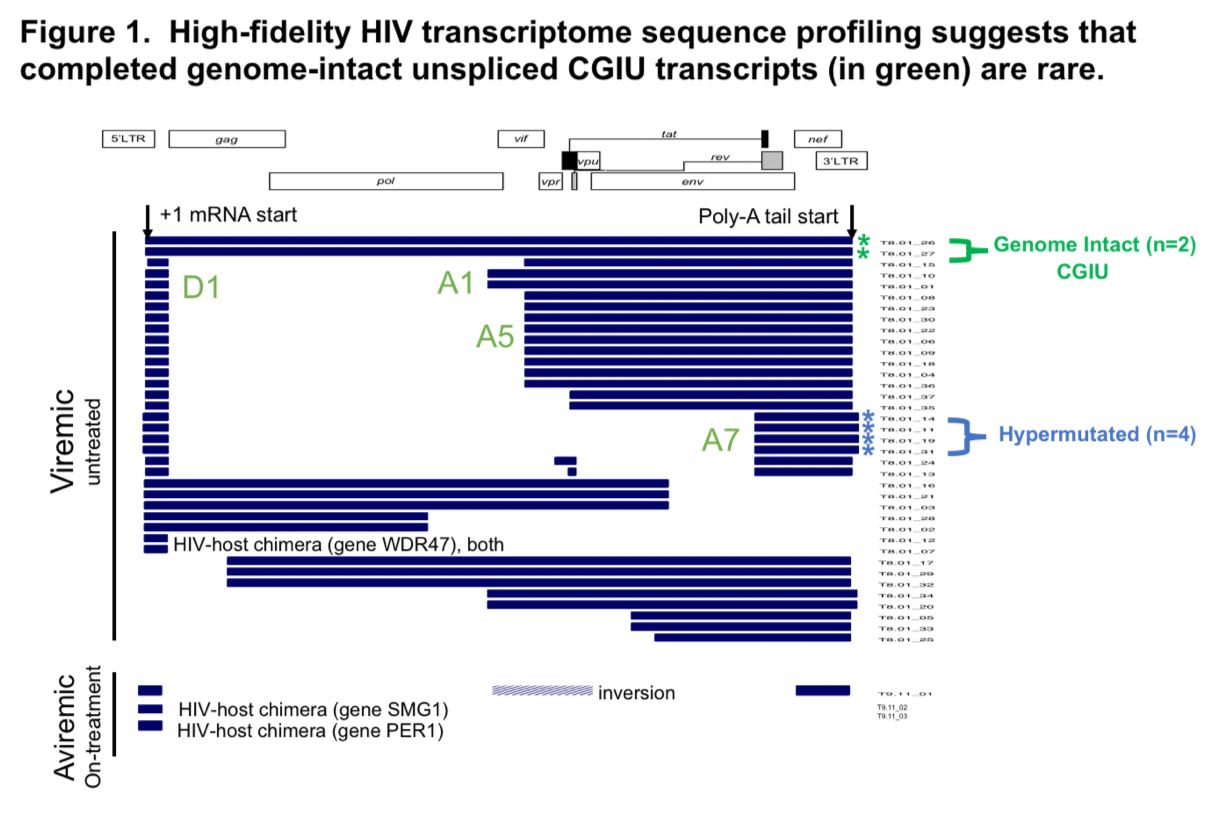
During virologic rebound, HIV-infected cells must produce 5′ to 3′ completed, genome-intact and unspliced (CGIU) viral transcripts for packaging into new virions. Conventional methods to study HIV transcription are unable to obtain genome-intactness information. Here, we present a novel high-fidelity long-read sequencing method, TranSeq, and profiled HIV transcriptomes in clinically-derived CD4+ cells with emphasis on CGIU transcripts.
CD4+ cells were enriched from total PBMCs. Poly-adenylated RNA was extracted and subjected to TranSeq using PacBio Sequel II single molecule real-time long read sequencing at an average of 3 million reads per sample. Resulting reads were analyzed using an in-house bioinformatics pipeline. A completed HIV transcript was defined as possessing +1mRNA, 3’LTR end site, and a poly-adenylated tail.
Human cell line 8E5/LAV with an integrated and defective HIV genome was used for benchmarking. We sampled 940 cells and observed 2882/12858 (22%) completed, unspliced transcripts. Next, we examined unstimulated CD4+ cells from two persons with viral load 96125 (untreated viremic) and 92 copies/mL (persistent low-level viremic). We sampled ~100,000 CD4+ cells each and detected 37 and 0 HIV transcripts respectively (Figure 1). Despite the highly viremic state in the first individual, only 2, 13 and 2 transcripts were completed genome-intact unspliced (CGIU), singly-spliced and doubly-spliced respectively. APOBEC-associated hypermutations were present in 4/37 (11%). HIV-human splice chimeras were in 2/37 (5%). Then, we examined 100,000-700,000 unstimulated CD4+ cells from five treated and virologically suppressed individuals: Only one was positive for three copies of HIV transcripts: One displayed defective splicing with an internal inversion, whereas two spliced from splice donor 1 into known splice acceptor sites in human genes SMG1 and PER1 (Figure 1). In this individual, ex vivo stimulation by PMA/ionomycin or CD3/CD28 increased HIV transcripts detection by 375- and 20-fold respectively.
Our results suggest CGIU transcripts were rare. Even during uncontrolled viremia, cell-associated CGIU transcripts only made up 2/37 (5%) of the HIV transcriptome, and were undetectable in the low-level viremic and virologically suppressed individuals. Future studies will increase sampling-depth and explore time- and dosage-dependent effects of latency reversing agents on CGIU transcripts production.