Blockade of the programmed cell death protein-1 (PD-1) pathway can reverse HIV latency, can potentiate virus-specific CD8 T cell responses, and has been associated with favorable outcome in some cases of central nervous system (CNS) infection. The effects of PD-1 blockade on CNS reservoirs for HIV are under study in clinical trial NCT03239899. We evaluated HIV-infected CD4 T cell reservoirs in blood in participants from this trial.
People with HIV on ART and with CD4 counts >350 cells/?L received one infusion of 200 mg pembrolizumab, a monoclonal antibody against PD-1. PBMC were collected at baseline and at 3 and 24 weeks post-infusion. Control participants who had not received pembrolizumab were also studied. CD4 T cells in PBMC were FACS-sorted into naïve, central/transitional memory (CTM), and effector memory (EM) subsets. HIV DNA in sorted cells was quantified by limiting dilution PCR of a portion of env. PCR products were Sanger sequenced. HIV RNA was quantified by qRT-PCR. Cell gene expression patterns were determined by mRNA-Seq. Paired integration site analysis and near-full length sequencing was performed by multiple-displacement amplification and single-genome sequencing. Intact HIV proviruses in total CD4 T cells were enumerated with intact proviral DNA assay.
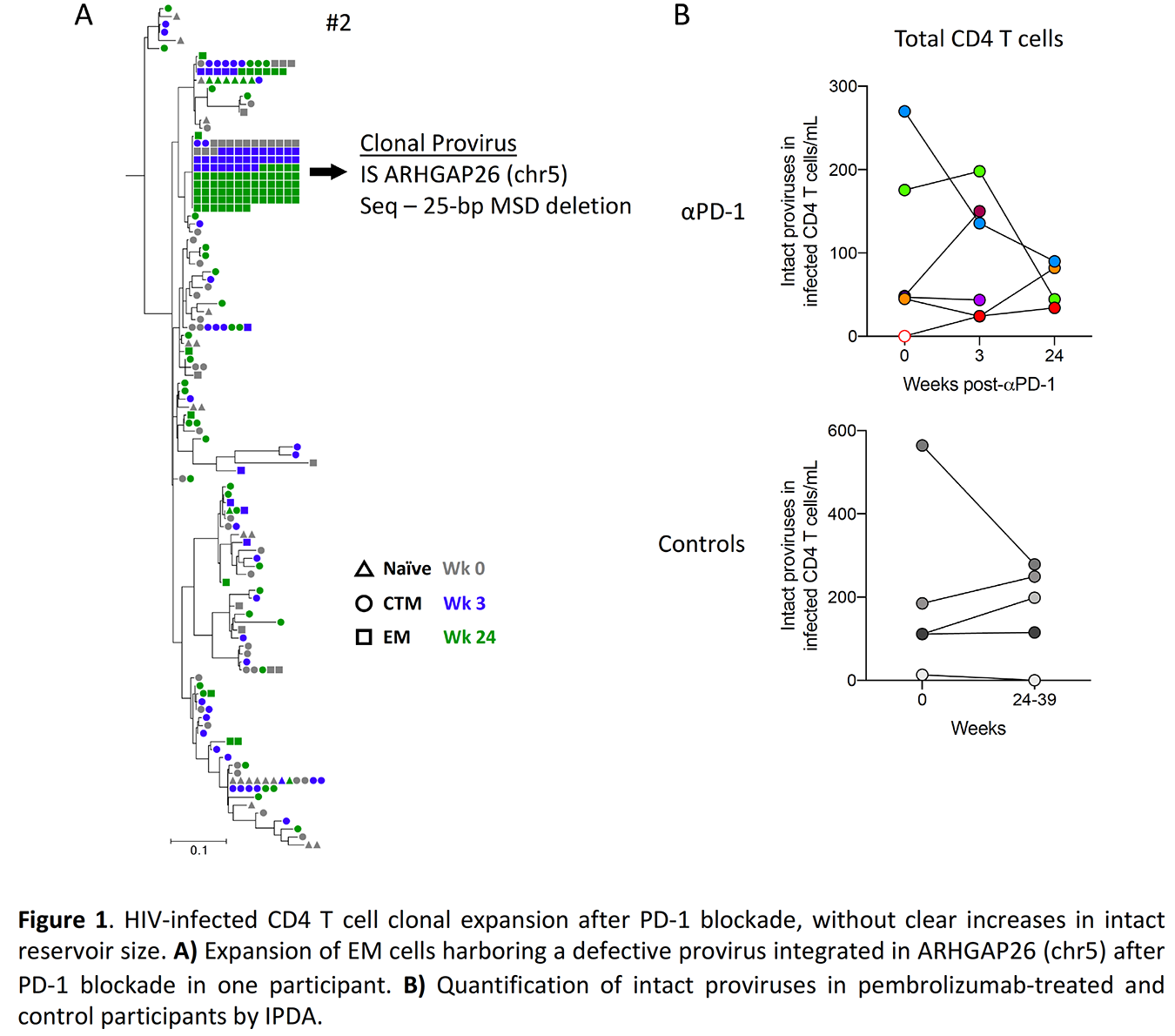
Pembrolizumab infusion and 24 weeks of follow-up were completed for six participants. Changes in sorted cell HIV DNA and RNA over time were similar in pembrolizumab-treated and control groups. However, a shift in distribution of HIV-infected cells to the EM subset and a reduced genetic diversity of HIV DNA sequences were observed after pembrolizumab. These were associated with lower levels of T cell activation signaling gene transcripts and with expansion of a small number of HIV-infected cell clones. In one participant, one clone expanded to account for ~1% of all circulating CD4 T cells post-infusion. This clone harbored a provirus with a deletion in the major splice donor site. Intact proviruses were infrequent in both pembrolizumab-treated and control participants, with no consistent change in frequency over time in either group.
PD-1 blockade was associated with perturbations in the HIV-infected CD4 T cell pool including a shift to an EM phenotype and further expansion of some infected cell clones. Further investigation of intact proviruses in T cell clones following checkpoint inhibitor administration will help clarify the net effect of these agents in HIV cure strategies.