HIV-1 establishes long-lived latent reservoirs that present a barrier for virus eradication. One approach to reduce the latent reservoir is the use of latency reversal agents followed by the killing of virus-producing cells. However, this approach is limited by the inability to reactivate the majority of latent proviruses, highlighting the need for a greater understanding of the interplay of mechanisms involved in the maintenance of HIV-1 latency.
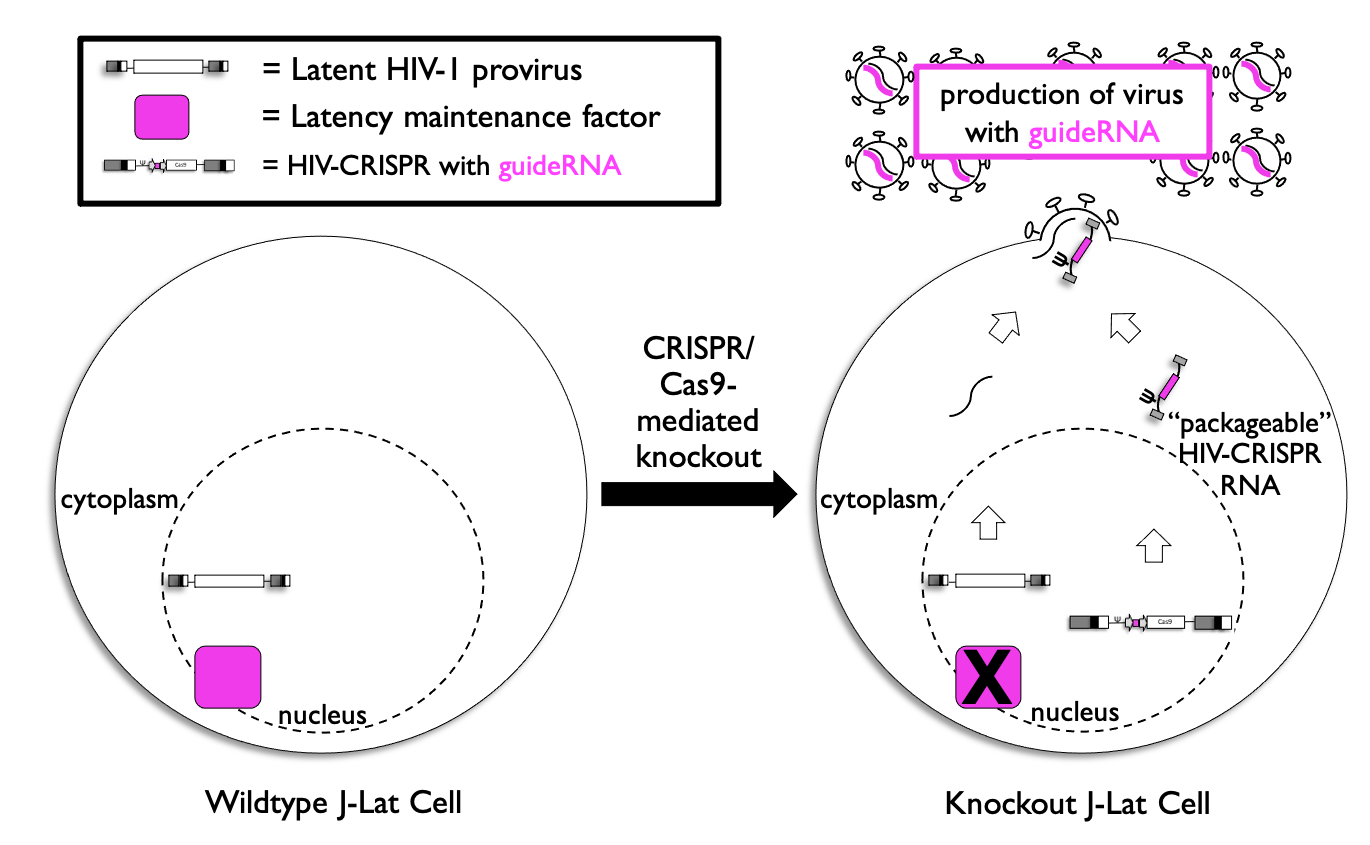
We initiated a multi-arm CRISPR screening approach in the J-Lat model of latent infection to gain a comprehensive representation of the pathways involved in HIV-1 latency. Upon CRISPR/Cas9-mediated knockout of a latency maintenance gene, the provirus of the J-Lat cell line is reactivated. The screen also adapts a functional CRISPR screening methodology developed in the Emerman lab called HIV-CRISPR. The HIV-CRISPR vector is a lentiviral vector that encodes Cas9, a library of single guide RNAs (sgRNA), and two intact LTRs that can be mobilized to produce an HIV-CRISPR RNA containing the sgRNA of interest in the presence of the reactivated HIV-1 provirus. The HIV-CRISPR RNA is packaged in trans into the reactivated virion and released into the supernatant. Sequencing is then used to quantify the enriched sgRNAs in the released viruses serving as a direct readout to identify genes controlling HIV-1 latency maintenance. We investigated the mechanisms controlling the chromatin state of latent HIV-1 by developing a custom sgRNA library specifically targeting ~800 human genes involved in some aspect of epigenetic control of gene regulation or DNA modification.
The screen involving knockout of the epigenetics genes identified known HIV-1 latency maintenance factors including BRD4 and KAT5. Our top gene hit in the screen was Cullin 3 (CUL3), which is involved in ubiquitination of target proteins, and novel to HIV-1 latency. Knockout of CUL3 in two different J-Lat clones leads to the release of HIV-1 from latency. Similar experiments in primary CD4+ T-cell models of HIV-1 latency are ongoing.
We developed a new high-throughput, combination latency HIV-CRISPR screen that is able to identify novel and known HIV-1 latency maintenance genes. Initial validation of the screen demonstrates that protein ubiquitination through the CUL3 pathway is important for HIV-1 latency maintenance. Further analysis and combining the results from additional screens will provide a more comprehensive view of HIV-1 latency.