Treatment of HIV-1-positive individuals early in the course of infection provides the best opportunity for preservation of host immune function and limits the size of the latent HIV-1 reservoir. However, the transcriptional dynamics of discrete cellular subsets during treatment for primary HIV-1 infection has not been described in detail. We used single-cell RNA-sequencing to examine cell-type specific changes in gene expression in response to the initiation of cART during primary HIV-1 infection.
Using Drop-seq single-cell profiling, we generated longitudinal, unbiased gene-transcriptional profiles from cryopreserved PBMC of 10 HIV-1 positive MSM presenting during primary HIV-1 infection (TP1) and after approximately 1 year of uninterrupted, suppressive cART with PI or NNRTI based regimens (TP2). Mean age was 36 (24-44) years at initial presentation. Median estimated duration of HIV-1 infection at TP1 was 60 days (30-130). At TP1, individuals had lower median CD4/CD8 T cell ratios (0.47 versus 1.22) and higher HIV-1 RNA levels (Log 10 5.6 vs. < 1.7) compared to TP2, at which time all individuals were virologically suppressed (p<0.05 for all comparisons). GSEA identified gene pathways significantly modulated by cART.
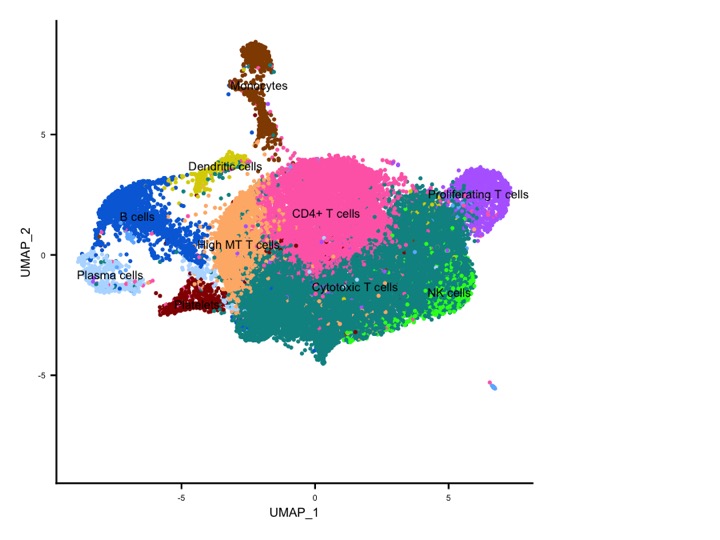
After strict quality control and filtering, our analysis identified 27,388 cells. The mean read depth per cell was approximately 43,000–84,000 as reported by CellRanger. Clustering using Seurat identified 10 clusters using expression of classical cell type markers (Fig 1). We then compared abundance of cell populations and transcriptional profiles within specific cell populations before and after cART initiation. As expected, we identified increases in the CD4/CD8 ratio after cART in all participants. In the CD4+ T cell, cytototic T-cell and B-cell compartments, gene pathways significantly down-regulated after cART initiation include inflammatory, complement, interferon-? and interferon-? and the G2/M checkpoint (adj p < 0.05). In NK cells, novel significant down-regulation of E2F targets essential for DNA replication and cell cycle progression was also identified.
Single-cell transcriptional profiling of cohorts of HIV-1 positive individuals initiating cART during primary infection can provide an immunologic picture of an idealized immune response to cART and identify cell-type specific and global modifiable pathways of immune reconstitution.