Human apolipoprotein B mRNA-editing enzyme catalytic polypeptide-like 3 (APOBEC3; A3) cytidine deaminases can either promote cancer progression or defend against HIV. Nuclear-localized A3s, such as A3B, are at low or non-existent levels in primary cells, and often up-regulated in cancer cells causing pathogenic chromosomal mutagenesis. In contrast, increasing T lymphocyte content of cytoplasmic A3G decreases infectivity of progeny VIF-positive HIV virions in vitro. It is not known how A3s are regulated in uninfected cells. Here, we studied the regulation of A3 proteins in uninfected cells.
Cancer cell lines with endogenous A3 expression and 293T cells expressing HA-tagged A3s were studied. We performed mass spectroscopy to identify candidate A3-interacting proteins. Effects of a candidate interactor, the von Hippel–Lindau tumor suppressor (pVHL), on cellular A3 levels, as detected by immunoblotting, were characterized by genetic knockdown, over-expression, and co-immunoprecipitation.
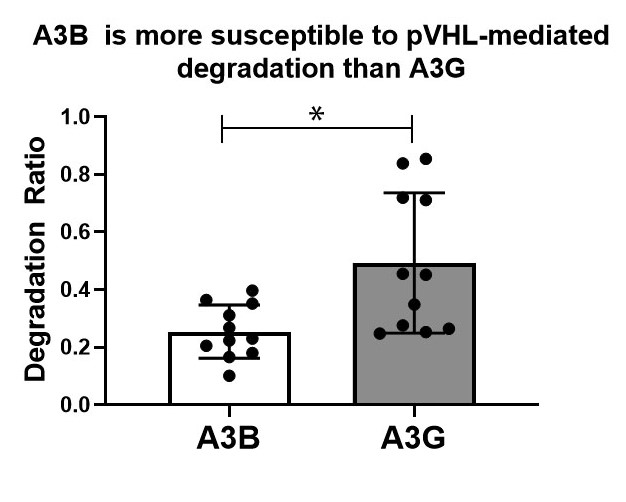
Levels of an endogenous A3 were reproducibly increased by epoxomicin, an irreversible proteasome inhibitor. An A3 interaction with pVHL was identified by a proteomic analysis. siRNA knockdown of pVHL increased levels of an endogenous A3. Ectopic expression of pVHL decreased levels of each A3 (A3A, B, C, D, F, G, HI and HII). This decrease was dependent on CRLpVHL formation, as it was not seen with co-transfection of C162F mutant pVHL which lacks Elongin C binding capacity. The E3 ligase ARIH1 potentiated pVHL-mediated degradation of each A3, except A3H. Finally, CRLpVHL more effectively degraded nuclear, pro-cancer A3B than the cytoplasmic, anti-retroviral A3G (Figure shows ratio of A3 immunoblot band intensity normalized to Lamin in 11 lysates of 293Ts co-transfected with Flag-pVHL and either HA-A3B or -A3G, divided by normalized control HA-A3 intensity in absence of pVHL. P = 0.03, Wilcoxon).
A cellular mechanism of A3 regulation requires formation of CRLpVHL. pVHL serves as a substrate receptor in that complex, facilitating ubiquitination and proteasomal degradation of target proteins. This parallels the well-characterized mechanism of retroviral VIF in A3 degradation. The observation of better pVHL-mediated degradation of A3B than A3G suggests the possibility of decreasing A3B-accelerated cancer progression without impairing the A3G anti-HIV intrinsic immune defense in people living with HIV (PLWH).