HIV-controllers are a heterogeneous group of individuals who maintain low or undetectable levels of viremia in the absence of antiretroviral treatment. Some of them eventually experience immunologic progression with marked CD4+ T-cell decline. Our aim was to identify genetic factors associated with avoiding CD4+ T-cell loss in HIV-controllers.
Retrospective case-control genome wide association study (GWAS). We analyzed genotype data-sets within long-term non-progressor HIV-1 controllers (LTNP-Cs); who maintained CD4+ T-cells counts >500 cells/mm3 for more than 7 years after HIV-1 diagnosis vs non-LTNP-Cs who developed CD4+ T-cell counts <500 cells/mm3 belonging to both, the International HIV-controllers Study Cohort (ICSC) and Swiss HIV Cohort Study (SHCS). Plink was used to carry out individual GWAS and meta-GWAS, logistic regression procedures and fixed or random effect models were applied, respectively. Magma and Webgestalt softwares were used to carry out gene-based association studies with detection of multi-marker effects and enrichment analyses with multiple testing corrections, respectively.
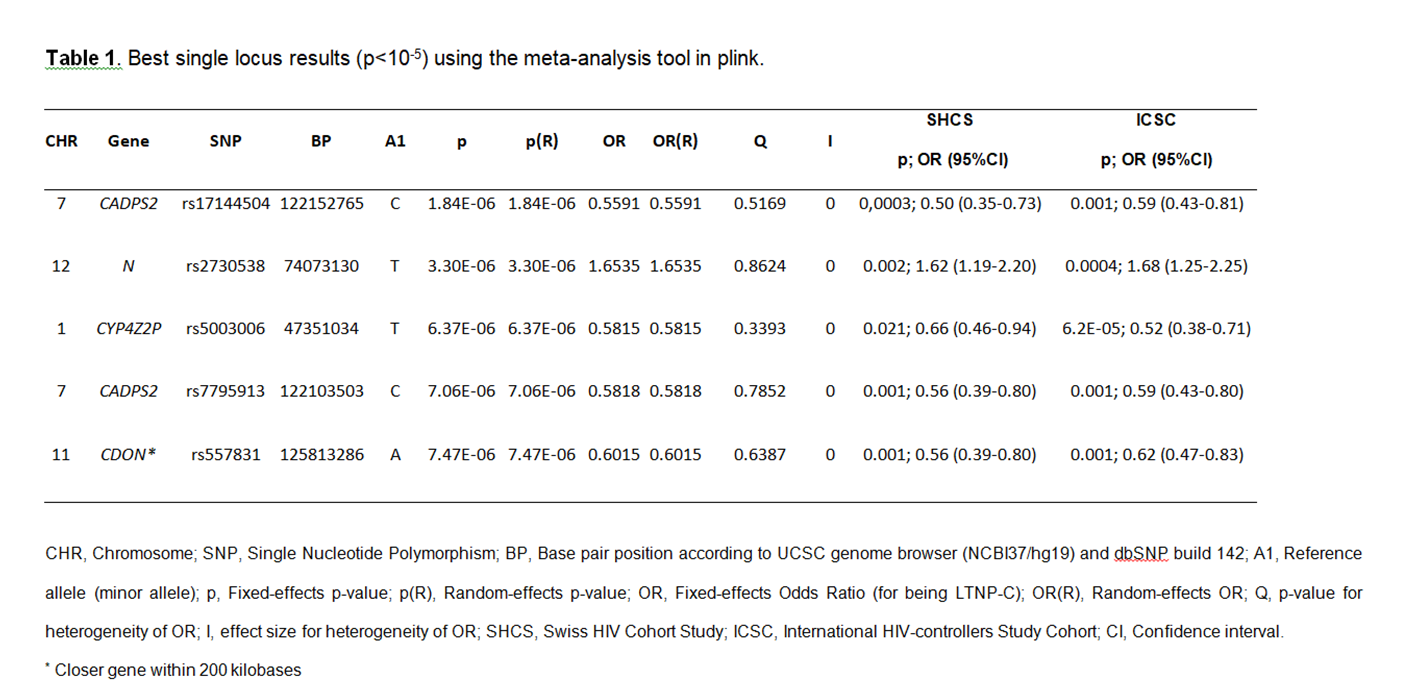
A total of 471 and 442 HIV-controllers were included from the SHCS and ICSC, respectively. Among them, 115 (24.2%) and 233 (52.7%) were LTNP-Cs, respectively. No SNP or gene association with the LTNP-C phenotype in the individual GWAS or in the meta-analysis after multiple testing corrections was found (Table 1). However, those SNPs previously associated with natural HIV control linked to HLA-B (rs2395029 [p=0.0004; OR=1.82], rs9266409 [p= 0.003; OR=1.42], rs59440261 [p= 0.00004; OR=1.97]), MICA (rs11224303 [p= 0.0005; OR=1.54]) and PSORS1C1 loci (rs3815087 [p=0.026; OR=1.28]) showed nominal association with this phenotype.
Genetic factors associated with the long-term HIV-controllers without risk of immunologic progression are those previously related to the overall HIV-controller phenotype. The results could help us to understand the biological factors underlying this persistent non-progressor HIV controller phenotype as a crucial issue to consider these subjects as a good model of functional cure and, therefore, for the design of strategies for preventing HIV progression and personalized treatment strategies to those subjects who show CD4+ T cell loss.