Severe acute respiratory syndrome coronavirus 2 (SARS-CoV-2), the etiologic agent of Coronavirus Disease 2019 (COVID-19), began circulating in humans in late 2019 and has since spread to pandemic levels. Numerous clinical studies into the inflammatory syndrome in critically ill COVID-19 patients have highlighted aberrant immune responses and levels of pro-inflammatory cytokines. Among the dysregulated pro-inflammatory cytokines are interleukin (IL)-18 and IL-1?. These two cytokines are produced after the activation and assembly of inflammasomes, multi-protein structures of the innate immune system that recognize and respond to traumas such as viral infection, tissue damage, and other stimuli. The purpose of this study is to define the viral trigger for inflammasome activation by SARS-CoV-2 and to understand its mechanism for activation.
In this study, we employed a transfection reconstitution system to study the structural and non-structural components of SARS-CoV-2 for inflammasome activation. Plasmids encoding the inflammasome components and individual plasmids encoding each SARS-CoV-2 protein of interest were co-transfected, allowing us to probe the relationship between these viral proteins and the NLRP3 inflammasome.
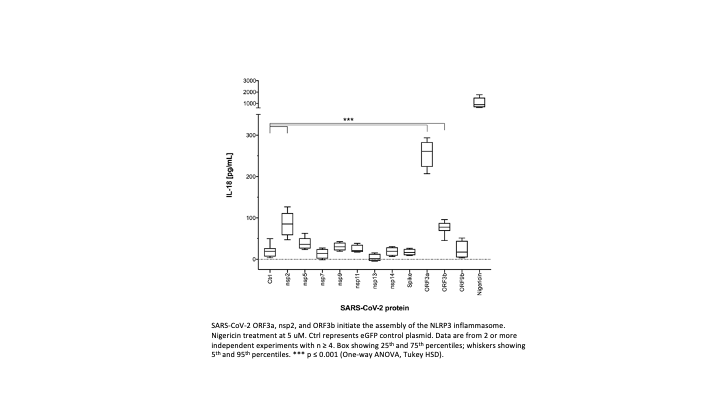
We report that the accessory protein open reading frame (ORF) 3a is sufficient to trigger assembly of the NLRP3 inflammasome and production of mature IL-18. Among the 26 viral proteins assayed, non-structural protein (nsp) 2 and ORF3b also triggered NLPR3 inflammasome activity and release of mature IL-18, though to a less extent. MCC950, a selective small molecule inhibitor of the ATPase function of NLRP3, reduces IL-18 production in response to these viral proteins to mock levels.
The identification of SARS-CoV-2 ORF3a as the viral protein responsible for NLRP3 inflammasome activation is an important step in understanding the inflammatory response seen in severe COVID-19 disease. Further study into the mechanism of this event has the potential to highlight clinical targets for drug interventions in severe cases of the disease.