Strategies to eradicate or control the persistent HIV reservoir, the major obstacle to cure, would be highly beneficial for the 1.8 million children living with HIV. The ‘shock and kill’ approach combines a latency reversing agent (LRA) to reactivate CD4+ T cells harboring integrated HIV-1 DNA with a clearance agent to enhance the immune-mediated elimination of infected, reactivated cells. Recent work in our lab identified a mimetic of the second mitochondrial-derived activator of caspases (SMACm), AZD5582, as an effective LRA in adult rhesus macaques. LRAs have not yet been evaluated in pediatric clinical or preclinical studies.
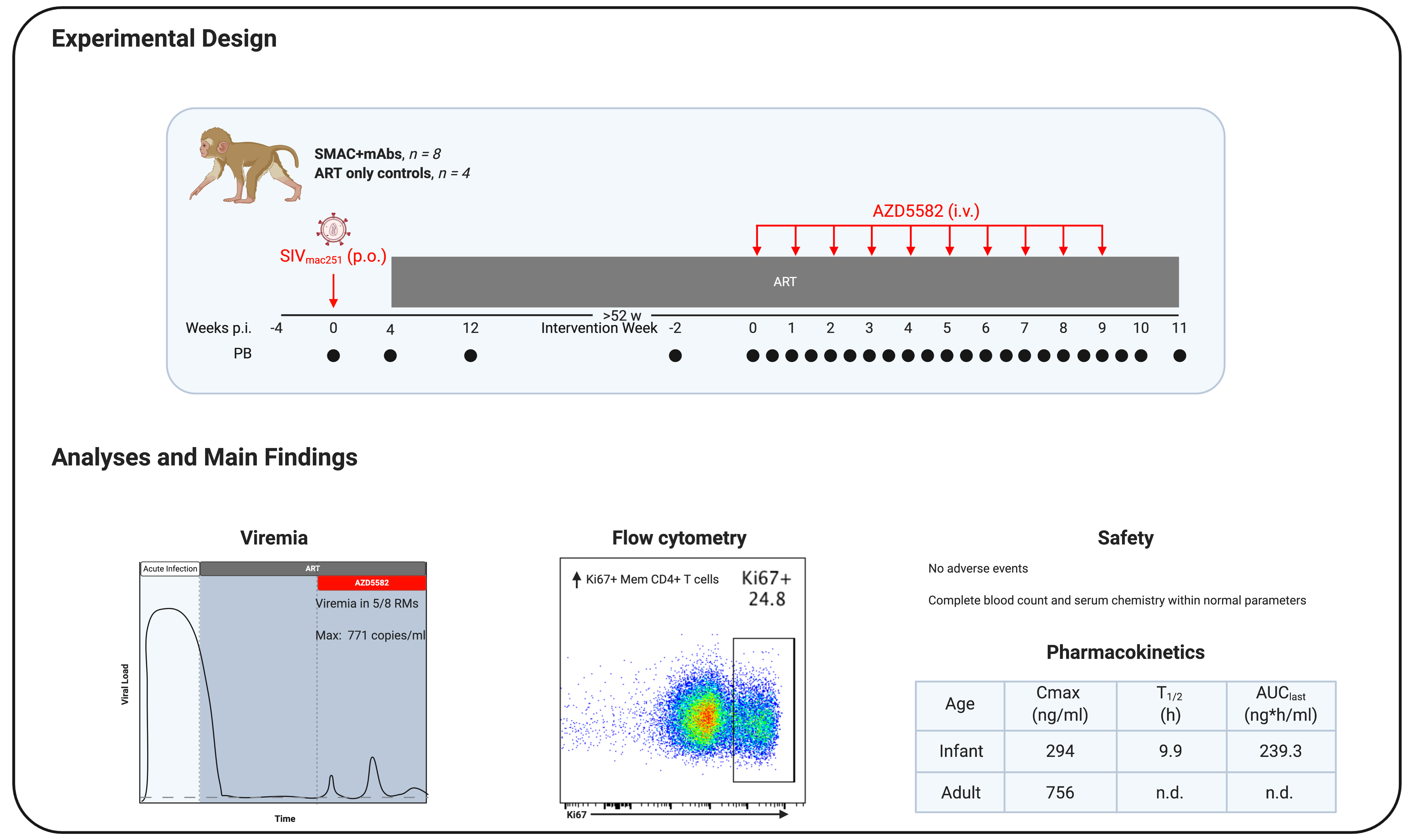
We evaluated the SMACm AZD5582 in 8 SIV-infected, ART-suppressed infant rhesus macaques (RM) compared to 4 ART-only controls. Infants were orally challenged with SIVmac251 at 4 weeks of age and treated with a suppressive triple ART regimen for over 1 year beginning 4 weeks post infection. SMACm treated animals received 10 weekly doses of AZD5582 i.v. at 100 ug/kg. Viral loads, Ki67 expression on CD4+ T cells, and AZD5582 concentrations were measured longitudinally to assess AZD5592 response.
SMACm treated infants had similar viral loads at ART initiation as adult RMs that showed on-ART viremia following AZD5582 treatment (p = 0.72). Treatment with AZD5582 during ART was safe in our pediatric model, with no adverse clinical events. A significant increase in Ki67 expression on memory CD4+ T cells was observed 3d post-dose 1, 3, and 6 (p = 0.04). The first incidence of viremia >60 copies/ml was observed 3d following dose 4 with transient viremia observed in 5/8 treated RMs (63%, max = 771 copies/ml). Out of 135 viral load measurements performed on the 5 RMs that exhibited on-ART viremia during AZD5582 treatment, 8 were >60 copies/ml (6%), lower than the 46% we have observed in adult RMs. Plasma concentrations of AZD5582 indicate altered pharmacokinetics in infants compared to adults (Cmax = 294 ng/ml vs 756 ng/ml, respectively).
In summary, we have demonstrated that despite similar predicted reservoir size and expected pharmacodynamics, alterations in the pharmacokinetic profile of AZD5582 may lead to dampened latency reversal in infant RMs. These results support a growing body of evidence that distinctions in the pediatric viral reservoir may result in divergent or blunted responses to LRAs in HIV-1-infected children and highlight the importance of pediatric models to evaluate HIV-1 cure interventions.