The Abbott point-of-care (POC) urine lateral flow assay for tenofovir (TFV) was developed and validated on stored specimens from patients on pre-exposure prophylaxis. We compared the POC urine TFV test to self-reported ART adherence among patients in routine HIV care in Cape Town, South Africa.
Adults living with HIV, on a TFV-containing regimen and having a routine viral load (VL) test at a large ART clinic were enrolled in a cross-sectional study. Interviews collected demographic information and self-reported missed ART doses in the past 7 days. A urine sample was collected and immediately tested using the POC urine TFV test. VL results from the day of visit were abstracted from medical records.
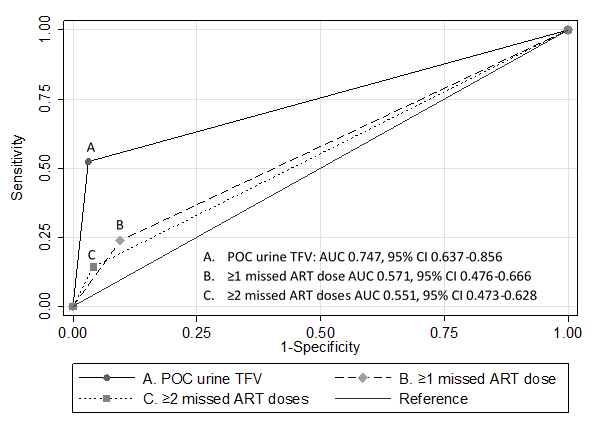
314 patients were enrolled Feb-Nov 2020 (mean age 39 years, 79% female, 61% >5 years on ART). Most patients were on EFV+FTC/3TC+TFV. Only 20 patients (6%) had no urine TFV detected. VL was <50 and <1000 copies/mL in 259 (82%) and 293 (93%) patients, respectively. Among 55 patients with VL ?50, 13 had no urine TFV detected (sensitivity 24%, 95% CI 13-37). Among 259 patients with VL <50, 252 had urine TFV detected (specificity 97%, 95% CI 95-99). Using a threshold of 1000 copies/mL, there was higher sensitivity (n=21 with VL ?1000: sensitivity 52%, 95% CI 30-74), but similar specificity (n=293 with VL<1000: specificity 97%, 95% CI 94-99). Results were independent of patient sex and weight. Self-reported adherence was high. Only 11% of patients (33/314) reported ?1 missed ART dose in the past 7 days; 5% (15/314) reported missing ?2 doses. Compared to self-report, the POC urine TFV test had a higher sensitivity, specificity and area under the receiver operating curve (ROC) to predict VL ?50 and VL ?1000, although confidence intervals were overlapping (Figure). Among 21 patients with VL ?1000 copies/mL, 10 (48%) had urine TFV detected and 16 (76%) reported no missed doses in the past 7 days.
In this largely adherent cohort, TFV detected on the POC urine test identified almost all suppressed patients and was a better predictor of VL than self-report. Although sensitivity was low, this simple POC test could prompt adherence discussions with patients with no TFV detected. There may also be value in combining this objective adherence measure with VL test results to flag patients with raised VL in the presence of ART. Further research is needed to understand the practical applications of this POC test for patient care, particularly in non-adherent populations.