Isoniazid (INH) preventive therapy (IPT), a key strategy for reducing tuberculosis (TB) and death among persons with HIV (PWH), was associated with increased composite adverse pregnancy outcomes in IMPAACT P1078 trial. The BRIEF-TB trial demonstrated non-inferiority of one-month of isoniazid and rifapentine versus nine months of IPT. We assessed adverse pregnancy outcomes among women exposed to IPT in a secondary analysis.
BRIEF-TB enrolled 3,000 adults with HIV infection in 10 countries. Pregnancy was an exclusion criterion at entry. We analyzed adverse pregnancy outcomes (non-live births; a composite of still-births, spontaneous abortions, ectopic pregnancy; preterm; low birthweight) among women who became pregnant in the IPT arm, according to whether the first pregnancy during follow-up started during INH use (INH-exposed) or after IPT was finished (INH-unexposed). Logistic regression models were used to evaluate association of pregnancy outcome with INH exposure adjusting for age, CD4, antiretroviral therapy (ART) and latent TB infection (LTBI) status at study entry, and separately for these variables at or proximal to pregnancy outcome.
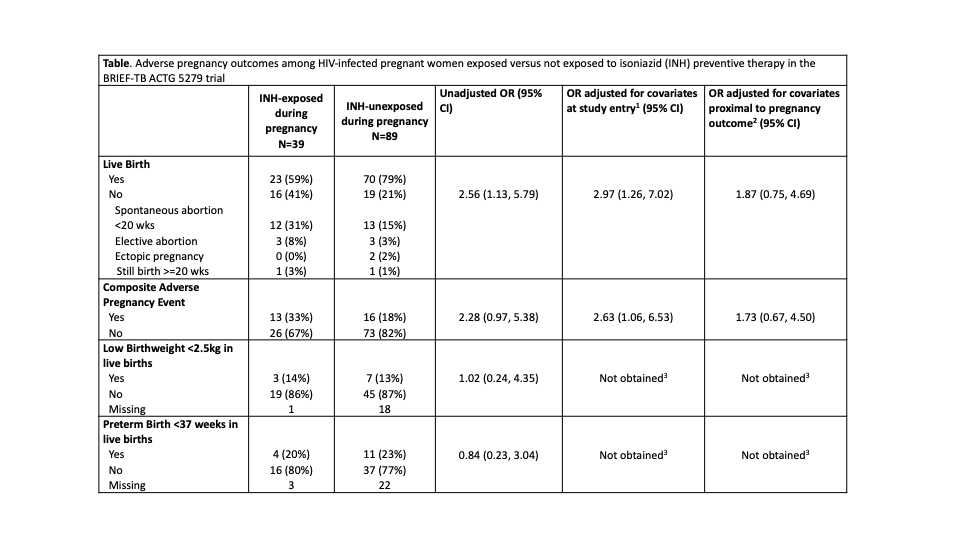
Of 1,614 women participants, 812 were randomized to IPT, 136 of whom became pregnant; 128 of 136 had pregnancy outcome data available. At entry, median age was 29 years, median CD4 was 534 cells/mm3, 45 (35%) were on ART (EFV or NVP-based regimen), and 26 (20%) were LTBI-positive. There were 93 live births and 35 non-live births (including 6 elective abortions). Sixteen (41%) of 39 INH-exposed pregnancies had non-live births (including 3 elective abortions) compared to 19 (21%) of 89 INH-unexposed pregnancies (including 3 elective abortions). A composite adverse pregnancy outcome was observed in 13 (33%) of 39 INH-exposed versus 16 (18%) of 89 INH-unexposed. The odds ratio, adjusted for covariates at or proximal to pregnancy outcome, of non-live birth for INH-exposed versus INH-unexposed was 1.87 (95% CI 0.75-4.69) and of adverse pregnancy outcome was 1.73 (95% CI 0.67-4.50; Table).
INH exposure starting in the first trimester was associated with increased adverse pregnancy outcomes in this trial. While none of the associations reached statistical significance in analyses adjusted for covariates at or proximal to delivery, this finding supports other recent data from the TEMPRANO and P1078 trials.