Kaposi sarcoma herpesvirus (KSHV, also known as human herpesvirus 8 [HHV-8]), is the causative agent of Kaposi sarcoma (KS), a multicentric angioproliferative tumor, and other diseases including a form of multicentric Castleman disease (KSHV-MCD) and KSHV inflammatory cytokine syndrome (KICS). KS can be difficult to treat when it occurs with KSHV-MCD or KICS; resulting in high mortality rates. Liposomal doxorubicin (dox), a chemotherapy, and pomalidomide (pom), an immunomodulatory drug, are FDA-approved therapies for KS. The safety and activity of the combination (pom/dox) in KS alone or with KSHV-associated diseases are unknown.
The primary objective of this Phase I/II study was to evaluate safety and tolerability of pom/dox in 2 groups of participants with KS requiring systemic therapy: Group I (G1)- KS alone; Group II (G2)- KS with concurrent KSHV-MCD or KICS. Patients received dox at 20 mg/m2 intravenously on day 1 of a 28-day cycle combined with pom once daily on days 1 to 21 at escalating dose levels (DL) (I – 2mg, II – 3mg, or III- 4mg) in a 3+3 design until plateau of response or other pre-specified criteria. Participants received 81mg of aspirin daily as thromboprophylaxis. KS responses were evaluated using the modified AIDS Clinical Trial Group criteria.
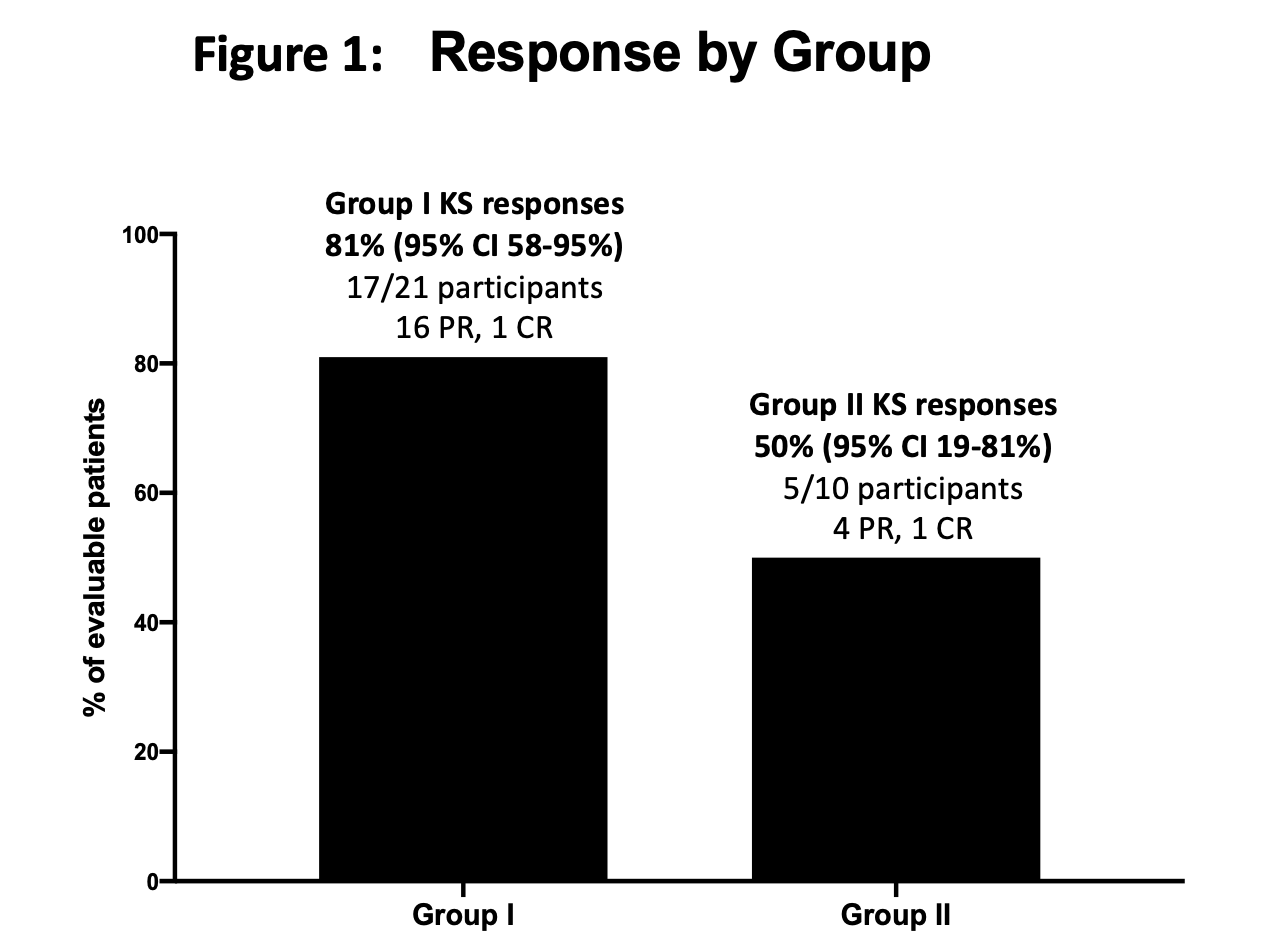
Thirty-four cisgender men, all with severe (T1) KS [21 patients (62%) in G1 and 13 patients (38%) in G2] were treated; 32 (94%) were HIV-infected and 22 (65%) had prior chemotherapy for KS (15/21 G1 and 7/13 G2). All participants with HIV were on antiretroviral therapy with a baseline median CD4 count of 217 cells/µL (interquartile range (IQR): 85 -362) and median HIV VL of 24 copies/ml (IQR: <20 – 134). There were no dose-limiting toxicities (DLTs) at DLIII for G1, and additional participants were treated at the maximum tolerated dose of 4mg of pom. In G2, grade 3 rash and pharyngeal edema were DLTs observed at 3mg of pom (DLII). A median of 6 cycles (IQR: 2-11) were administered; the most common CTCAE grade 3/4 toxicity was neutropenia. Among evaluable participants receiving >2 cycles,17/21 patients in G1 had a response (16 partial and 1 complete) (81% [95% confidence interval (CI) 58-95%]) and 5/10 patients in G2 had a response (4 partial and 1 complete) (50% [95% CI 19-81%], Figure 1).
Pom/dox was well-tolerated and active in heavily pretreated participants with KS alone. Among participants with KS and KSHV-MCD or KICS, activity was noted but pom/dox was less well-tolerated.