Background:
People with HIV (PWH) and tuberculosis (TB) have been historically at higher risk of TB-related unfavorable outcomes than those without HIV. Our goal is to understand risk factors for TB-related outcomes in PWH, by performing an integrative data analysis of PWH in 4 recent Phase 3 TB trials.
Methods:
Integrative analysis included data from PWH in 4 recent Phase 3 TB treatment trials (OFLOTUB NCT00216385, REMoxTB NCT00864383, RIFAQUIN ISRCTN44153044, S31/A5349 NCT02410772). Overall, PWH received 9 unique TB regimens of 4- and 6-month duration. Primary endpoint was TB-related unfavorable outcomes, including TB treatment failure, relapse, or death. Risk factors included demographics, baseline smear grade, CD4 counts, baseline cavitation on chest radiograph, TB treatment including adherence (percentage pills taken), and antiretroviral therapy (ART) initiated before or during the trial. The relationship between risk factors and outcome was tested through Cox proportional hazard controlled for treatment arm.
Results:
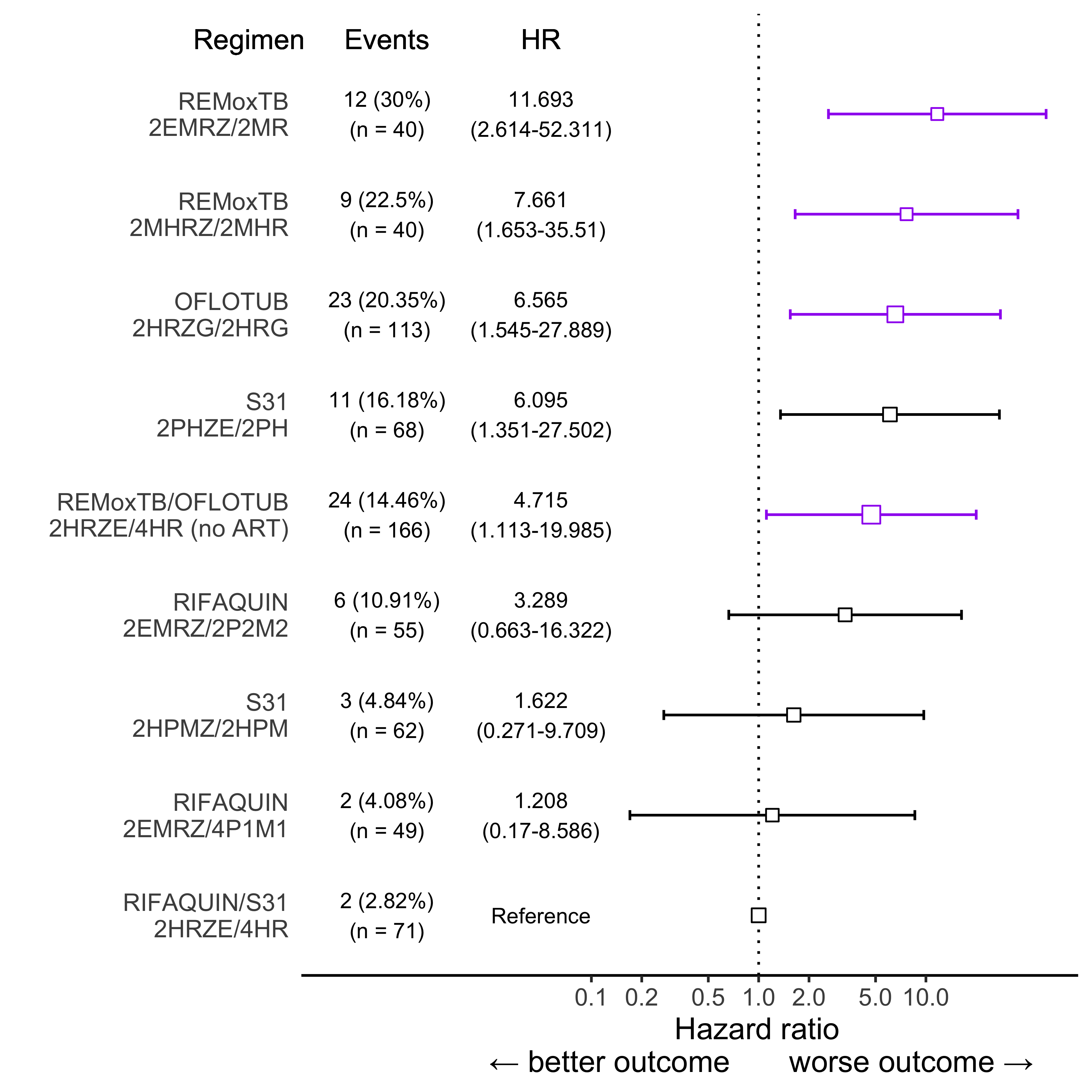
The dataset included 711 (11.2% of dataset) PWH (of which 45.4% female). Median (range) baseline CD4 count was 339 (19-1155) cells/mm3 and 359 (50.5%) were not on ART. Ninety-three unfavorable events occurred. RIFAQUIN’s 6-month moxifloxacin-, and S31’s 4-month rifapentine-moxifloxacin regimens performed similarly to standard-of-care (Figure 1). ART use (89% efavirenz-based) correlated with trial (only S31 and RIFAQUIN allowed ART); however PWH receiving ART (7.1%) had fewer TB-related unfavorable outcomes compared to PWH not receiving ART (18.9%). Multivariate analysis showed that male PWH (adjusted hazard ratio [HR] with 95% confidence interval 2.08 (1.34-3.24) compared to female) with high baseline smear grade (HR 1.25 (0.62-2.53) and 2.27 (1.26-4.09) for 2+ and 3+, respectively, compared to negative or 1+), and with decreased adherence (HR 1.04 (1.01-1.07) per percent point decrease) were predictive of unfavorable outcomes. Male PWH with smear grade 2+ or 3+ had high rates of TB-related unfavorable outcomes (12.9% with ART and 25.8% without ART) compared to patients at lower risk (defined as female PWH or male PWH with negative smear grade or 1+) (7.1% with ART and 13.5% without ART).
Conclusions:
PWH are efficaciously treated with anti-TB regimens containing rifapentine and moxifloxacin. Male PWH with baseline smear grade 2+ or 3+ and lower treatment adherence are at highest risk of unfavorable TB outcome. Positive effects of ART while undergoing TB treatment are confirmed.
Cox proportional hazard of the integrated data analysis of four Phase 3 clinical trials showing hazard ratios (HR) with 95% confidence intervals. ART = antiretroviral therapy, 2EMRZ/2MR: 2 months of daily ethambutol, moxifloxacin, rifampin, and pyrazinamide followed by 2 months of daily moxifloxacin and rifapentine (REMoxTB), 2MHRZ/2MHR: 2 months of daily moxifloxacin, isoniazid, rifampin, and pyrazinamide followed by 2 months of daily moxifloxacin, isoniazid, and rifapentine (REMoxTB), 2HRZG/2HRG: 2 months of daily isoniazid, rifampin, pyrazinamide, and gatifloxacin followed by 2 months of daily isoniazid, rifampin and gatifloxacin (OFLOTUB), 2PHZE/2PH: 2 months of daily rifapentine, isoniazid, pyrazinamide, and ethambutol followed by 2 months of daily rifapentine and moxifloxacin (S31), 2HRZE/4HR: 2 months of daily isoniazid, rifampin, pyrazinamide, and ethambutol, followed by 2 months of daily moxifloxacin and rifapentine (REMoxTB, RIFAQUIN, OFLOTUB, S31), 2EMRZ/2P2M2: 2 months of daily ethambutol, moxifloxacin, rifampin, and pyrazinamide followed by 2 months of twice weekly rifapentine and moxifloxacin (RIFAQUIN), 2HPMZ/2HPM: 2 months of daily isoniazid, rifapentine, moxifloxacin, and pyrazinamide followed by 2 months of daily isoniazid, rifapentine, and moxifloxacin (S31), 2EMRZ/4P1M1: 2 months of daily ethambutol, moxifloxacin, rifampin, and pyrazinamide followed by 4 months of once weekly rifapentine and moxifloxacin (RIFAQUIN). Purple indicates trials where no ART was used.