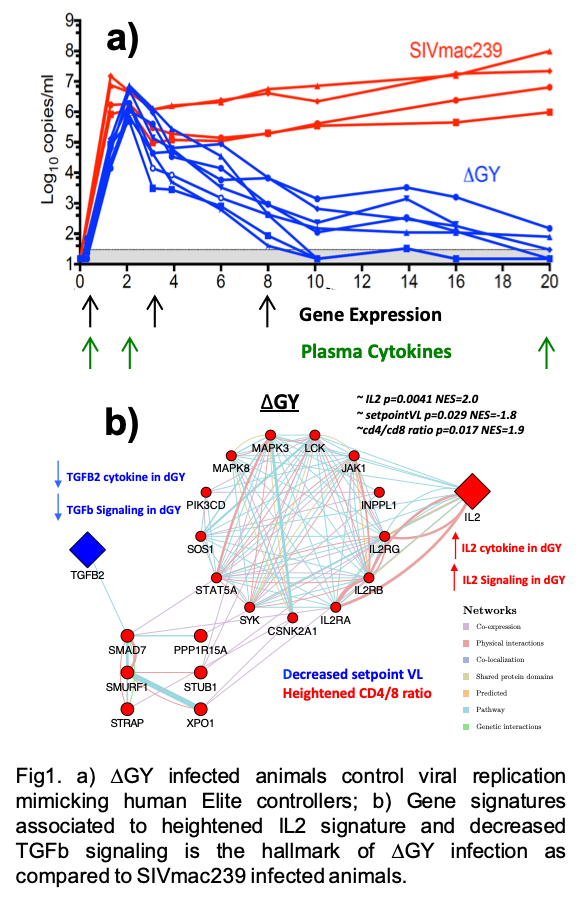
HIV reservoir persistence is an obstacle to cure. Elite controllers (ECs) suppress virus in the absence of anti-retroviral drugs. Immunologic mechanisms that lead to viral control and interventions that could reduce or eliminate HIV reservoirs in ECs are unknown. Relevant models of EC in nonhuman primates (NHP) could be critical to address these questions. Our lab has described and published a unique NHP model of elite SIV control termed ?GY. This variant of SIVmac239 contains a 2 amino acid deletion in a Tyr-dependent Env trafficking motif and is replication fit but susceptible to host control through cellular immune responses (CTL and/or ADCC) in the absence of neutralizing antibodies.
Pigtail macaques were infected with ?GY (n=8) or SIVmac239 (n=4) and PBMC, lymph node (LN), duodenal tissues and plasma were collected longitudinally to identify transcriptional signatures and cytokines correlating with viral control, respectively (Fig1). Animals were challenged at week 80 with SHIV-SF162P3N.
Gene signatures (all tissues) and cytokine/chemokines profiles at day 2 post-infection discriminated both groups while peak viral loads were similar. Compared to SIVmac239, ?GY-infected animals presented decreased inflammasome signature/cytokines (IL1b, IL18), decreased anti-inflammatory signature/cytokines (TGFb1, TGFb2) and increased homeostatic signaling downstream of IL2. Additionally, NLRX1, an early antagonist of type I IFN anti-viral signaling, was decreased in ?GY-animals and this was concomitant with higher CD8 effector function signatures (TBX21, IFNG, GZMB), lower T cell exhaustion (TOX, PDCD1) and preserved chemokine signaling (CXCL1, CXCL10-12). Correlates of these findings in ?GY-infected animals included 1) control of viremia by 10-20 weeks; 2) normal numbers of CD4 T cells in blood and gut; and 3) lack of immune activation signatures. Additionally, when 6 ?GY-controllers were challenged i.v. at 80 weeks with SHIV-SF162P3N, they controlled the challenge for more than 2 years (set points of ?102-3 RNA cps/mL) in contrast to 4 naïve controls (set points 10^5-10^6 cps/mL).
?GY infection leads to a preserved adaptive immune response signature, in association with sustained viral control, CD4 T cell counts and resistance to a pathogenic i.v. heterologous challenge. Understanding of the mechanisms by which ?GY infection can augment host immune responses to resist challenge viruses could have important implications for both HIV vaccine and pathogenesis fields.