Background:
Adolescent girls and young women (AGYW) seeking emergency contraceptive pills (ECP) to prevent conception also face increased risk of HIV acquisition due to implied unprotected sex. AGYW who are eligible for ECP are therefore likely to also be eligible for post-exposure prophylaxis (PEP) to reduce their risk of HIV acquisition. Pharmacies, where most AGYW purchase ECP, can serve as convenient outreach points for HIV prevention services including PEP. We assessed the willingness of AGYW seeking ECP to test for HIV and initiate PEP
Methods:
We assessed willingness to test for HIV and initiate PEP as the main outcomes in a study among AGYW aged 15-24 seeking ECP in 5 pharmacies in Kisumu and Nairobi, Kenya, between May and August 2023. We trained pharmacy providers on research ethics, documentation, screening and consenting. They collected data via REDCap at baseline, with follow-up conducted within 10 days post enrollment. Baseline data captured socio-demographics, use of ECP, HIV risk perception, HIV testing history, willingness to test for HIV and willingness to initiate PEP. Post survey data captured their experience in seeking HIV testing and PEP. Participants were issued an information sheet on HIV testing and PEP and those interested referred to nearby health facilities for services. Data were summarized using descriptive statistics.
Results:
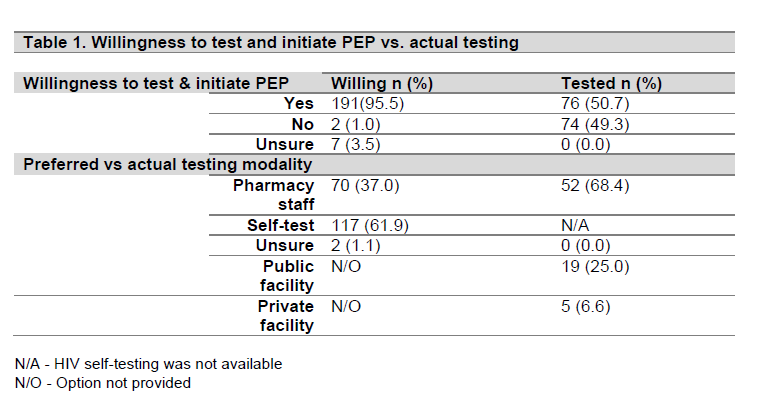
We screened 297 AGYW and enrolled 200; mean age was 22 years; 90.0% were single; 10.0%, 41.7% and 48.2% had primary, secondary, and post-secondary education, respectively. 41.5% perceived themselves to be at high HIV risk and 28.5% at medium risk; 28.5% felt at low-no risk despite seeking ECP. Table 1 shows those willing to test for HIV and to initiate PEP compared to those who actually went for testing after being educated on why they would be eligible. Overall, 50.7% AGWY took up testing compared to 95.5% who were willing. The most preferred testing modality was self-testing but since this was unavailable, most tested at the pharmacy; 25% tested at government facilities. Of those who tested, 80.2% tested within 3 days of enrolment. The 49.3% who did not test/take PEP cited low perceived risk (20.3%), fear of knowing HIV status (10.8%), awareness of partner’s status (9.5%), distance (6.8%), and procrastination (20.3%) as barriers.
Conclusions:
The findings underscore the potential of pharmacies to enhance access to HIV testing and PEP initiation among at-risk AGYW by providing convenient outreach points