Background:
Long-acting injectables (LAIs) have attracted interest for prevention and treatment of infection (including HIV, HCV and tuberculosis), addressing issues with pill burden and adherence. Better methods for scaling preclinical pharmacokinetics (PK) for prediction of human exposure are needed to aid decision making, and accelerate early clinical development through better human dose prediction.
Methods:
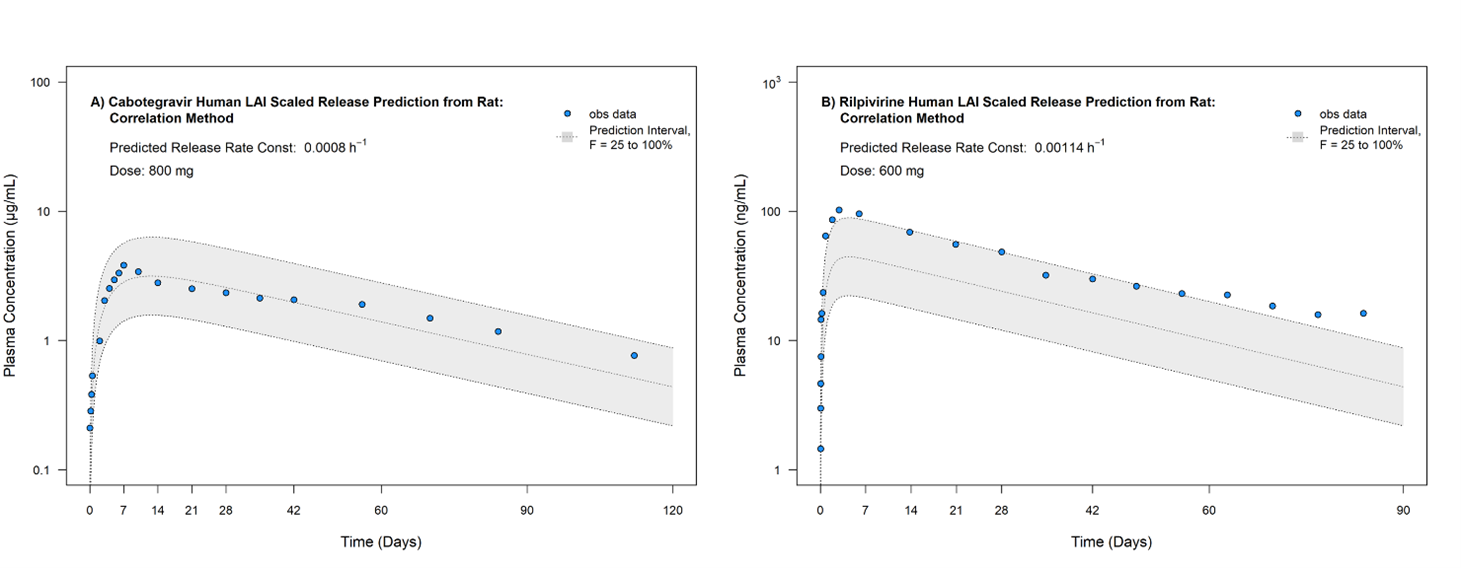
Matching rat and human PK data were sourced from publications or in-house PK studies for 11 marketed intramuscular LAIs. Terminal depot release rates (KA) were determined from analysis of terminal phase, release-dependent, ‘flip-flop’ half-lives. Two approaches for human KA prediction were: 1) Linear regression between human and rat KAs (Fig 1A). 2) Allometric scaling of KA by body size according to formula: KA (human, pred) ≈ KA (rat) x (70 kg/0.3 kg)-0.25 = KA (rat) x 0.255. Qualification was undertaken for cabotegravir and rilpivirine with human LAI PK profiles simulated for comparison with empirical human PK data. For this, human PK disposition was described by a minimal 1-compartment model parameterised with clearance (CL) and steady state volume of distribution (Vss) from published IV PK if available, or via PBPK where absent. This model was deemed sufficient under flip-flop PK due to slow LAI depot release masking multiphasic PK disposition. Depot release input was treated as a simplified 1st order process governed by KA. For qualification, the LAI of interest was removed from the regression used to predict the KA. Given that bioavailability (F) is unknown for novel LAIs and varies for approved LAIs, profiles were simulated assuming 25, 50 and 100% F.
Results:
A variety of PK profile shapes were evident across LAIs and terminal flip-flop KAs trended faster in rat than human. A good correlation was observed between human and rat KA with all 11 LAIs included (R2 = 0.81, slope coeff. 0.38), and retained with the removal of cabotegravir (R2 = 0.82) or rilpivirine (R2 = 0.81). Reasonable concordance of resulting human PK predictions was observed for cabotegravir (assuming 50% F; Fig.1A) and rilpivirine (assuming 100% F; Fig.1B).
Conclusions:
This simplified scaling may be useful to predict human terminal release PK from rat studies to inform phase I human dose prediction. More work is needed to predict LAI F, and understand relationships across other species and routes of administration. Final validation of the approach will require a priori application for a novel LAI.