Background:
To increase access to daily oral HIV pre-exposure prophylaxis (PrEP), policy makers and implementors are seeking evidence on whether and how PrEP can be delivered with high quality in non-clinical settings, including private pharmacies. Following a 12-month pilot study of pharmacy provider-initiated and managed PrEP, we conducted a 6-month extension to evaluate a modified version of this model that additionally offered post-exposure prophylaxis (PEP) and sexually transmitted infection (STI) testing.
Methods:
We piloted the modified delivery model in 12 private pharmacies in Kisumu and Kiambu Counties. Pharmacy providers were trained to administer an HIV risk assessment screening tool; assess medical safety; assist clients with HIV self-testing; counsel; consult a remote clinician about complex cases and, if needed, refer to nearby public health facilities; and dispense. Eligible clients (≥18 years) received all services for free. Client and provider perceptions of model acceptability were assessed using Likert-type items derived from the Theoretical Framework of Acceptability.
Results:
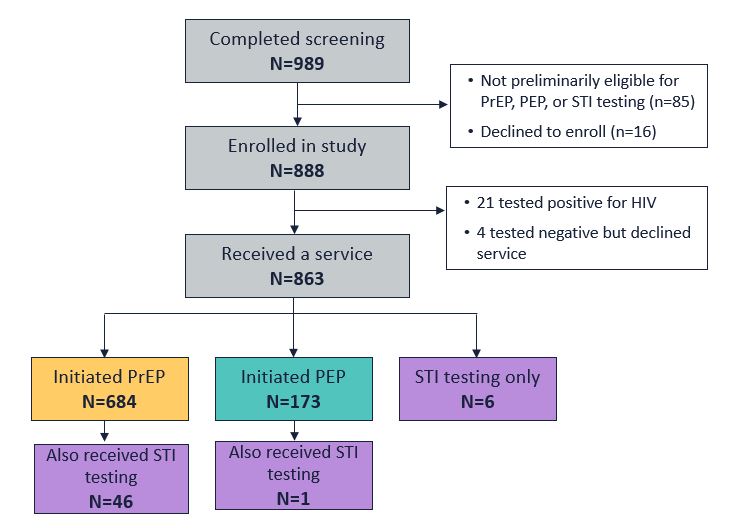
From January to July 2022, we screened 989 clients and initiated 863 (87%) on PrEP (n=684), PEP (n=173), and/or STI testing (n=53), Fig. 1. Among these 863 clients, 46% were male (n=400), 46% were < 25 years (n=399), and 78% were unmarried (n=670). Most PrEP clients (n=684) reported inconsistent condom use (86%, n=587), not knowing partners’ HIV status (67%, n=459), and having multiple partners (62%, n=425). PrEP continuation at one month was 71% (484/684), and 18% (32/173) of PEP clients transitioned to PrEP upon PEP completion. STI positivity rate was 26% (14/53); the most prevalent STI was gonorrhoea (8/14). Model acceptability was high, with the majority (70-100%) of clients and providers reporting that they liked getting/delivering PrEP/PEP at the pharmacy and that getting/delivering PrEP/PEP at the pharmacy was not hard.
Conclusions:
Our findings suggest that, when trained, pharmacy providers are capable of initiating and managing clients on PrEP in accordance with national guidelines and that additionally offering PEP and STI testing is a promising strategy for engaging clients in PrEP services. If this model were scaled up in Kenya, the rates of PrEP uptake and continuation might match or exceed those seen in public health facilities. More research is needed to identify business models (e.g., cost-sharing options) capable of sustaining pharmacy-delivered PrEP services in the long-term.
Figure 1. Study flow diagram