Limitations to achieving a complete HIV-1 infection cure include failure to remove latent reservoirs, CD8 T cell dysfunction due to immune exhaustion, and failure to induce anti-viral CD8+ T cells in lymphoid tissue where most reservoirs persist, even under anti-retroviral therapy (ART). These findings warrant the development of strategies that can simultaneously reduce reservoir burden under ART, improve virus-specific T cell functions, enhance cytolytic CD8 T cell localization to the lymphoid tissues, and sustain these responses in the absence of ART. The combined action may enable an effective viral control in the absence of ART potentially leading to complete remission.
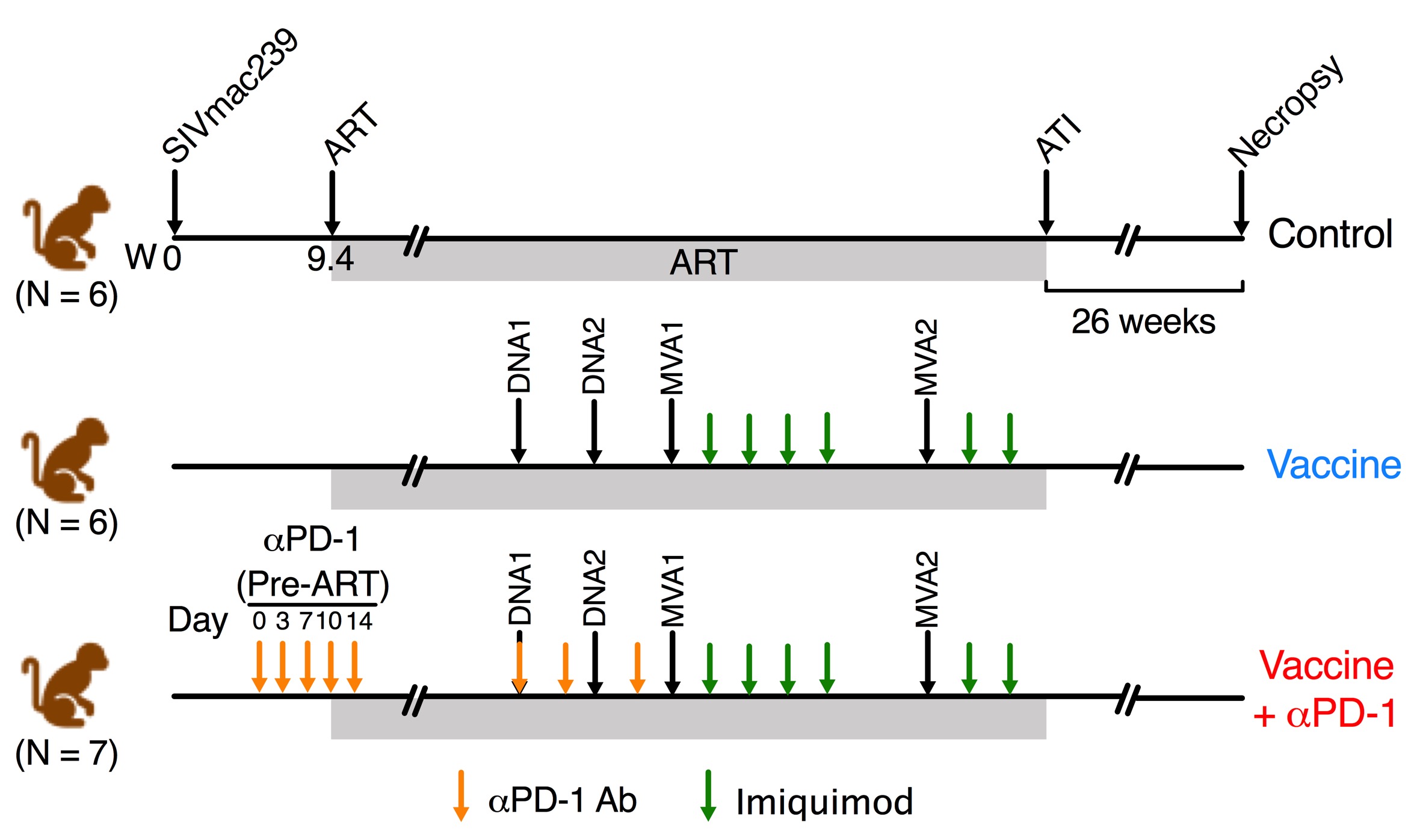
Three groups of rhesus macaques (RMs) were infected with SIVmac239 intrarectally and ART was initiated at 10 weeks post infection. Two groups were subsequently immunized with two DNA-SIV239/MVA-SIV239 prime/boost vaccines. The third group served as the control group. Both vaccinated groups also received the ectopic application of imiquimod (a TLR7 agonist) as a potential immune adjuvant/latency reversal agent. The Vaccine and PD-1 group received anti-PD-1 antibody prior to ART initiation and concomitant with DNA priming. All vaccinations were carried out under complete viral suppression by ART. RMs were followed for 26 weeks post-analytical treatment interruption and tracked for the viral rebound, development of AIDS, and survival. Key parameters such as T cell response, reservoirs, and lymph node localization of cytolytic CD8 T cells were interrogated longitudinally at key time points of the study.
We show that CD40L adjuvated DNA/MVA vaccine induced highly functional SIV-specific CD4+ and CD8+ T cell responses in blood, gut, and lymph nodes (LN) under anti-retroviral therapy. Combining PD-1 blockade with vaccine markedly increased the frequency of granzyme B+ perforin+ CD8+ T cells in blood and LN, enhanced their localization to BCF, and reduced viral reservoir. Upon ART interruption, combination therapy showed marked preservation of the granzyme B+ CD8+ T cells in the T cell zone and BCF regions of LN, maintained high SIV antigen-recognition breadth, showed notable control of reemerging viremia, and significantly improved survival, but not vaccine alone or control animals.
Our findings reveal that PD-1 blockade enhances the therapeutic benefits of vaccination by improving and sustaining the function and localization of vaccine-induced CD8 T cells to BCF and decreasing viral reservoirs.