In sub-Saharan Africa (SSA), the COVID-19 pandemic and response has posed a challenge for HIV prevention, testing, and treatment. We used routinely collected President’s Emergency Plan for AIDS Relief (PEPFAR) Monitoring, Evaluation, and Reporting (MER) data to assess potential loss to follow-up (LTFU) across PEPFAR countries in SSA before and during the pandemic to determine the impact of COVID-19 on HIV clinical treatment.
Treatment and LTFU data for people living with HIV (PLHIV) aged 15+ from Oct – Dec 2019 (fiscal year[FY]20 quarter[Q]1; pre-COVID) and Apr – Jun 2020 (FY20Q3; during COVID-19) were extracted from two MER indicators: TX_CURR (PLHIV on treatment) and TX_ML (tracking outcomes of PLHIV potentially LTFU) for 18 countries in SSA. Aggregate indicator data are not linked. Data were disaggregated by age band (15–19, 20–29, 30–39, 40–49, 50+) and sex. Proportions of potential LTFU were calculated as total number of PLHIV with no known clinical contact since last expected contact divided by total PLHIV on treatment during the reporting quarter. Proportions of select outcomes of potential LTFU (Died, LTFU <3 months since last expected clinical contact, LTFU ?3 months since last expected clinical contact) were calculated as total individual outcome divided by total LTFU. Analyses were disaggregated by reporting quarter, age band, and sex and paired t-tests were run to test for statistical significance between quarters.
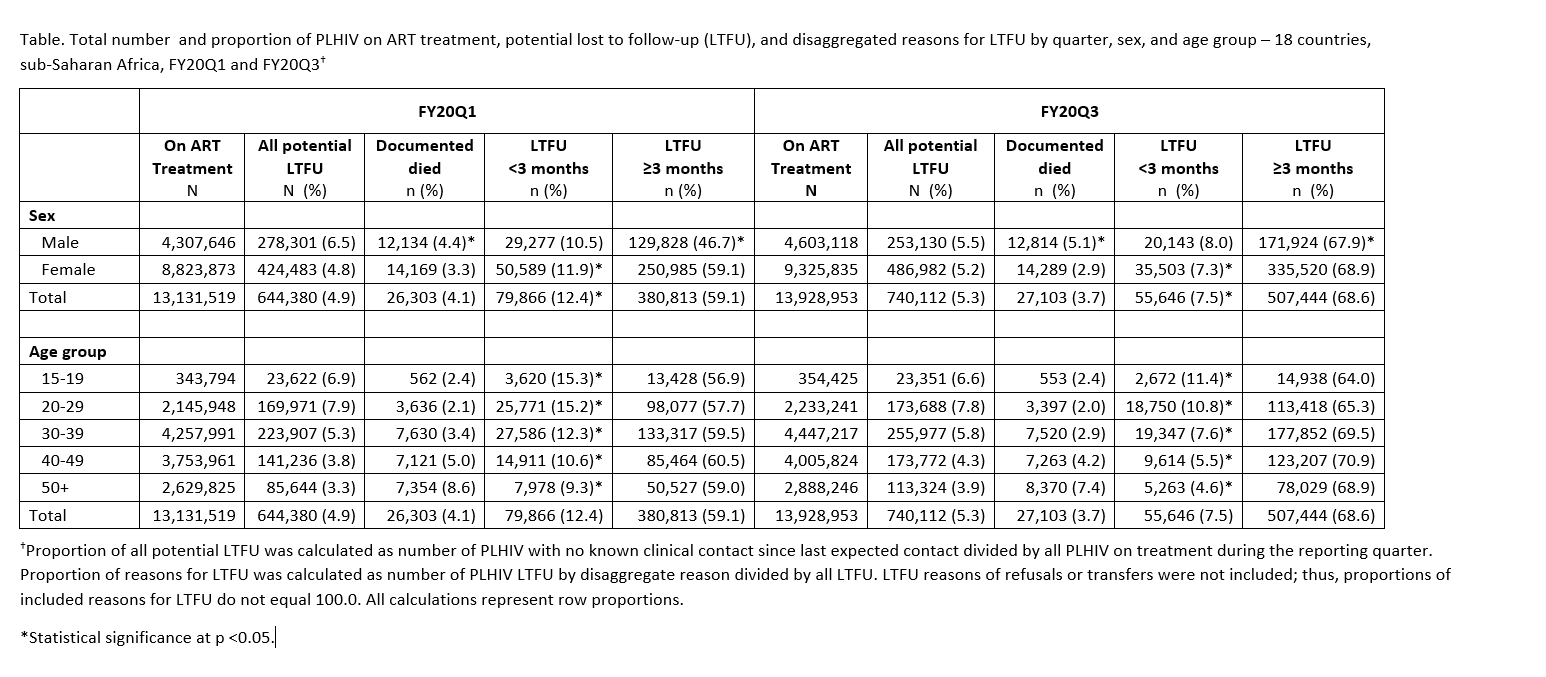
Number of PLHIV LTFU was 644,380 in FY20Q1 and 740,112 in FY20Q3 across the 18 countries. Proportion of any LTFU outcome was 4.9% and 5.3% for the two quarters, respectively, and was higher overall among men and those aged 20-29, although not statistically significant (Table). Among all LTFU, an increase in deaths and in LTFU ?3 months among men and a decrease in LTFU <3 months among women and all age bands were statistically significant.
The proportion of LTFU <3 months decreased during the early months of the COVID-19 pandemic in SSA, which, in part, may be attributed to adaptations in HIV programming implemented to mitigate further transmission of COVID-19. These data give an initial indication that the COVID-19 pandemic may have implications for HIV treatment in the coming months and ongoing data review is critical.