Background:
The HIV epidemic disproportionally affects transgender women (TGW) and young men who have sex with men (YMSM) in Latin America. Monitoring adherence is key to designing tailored strategies to improve PrEP persistence, targeting these vulnerable populations. We aimed to identify factors associated with non-protective TDF-FTC levels in dried blood spots (DBS) in TGW and YMSM using PrEP.
Methods:
ImPrEP was an implementation study offering same-day oral PrEP (TDF/FTC) for 9509 MSM/TGW in Brazil, Mexico, and Peru (2018-2021). Follow-up visits were scheduled 4 weeks post-enrolment and then quarterly. In this analysis, YMSM (18-24 years) and TGW (all ages) who had at least one DBS obtained during study follow-up were included. We used generalized estimating equations to identify factors associated with inadequate PrEP adherence (tenofovir diphosphate [TFV-DP]<550 fmol/punch [week 4] or 800 fmol/punch [weeks 28-124] in DBS) among MSM/TGW (18-24 years) and TGW (all ages), separately.
Results:
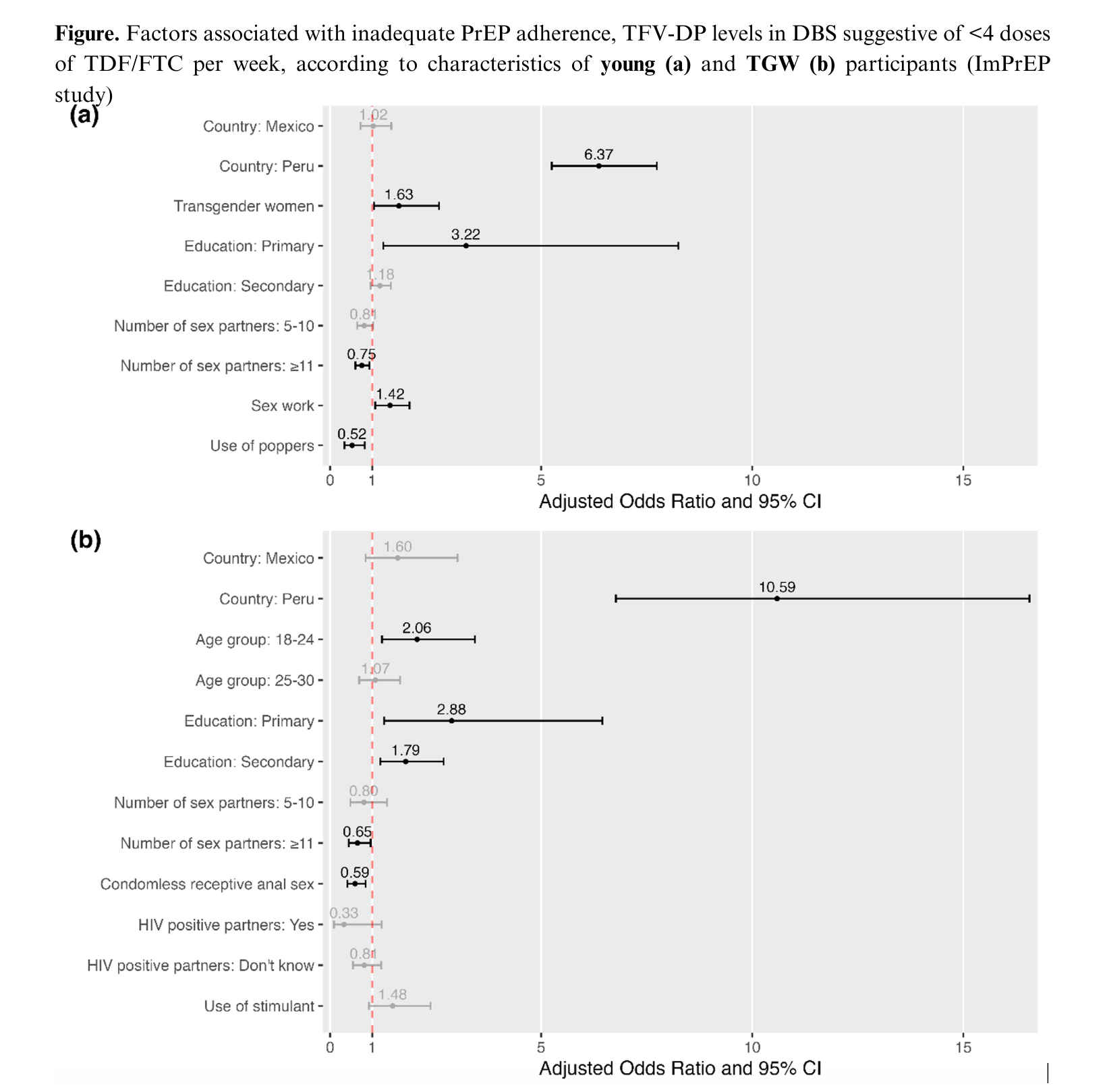
We analyzed 3573 DBS samples of 1,802 young participants [week 4: 1645 (46%); weeks 28-124: 1928 (54%)], and 928 DBS samples of 404 TGW [week 4: 358 (39%); weeks 28-124: 570 (61%)]. Of young participants, 94% were MSM, 14% aged 18-19 years, 75% non-white and 70% had post-secondary education. Among TGW, 27% were 18-24 years, 77% non-white and 57% had secondary education. For both populations, being from Peru and low educational level (primary or secondary education) increased the odds of inadequate PrEP adherence, while having more than 10 partners decreased the odds of inadequate adherence. Sex work and being TGW were associated with inadequate adherence among young participants, while for TGW, being 18-24 years showed the same association. Use of poppers (for young participants) and reporting condomless anal sex (for TGW) decreased the odds of inadequate adherence (Figure).
Conclusions:
Sexual behavior might have influenced HIV risk perception, leading to higher PrEP adherence. Social determinants of health such as education played a major role in PrEP adherence among TGW and young MSM/TGW in Latin America. In Latin America, PrEP programs for young MSM/TGW must implement tailored interventions to tackle stigma within health services and optimize adherence among the most vulnerable, such as those with lower education and sex workers. Long-acting PrEP can be strategical to improve PrEP adherence in these populations.