HIV establishes a persistent infection in cell reservoirs which are not susceptible to current antiretroviral therapy (ART). The expression of the Fc? receptor CD32 in infected cells has been identified as a marker of the active cell reservoir that persist during ART, but the mechanism by which these cells are maintained and evade the action of the immune system is currently unknown.
Antibody-dependent cell cytotoxicity (ADCC) and natural cytotoxicity (NC) NK functional responses were evaluated by flow cytometry in different subpopulations of CD4+ T cells after peptide-loading (n=30), ex-vivo infection (n=14) and viral reactivation from latency (n=6). Protein-defective viruses were used to elucidate the contribution of HIV to CD32 upregulation. Binding of HIV-specific antibodies, cell proliferation in response to immune complexes (IC) and expression of NK-ligands HLA-E, MICA/B, CD155 and ULBP after ADCC and NC, were measured by flow cytometry. The viral reservoir was assessed by quantification of total HIV-DNA and caHIV-RNA by qPCR in CD4+ T cells from ART-suppressed patients. Statistical comparisons were performed using Wilcoxon matched-pairs signed rank test, Mann-Whitney test, ANOVA Friedman test, and Spearman correlations, when appropriate.
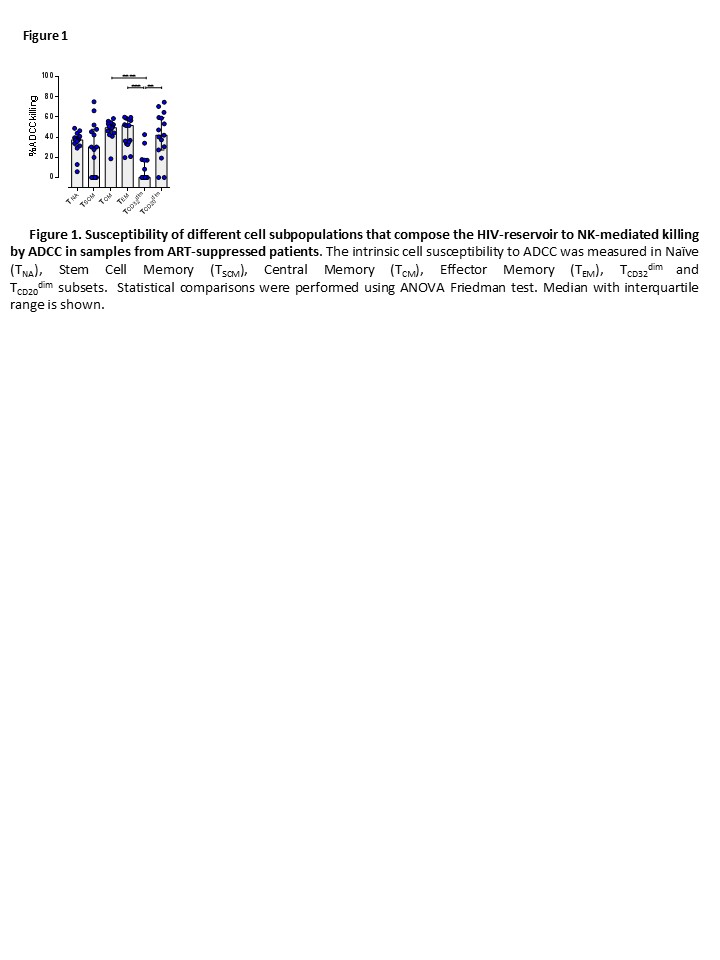
CD4+ T cells expressing CD32 were highly resistant to ADCC after peptide-loading (ANOVA p=0.0001) (Figure 1), and ex-vivo infection (median % 19.6 vs. 35.8 for TCD32+ and TCD32-, p<0.01). This observation was particularly significant in ART-suppressed patients compared with elite controllers and healthy donors (median % 0.0, 34.8 and 45.0, for ART, EC and HD, p<0.01). Upregulation of CD32 was facilitated by the viral protein Nef (p<0.0001), decreased HIV-specific antibody binding (p<0.05), and conferred cell proliferation potential upon IC engagement (mean %Ki67 9.8 vs. 20.5 for basal vs. plasma HIV+, p<0.01). NK-resistant CD32-expressing cells expressed higher levels of HLA-E (median % 22.2 and 11.0, for TCD32+ and TCD32-, p<0.0001), but the administration of anti-HLA-E blocking antibodies, IFN-? or IL-15 did not reverse immune resistance. Furthermore, latently HIV-infected cells expressing CD32 upon viral reactivation resisted NK-killing (p<0.05) and an inverse correlation was observed between ADCC-killing and total HIV-DNA reservoir size (p=0.02).
We report a novel mechanism of viral evasion to NK-immune responses through the upregulation of CD32, which might represent a new obstacle to fully eliminate HIV.