Residual HIV replication in reservoirs might contribute to immune activation and inflammation and constitutes a barrier to eradication. Antiretroviral distribution in male and female genital tract is required to suppress HIV replication within these compartments. We determined doravirine concentrations and HIV-1 RNA in blood plasma (BP), seminal plasma (SP) and cervicovaginal fluid (CVF) of HIV-1-infected adults receiving ART with doravirine plus emtricitabine/tenofovir alafenamide (DOR+FTC/TAF).
This prospective study included 15 male and 15 female HIV-1 infected, virologically suppressed adults on stable ART. ART was switched to DOR+FTC/TAF. After 8 weeks, total and protein-unbound DOR concentrations were determined at the end of a dosing interval (C24h) in paired SP/CVF and BP samples. HIV-1 RNA was evaluated in SP/CVF and BP samples at baseline and week 8. Validated liquid chromatography-tandem mass spectrometry (‘LC-MS/MS) was used to quantify DOR concentrations, and HIV-1 RNA was determined by real-time PCR (Abbott). Data are presented as median (range).
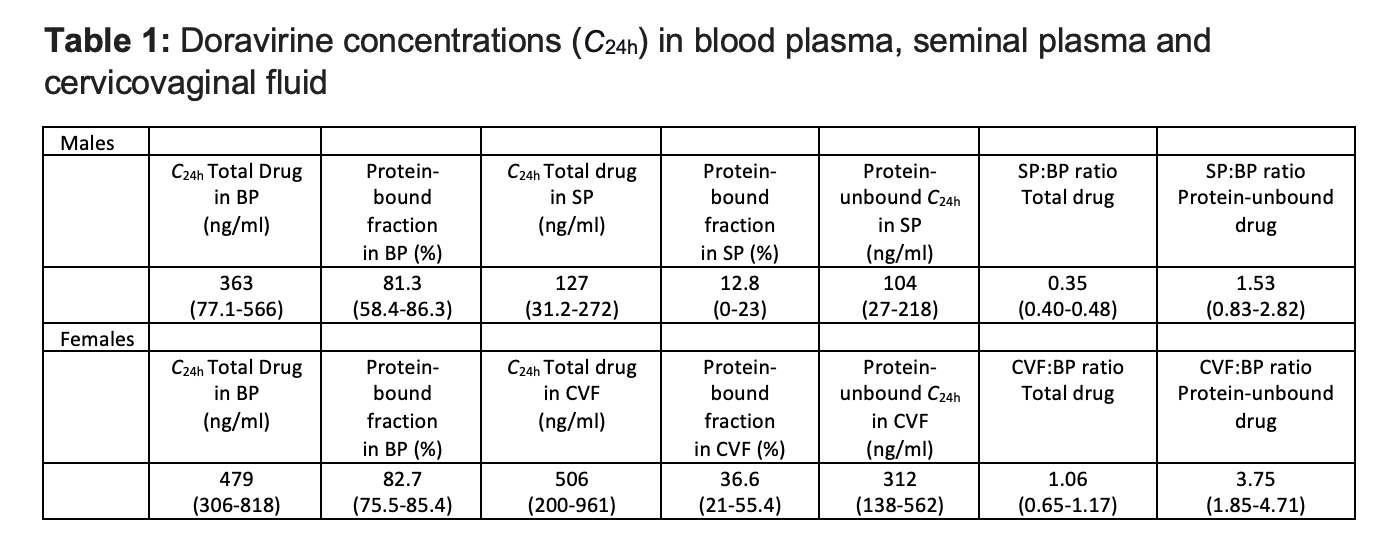
15 males and 14 females completed the study and were included in the analysis. Age was 41 years (23-62), time on ART 109 months (16-305) and CD4 count 791 cells/?L (329-1926). At baseline, all subjects had HIV-1 RNA <40 copies/mL in SP and CVF samples. Eight weeks after switching to DOR+FTC/TAF, total DOR C24h was 127 ng/mL (31.2-272) in SP and 506 ng/mL (200-961) in CVF, corresponding to 35% and 106% of total DOR concentrations in BP, respectively. DOR protein-unbound fractions were 82.2% in SP and 63.5% in CVF. Protein-unbound DOR C24h was 104 ng/mL (27-218) in SP and 312 ng/mL (138-562) in CVF (Table 1). Thus, median protein-unbound DOR C24h in SP and CVF were 20.4-fold and 61.2-fold above the half-maximal effective concentration value (EC50) for wild-type HIV-1 (5.1 ng/mL). At week 8, all individuals maintained HIV-1 RNA suppression <40 copies/mL in BP and genital fluid samples with the exception of one male with detectable HIV-1 RNA (263 copies/mL) in SP despite a high DOR concentration in this compartment (protein-unbound C24h 104 ng/mL).
Protein-unbound DOR concentrations in SP and CVF highly exceeded the EC50 value for wild-type HIV-1 in all individuals. DOR+FTC/TAF seems effective to maintain HIV-1 RNA suppression in SP and CVF.