Background:
HIV clusters show heightened transmission rates and may contribute disproportionally to new infections. However, the influence of these periods of rapid transmission on future HIV infections and the populations that they affect are incompletely characterized.
Methods:
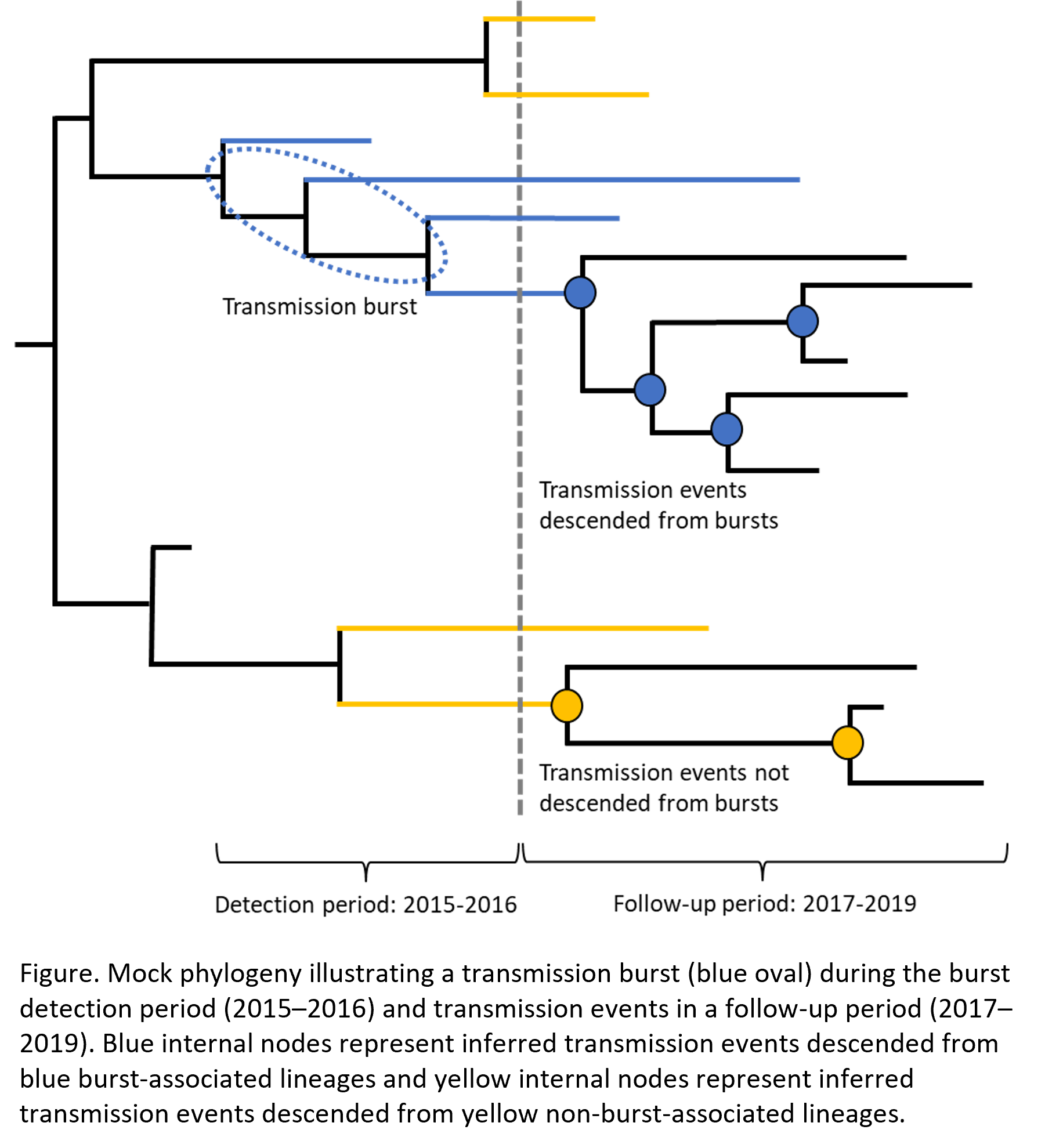
Using subtype B HIV pol sequences from the U.S. National HIV Surveillance System reported through 2022 for people with HIV (PWH) diagnosed during 2014–2019, we inferred separate, time-scaled phylogenetic trees with ETE3, FastTree2, and TreeTime for six geographic regions composed of 14 jurisdictions with >50% sequence completeness. We detected transmission bursts, defined as ≥3 connected internal nodes (or transmission events) in a 2-year detection period [Figure]. We first calculated the relative contribution of transmission bursts in a fixed detection period to future transmission in a follow-up period by dividing the number of internal nodes during 2017-2019 descended from bursts by the number of lineages associated with bursts during 2015-2016, compared to non-burst-descended internal nodes divided by non-burst-associated lineages. To characterize PWH diagnosed in the follow-up period who were ever members or descendants of a transmission burst, we then detected bursts within any sliding 2-year period during 2014–2019 and identified populations overrepresented among PWH associated with transmission bursts.
Results:
The 2,795/86,006 (3.2%) lineages (or persons) associated with a transmission burst during 2015–2016 contributed to 493/3,926 (12.6%) transmissions during 2017–2019 across all jurisdictions. Lineages associated with transmission bursts were 4.3 times as likely as lineages not associated with bursts to contribute to future transmissions. Among PWH diagnosed during 2017–2019, 5,603/43,721 (12.8%) were ever members or descendants of transmission bursts during 2014–2019. Groups overrepresented among members or descendants of transmission bursts (i.e., >12.8%) included PWH aged 13–19 (24.5%) or 20–29 years (16.6%) at HIV diagnosis, diagnosed during acute or early HIV infection (17.9%), who reported male-to-male sexual contact (15.5%), or who were transgender, non-binary, or another gender (15.3%).
Conclusions:
Lineages associated with transmission bursts contribute disproportionately to future transmission, underscoring the value of detecting and responding to clusters to prevent transmissions. Bursts of rapid HIV transmission likely contribute to disparities in overall HIV incidence for some key populations.