The role that CD4+ and CD8+ T cells play in the protection from and disease severity of COVID-19 is not completely understood. A better understanding of T cell function and the epitopes that they target will be invaluable in the development of the next generation of vaccines and therapeutics. To better understand the role of T cells, we characterized the frequency, effector functions and phenotype of SARS-CoV-2-specific CD4+ and CD8+ T cells in a cohort of patients who recovered from COVID-19, and identified multiple peptides that contain T cell epitopes within the Spike protein (S), Nucleocapsid protein (N) and Membrane protein (M).
The frequency and phenotype of SARS-CoV-2-specific T cells from convalescent patients with mild or moderate disease (n=27, 25 to 92 days post-symptom onset) were determined by polychromatic flow cytometry and intracellular cytokine staining (ICS). Cells were stimulated for 6 hours with peptide pools corresponding to S, N and M. Cytokine production, memory phenotype, chemokine receptor expression and PD-1 expression were analyzed. For a subset of individuals (n = 19 for S; n=14 for N and M), IFNg ELISpot assays and peptide matrices were utilized to identify peptides that contain T cell epitopes.
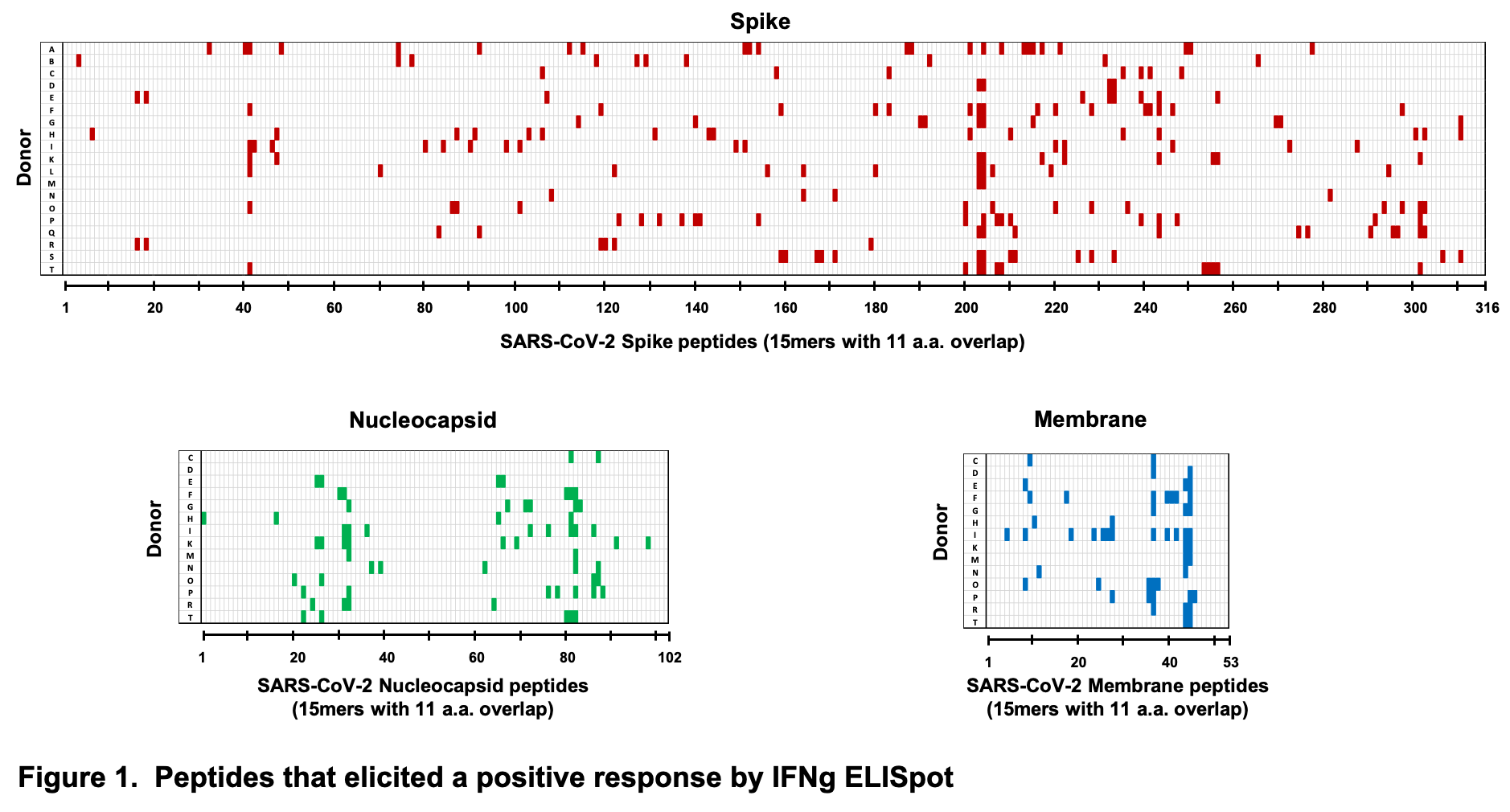
CD4+ T cell responses to S, N and/or M were detected in almost all donors by ICS and were predominantly a Th1-type response as determined by cytokine production (IFNg, IL-2 or TNF) and expression of CXCR3. A majority of the antigen-specific CD4+ cells were found in the effector memory compartment. Although less robust than the CD4+ T cell response, antigen-specific CD8+ T cells were detected in a majority of donors, were found within the effector memory compartments and displayed modest PD-1 upregulation. Multiple peptides that contain T cell epitopes were identified by IFNg ELISpot (Figure 1). Some of the most commonly identified peptides include S42 (amino acids 165-179; 7/19 donors), S205 (a.a. 817-831; 10/19 donors), N83 (a.a. 329-343; 7/14 donors), M37 (a.a. 145-159; 8/14 donors) and M45 (a.a. 177-191; 10/14 donors).
These data suggest that T cells that target S, N and M play an important role in the immune response to SARS-CoV-2 and should be considered in future vaccine development. Further studies such as transcriptomic analysis and the TCR usage in longitudinal samples will provide a better understanding of epitope-specific T cells and their longevity.