Background
The 2030 global cervical cancer (CC) elimination strategy recommends to achieve a 70% coverage for CC screening and 90% of precancerous lesions treated in eligible women. We evaluated progress towards these WHO CC elimination targets according to HIV status in Côte d’Ivoire over the 2010-2021 period.
Methods
A CC screening registry was initiated in Cote d’Ivoire since 2010, collecting standardized individual-level data from all health facilities offering visual inspection with acetic acid (VIA). Initially restricted to the economic capital (Abidjan), the registry progressively expanded to the three most populated administrative regions accounting for almost half of nationwide eligible women. The CC screening coverage was estimated based on the 2021 population census and Spectrum 2023 (HIV national database) in women aged 25-49 years from the general population and in women with HIV (WHIV). CC screening and care cascade indicators were compared according to HIV status, using Chi-square test. Access to same-day cryotherapy/thermal ablation and associated factors were analyzed through a logistic regression model.
Results
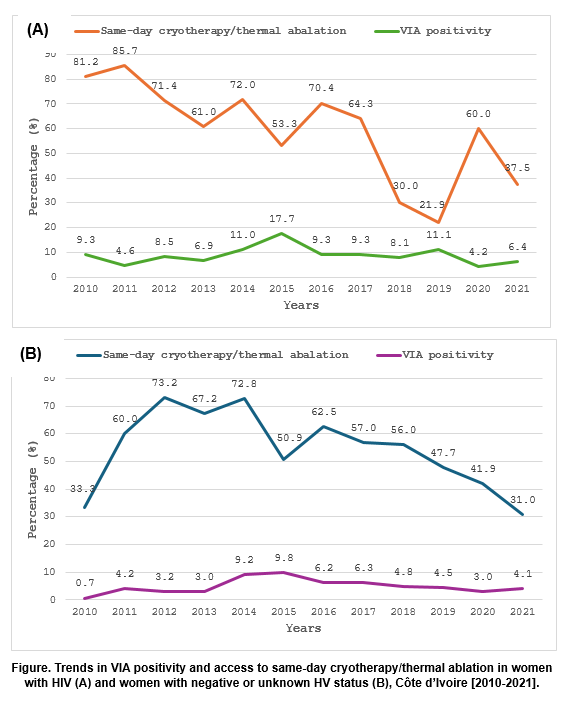
A total of 66,268 women aged 34 years [IQR: 28-41] in median were screened for CC, 17.0% being WHIV. Overall, the estimated CC screening coverage was 4.4% [95%CI (2.6-5.2)] and 14.8% [95%CI (14.6-15.1)] in WHIV. Among the 4,210 VIA-positive women, 3,500 (83.1%) were eligible for same-day cryotherapy/thermal ablation (83.9% in WHIV). Overall, access to same-day treatment was 59.1% (57.1% in women without HIV and 65.2% in WHIV, p<0.001) but declined over time, particularly in WHIV (Figure) and was higher in those screened in HIV specialized clinics (81.6%) versus HIV-integrated facilities (53.2%), p<0.001). In multivariate analysis, access to same-day treatment was higher in WHIV [aOR= 1.55 [CI: (1.32-1.84)] and women screened in secondary level [aOR=1.82 (CI: 1.49-2.23)] or tertiary level facilities [aOR=1.79 (CI: 1.54-2.09)] compared to primary level facilities.
Conclusions
In 2021, CC screening program performances remained particularly low regarding the 2030 CC elimination goals. Access to treatment was unacceptably low, particularly in WHIV, raising the need to improve/expand integration of cryotherapy/thermal ablation in integrated HIV services and primary healthcare facilities. Overcoming delivery gaps and implement monitoring/tracing strategies for positively screened women is a priority as HPV-based primary screening in being scaled-up in the country.
Table or Figure