Background
Cognitive intra-individual variability (IIV) refers to the variation observed in cognitive performance when various cognitive tests are administered within the same person (i.e., dispersion). In people with HIV, greater cognitive IIV has been associated with poorer cognitive performance and decline over time, cortical brain atrophy, and increased mortality risk. In this study, we calculated cognitive IIV from cognitive test performance in women with HIV (WWH) and without HIV (WWoH) and examined its relationship to everyday functioning items (i.e., cooking).
Methods
This study examined the association between cognitive IIV and self-reported everyday functioning among 1,086 (WWH) and 494 socio-demographically similar WWoH. Objective cognitive performance across 7 domains and the self-rated modified Lawton and Brody scale of Instrumental Activities of Daily Living (IADL) were assessed among participants of the Women’s Interagency HIV Study. Two types of cognitive IIV were calculated by taking the standard deviation across 7 cognitive domains to calculate dispersion: 1) intra-individual standard deviation (denoted as sdIIV) and 2) coefficient of variation (denoted as covIIV). To account for the longitudinal nature of the data, generalized linear mixed effect models were conducted to examine the associations between the dispersion coefficient of cognitive IIV (predictor (sdIIV or covIV)) and functional status outcomes (item level scores). Models were constructed in the overall sample (WWH + WWoH), WWH only, virally suppressed (VS)-WWH, and WWoH.
Results
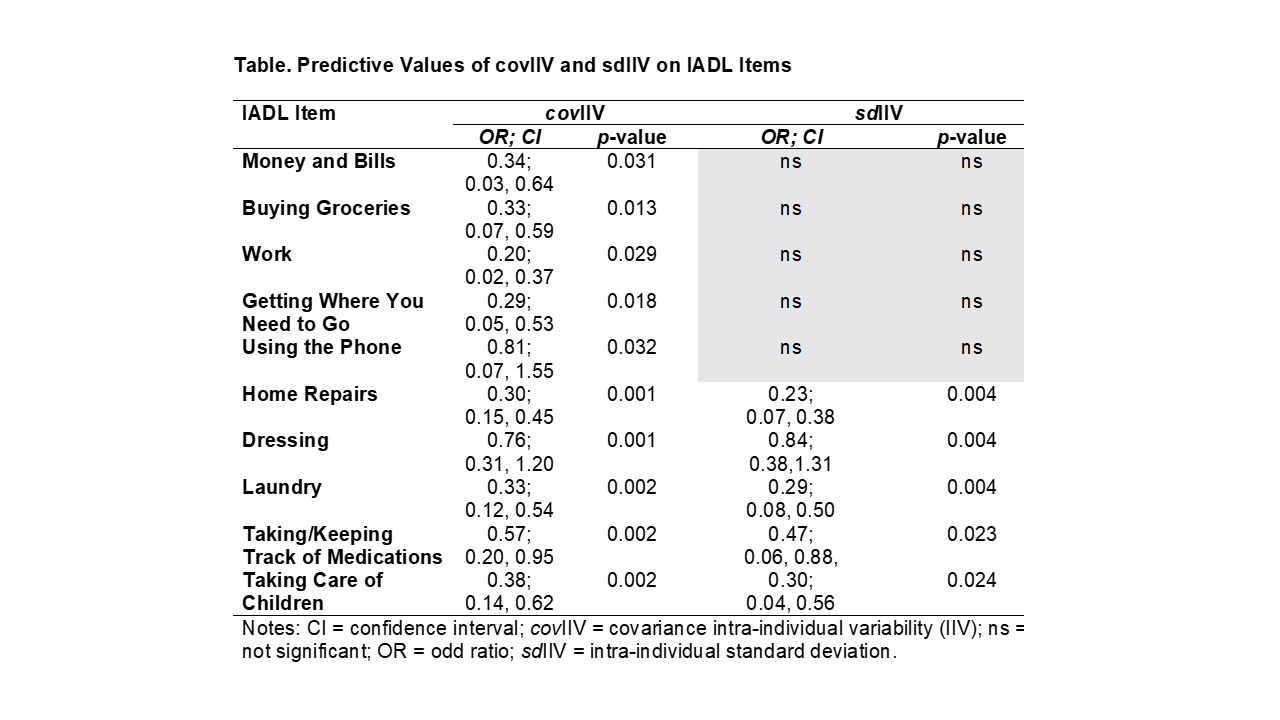
sdIIV and covIIV were not associated with any of the IADL items among WWoH but were for WWH and VS-WWH. At p<.05 (see Table), WWH cognitive IIV was predictive of poorer functional performance on 10 IADL items with covIIV and 5 items with sdIIV (indicated with asterisks; money and bills, buying groceries, work, getting where you need to go, using the phone, home repairs*, dressing*, laundry*, taking/keeping track of medications*, taking care of children*).
Conclusions
Several findings emerged. This study found that cognitive IIV was slightly greater among WWH compared to WWoH and predictive of everyday functioning. This study is unique in comparing two different mathematical formulae of cognitive IIV, indicating covIIV to be more sensitive of predicting impairment in various IADLs. This means cognitive IIV, especially covIIV, may be a predictive tool for other HIV-related behavioral phenomena.
Table or Figure