Background
Despite effective antiretroviral therapy (ART) and achieving virological suppression, a minority of adults living with HIV/AIDS (PLWHA) experience poor CD4+ T cell recovery, known as immune non-response (INR). The clinical outcomes for this population, particularly in relation to serious non-AIDS-related events (SNAE), remain poorly understood due to the challenges in controlling confounding factors across multiple cohorts. This study assessed INR clinical outcomes, focusing on SNAE in PLWHA on ART with virological suppression.
Methods
We conducted a multicenter, retrospective cohort study across three tertiary hospitals in Thailand. PLWHA aged ≥ 20 years, who received ART, had at least two consecutive HIV-1 viral load tests, and were followed for at least 24 months between January 1997 and March 2023 were included. The primary outcome was the incidence of SNAE between the INR group (CD4 < 350 cells/µL after sustained viral suppression (VS) < 50 copies/mL for ≥ 2 years) and a control group with adequate immune recovery.
Results
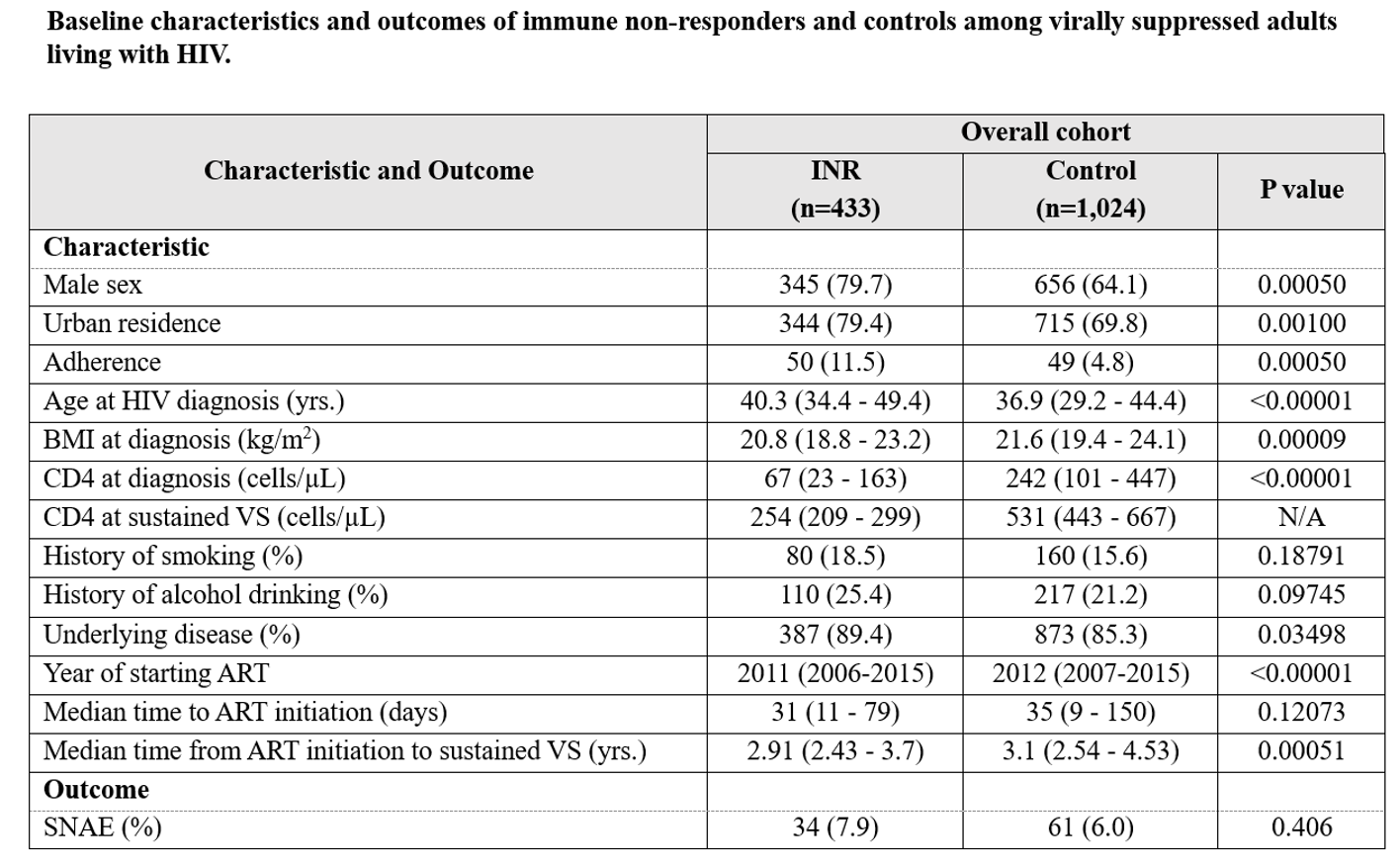
Between January 1997 and March 2023, 1,596 PLWHA met the eligibility criteria. After excluding cases with a follow-up period of less than two years, 1,457 PLWHA were included in the analysis. Demographic data indicated that male sex, older age, lower body mass index (BMI), lower CD4 count at diagnosis, earlier treatment era, and the presence of underlying diseases were significant risk factors for INR. The incidence of SNAE was 34 (7.9%) in the INR group compared to 61 (6.0%) in the control group (crude HR 1.20, 95% CI 0.79-1.82, p=0.406). Significant risk factors for SNAE included older age, underlying diseases, male sex, smoking, and a longer time to achieve virological suppression. However, after adjusting for these factors, INR was not significantly associated with SNAE (adjusted HR 1.14, 95% CI 0.74-1.76, p=0.541). The Kaplan–Meier curves demonstrated the time to incident SNAE after sustained VS as cumulative incidence, stratified by immune response status, age at ART initiation, and CD4 level at the time of sustained VS. Age over 50 years at ART initiation revealed a significantly increased incidence of SNAE, while immune response status and CD4 level did not show significant differences.
Conclusions
INR was not associated with an increased incidence of SNAE. This suggests that while INR is an important immunological marker, it may not independently predict serious non-AIDS-related outcomes in PLWHA with sustained virological suppression.
Table or Figure