Background
Prior analyses highlighted the association between starting INSTI-based antiretroviral therapy (ART) and weight gain among treatment-naïve people with HIV (PWH) in the North American AIDS Cohort Collaboration on Research & Design (NA-ACCORD). However, it is unclear whether observed relative weight gain after INSTI initiation reflected weight-suppressive effects of older NNRTIs or confounding due to differences in NRTI backbones.
Methods
Adult (≥18 years old), treatment-naïve PWH in NA-ACCORD initiating INSTI, PI, or NNRTI-based ART with dual-NRTI backbone from 01/01/2007 to 12/31/2021 were included. We used multivariable linear mixed-effects models to estimate marginal predictions of weight change over time, adjusted for age, sex assigned at birth, race/ethnicity, cohort site, ART initiation year, HIV acquisition risk, NRTI backbone, baseline HIV-1 RNA and CD4+ count, and weight at treatment start. Continuous variables were fitted using restricted cubic splines with 4 knots. Additional analyses were stratified by NRTI backbone.
Results
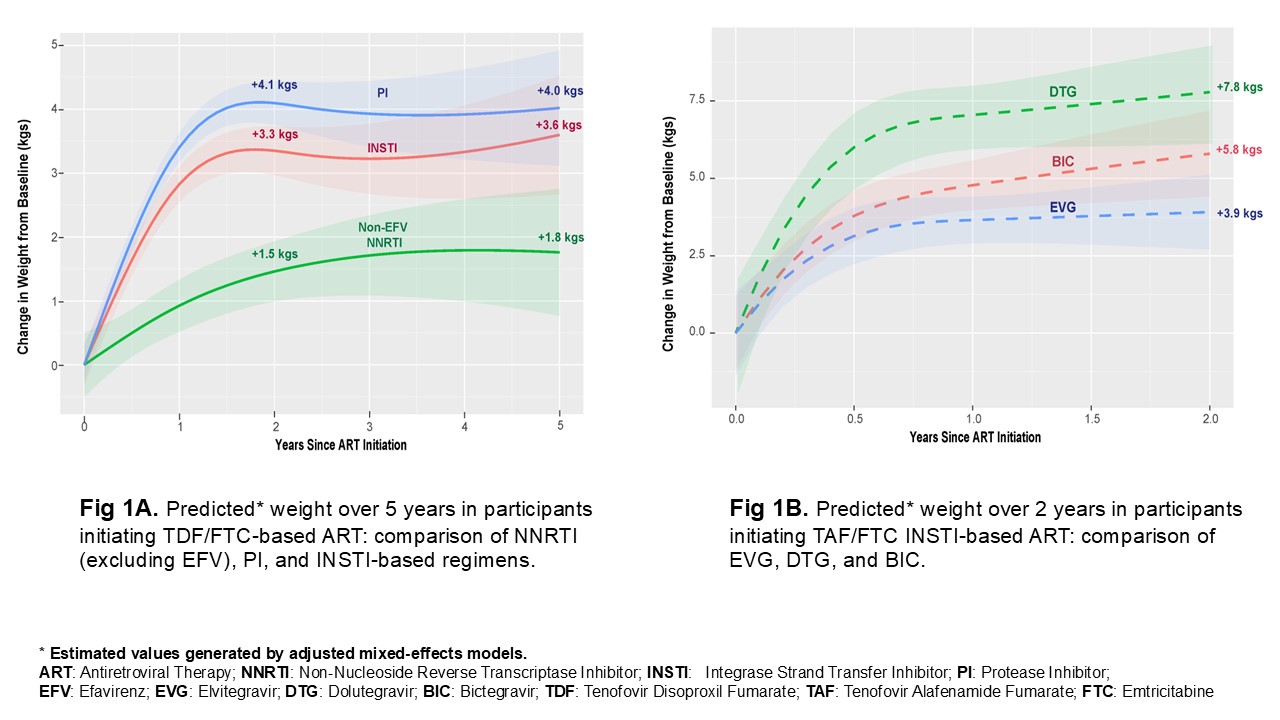
Among 32,962 included individuals, median baseline age and BMI were 41 years and 25.4 kg/m2, respectively; 84% were male, and 45% were Black; 10,406 started an INSTI, 13,500 an NNRTI, and 9,056 a PI; and 72% initiated on TDF/FTC, 12% ABC/3TC, and 11% TAF/FTC. At year 2, persons on NNRTIs gained less weight (2.0 kg) than those on PIs and INSTIs (both 4.1 kg). Notably, a similar difference was observed when the analysis was limited to regimens incorporating TDF/FTC and when EFV was excluded from the NNRTIs (Fig 1A). Among INSTIs, persons starting DTG (4.7 kg) and BIC (6.1 kg) had greater weight gain at year 2, while the change for those starting EVG/c (3.5 kg) and RAL (4.0 kg) was lower. In regimens incorporating TAF/FTC, those starting EVG/c still gained less weight—though the difference was not statistically significant—compared to those on DTG or BIC (Fig 1B).
Conclusions
Treatment-naïve PWH who initiated INSTI- or PI-based regimens gained more weight than those starting NNRTI-based regimens, even after adjusting for the NRTI backbone and excluding EFV. Among INSTI users, those on EVG/c with TAF/FTC gained less weight than those on DTG or BIC. These findings suggest that the previously reported differences in weight gain between ART regimens may not be entirely explained by EFV’s weight-suppressive effects or its coformulation with TDF. Additionally, other agents, such as non-EFV NNRTIs and EVG/c, may also have weight-suppressive properties.
Table or Figure