Background
Initiation of integrase strand transfer inhibitor (INSTI)-based antiretroviral therapy (ART) is associated with weight gain and diabetes mellitus (DM) among ART-naïve people with HIV (PWH). However, most are ART-experienced and may switch to an INSTI-based ART from a different antiretroviral regimen. We aimed to estimate the risk of incident DM associated with switching from a non-nucleoside reverse-transcriptase inhibitor (NNRTI) or protease inhibitor (PI) to an INSTI in a large, diverse cohort of ART-experienced PWH.
Methods
We studied PWH aged ≥18 years in the North American AIDS Cohort Collaboration on Research and Design who did not have DM history and had used NNRTI or PI for ≥180 days between 2007 and 2021. Our study design emulated a trial with multiple baselines: at each HIV clinic visit, participants were eligible to either continue NNRTI or PI or switch to INSTI (bictegravir, dolutegravir, elvitegravir, or raltegravir). We followed participants from each eligible index visits until incident DM, death, loss to follow-up, or administrative censoring at the end of study period or 10 years follow-up. We used inverse probability of treatment weights to balance treatment groups on demographics, body mass index, viral suppression status, comorbidities, and comedications (including tenofovir formulations). We additionally censored follow-up time if people switched to INSTI after the index visit and used weights to mitigate potential bias from informative censoring. We estimated hazard ratios (HRs) using weighted Cox regression with robust variance estimator.
Results
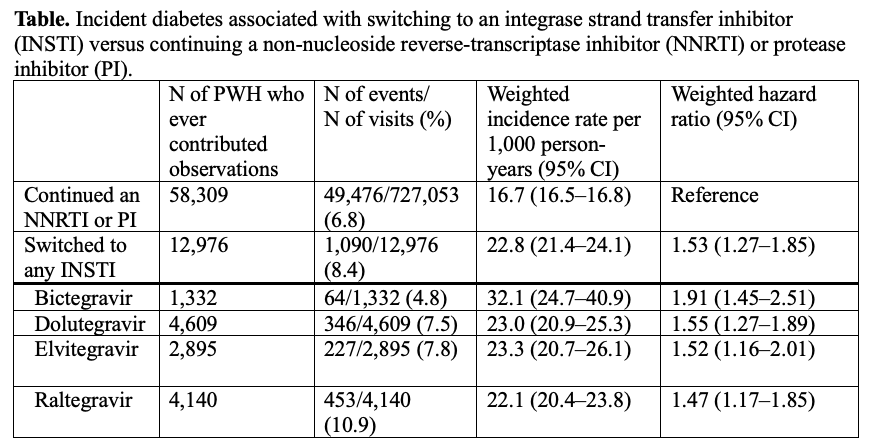
We included 58,971 PWH who attended 727,053 visits where they continued NNRTI or PI and 12,976 visits where they switched to INSTI. The median age was 51 years and 86% were male at birth. Switching to an INSTI was associated with a higher risk of incident DM (weighted HR, 1.53; 95% confidence intervals [CI], 1.27–1.85) compared to continuing an NNRTI or PI. Switching to specific INSTIs also conferred increased DM risk (weighted HRs 1.47–1.91; Table). In a post-hoc analysis of index clinic visits from 2016 onwards, switching to an INSTI was associated with weighted HR of 1.19 (95% CI, 0.92–1.54).
Conclusions
Switching from an NNRTI or PI to an INSTI was associated with an increased risk of incident DM in this diverse cohort of PWH from multiple sites across North America. These findings inform antiretroviral prescribing and tailored risk-benefit approach for PWH, especially those with clinical concern for new-onset DM.
Table or Figure