Background
HIV incidence remains a significant concern among pregnant and postpartum women. Offering multiple HIV PrEP options can increase coverage and use, yet the impact of HIV infections averted with implementation of various HIV PrEP options for pregnant/postpartum women is unknown.
Methods
We developed an equation to project HIV incidence through pregnancy and postpartum between a reference scenario (oral PrEP only) and five LA-PrEP scenarios: 1) Oral/Ring, 2) Oral/Ring/Injectable, 3) Oral/Ring/Injectable/Event-Driven, 4) Oral/Ring in pregnancy and Oral/Ring/Injectable/Event-driven in postpartum, and 5) Ring/Injectable/Event-driven as second-line PrEP (for those who discontinue Oral). The model incorporated uptake rates for different PrEP types, adherence and efficacy estimates, and base HIV risk. Uptake was based on data from a discrete choice experiment among pregnant and postpartum women participating in a PrEP adherence trial in Kisumu and Siaya, Kenya; adherence and efficacy were based on literature. All scenarios were compared to the reference of oral PrEP only.
Results
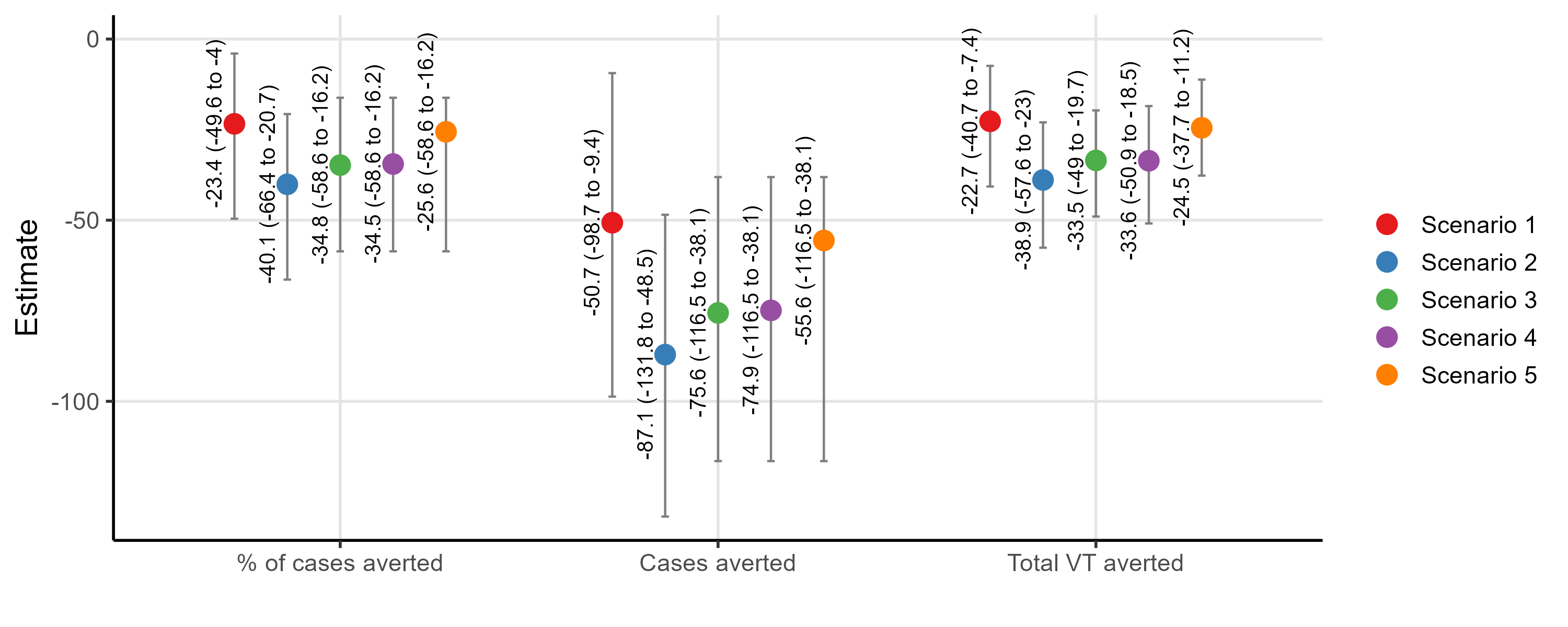
Assuming Oral/Ring availability, resulted in a 23.4% reduction in maternal HIV incidence (50.7 cases averted) and 22.7 cases of VT averted compared to the reference scenario. In the Oral/Ring/Injectable scenario, 40.1% of maternal HIV infections and 38.9 VT cases were averted. Oral/Ring/Injectable/Event-Driven was associated with 34.8% maternal HIV incidence reduction and 33.5 VT cases averted. Oral/Ring in pregnancy and Oral/Ring/Injectable/Event-driven in postpartum was projected to reduce maternal HIV cases by 34.5% and VT by 33.6 cases. Ring/Injectable/Event-driven PrEP for those who discontinued Oral resulted in a 25.6% maternal HIV incidence reduction and 24.5 VTs averted. (Figure 1: Reduction in HIV cases and VT across long-acting PrEP scenarios, compared to daily oral PrEP)
Conclusions
LA-PrEP formulations achieved greater reductions in total HIV infections and VT compared to oral PrEP only. Scenarios with universally available injectable PrEP, such as Oral/Ring/Injectable and Oral/Ring/Injectable/Event-Driven, showed the largest reductions. LA-PrEP only offered in postpartum also had substantial reductions. Utilizing LA-PrEP as a second-line intervention was better than oral PrEP alone but less effective than more comprehensive approaches. Injectable and event-driven PrEP could reduce maternal HIV, and VT, by up to 40% among high-risk peripartum women and infants.
Table or Figure