Background
The HIV reservoir in the central nervous system (CNS) poses a significant challenge to cure efforts, mostly by our limited understanding and access to this compartment
Methods
Tissue samples across 9 CNS regions, including 5 spinal cord (SC) segments (pons, medulla, cervical, lumbosacral, and thoracic spinal cord [TSC], frontal motor cortex [FC], basal ganglia [BG], hippocampus [HP], and occipital cortex [OC]), and peripheral blood mononuclear cells (PBMCs) were collected during rapid autopsies (≤6 hour from death) from people with HIV enrolled in the Last Gift cohort. For each tissue, we measured cell-associated HIV DNA and RNA by ddPCR. Adjusted mixed-effects models compared the HIV reservoir measures across tissues. Single genome HIV-1 env sequencing (SGS, Illumina) and T cell receptor repertoire (TCR) sequencing were performed in a subset of participants. Bayesian phylodynamic and generalized linear models evaluated viral dispersal and associated factors. Tree- and distance-based methods evaluated compartmentalization
Results
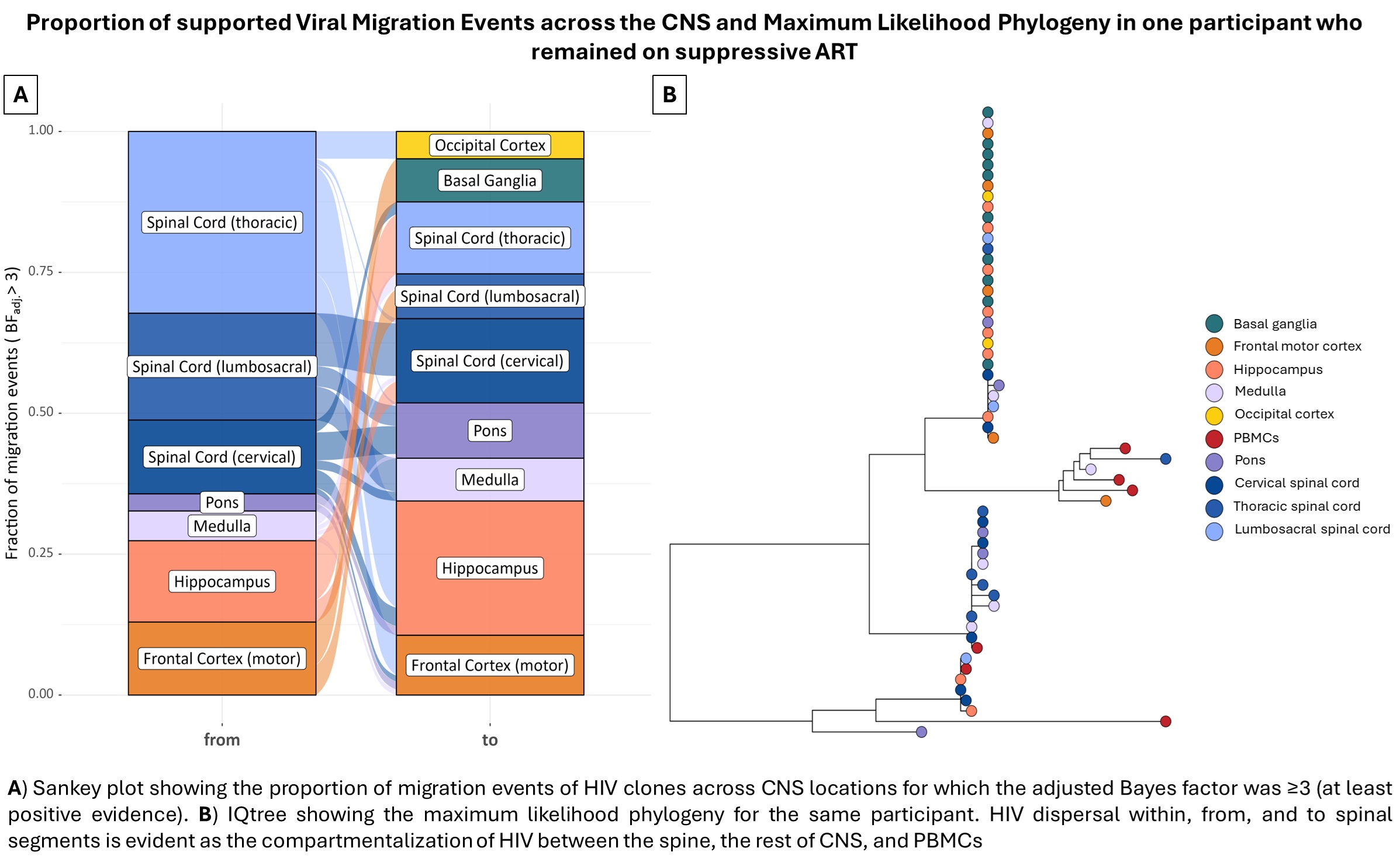
Twenty participants were evaluated: mean age 63±13 years, 85% males, median current CD4+ T cells 193/µL, 85% with plasma HIV RNA <40 cp/mL. While HIV DNA levels in all the SC segments were lower compared to those in PBMCs (p<0.0001), they did not differ from the other CNS regions, except for higher HIV DNA in TSC compared to OC (p=0.039). HIV RNA levels were also similar across the CNS, except for BG that had higher HIV transcriptional activity compared to all the other CNS tissues and PBMCs (p<0.05 all). HIV-1 env diversity (entropy) in TSC was higher compared to that in FC and HP (p<0.05 both). In the 8 participants with SGS and TCR sequencing (≥4 CNS regions including TSC), phylodynamic models revealed viral migration between the SC segments and across the other CNS regions in all participants (e.g., Fig.A). Viral diversity, divergence, and TCR overlap (Morisita index) between CNS locations were not associated with HIV migration. Clear evidence of compartmentalization of HIV in the SC compared to the virus in the rest of the CNS and in PBMCs was supported in 2 and 3 participants, respectively (e.g., Fig.B)
Conclusions
This study provides a comprehensive characterization of the HIV reservoir and its dynamics within the human SC. The SC contributes to HIV persistence and replenishment of brain reservoirs and can be a distinct site of compartmentalization within the CNS. Larger studies are needed to fully understand the SC’s role in reseeding peripheral tissues
Table or Figure