Background
Female bar and sex workers (FBSWs) in Eastern Africa experience a high burden of HIV. However, there is limited population-level data on HIV seroprevalence, incidence, and viral suppression among their male partners.
Methods
Men who had sex with FBSWs were identified through longitudinal population-based HIV surveillance in southern Uganda via the Rakai Community Cohort Study between 2013 and 2020. Surveillance was conducted across five surveys in four Lake Victoria fishing communities (HIV seroprevalence ~40%) and 36 inland agricultural and trading communities (~12%). Primary outcomes included laboratory-confirmed HIV seropositivity, incident infection, viral suppression (<200 copies/ml), and population prevalence of HIV viremia. Prevalence and incidence rate ratios (PR, IRR) were estimated using univariable and multivariable Poisson regressions with 95% confidence intervals (95%CIs). The inverse probability of censoring weights was incorporated into IRR estimates for potential selection biases from differential loss to follow-up.
Results
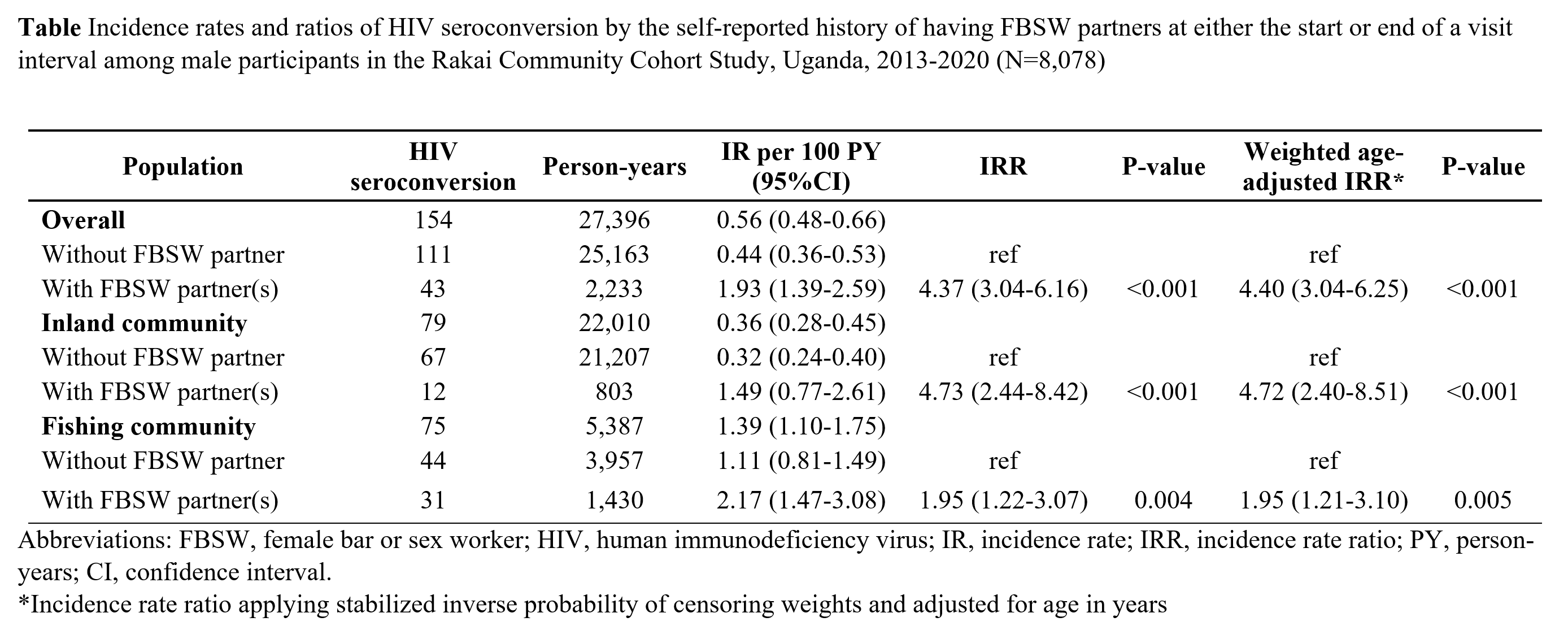
A total of 17,438 male participants contributed 35,273 visits, with 2,408 (13.8%) self-reporting FBSW partners at one or more study visits. Men with FBSW partners tended to be older, have less education and lower income, and never married. Their HIV seroprevalence was significantly higher compared to men without FBSW partners in both inland (21.0% vs 7.5%, PR=2.79, 95%CI=2.41-3.23) and fishing communities (38.6% vs. 23.0%, PR=1.67, 95%CI=1.53-1.84). Moreover, their HIV seroprevalence increased by the number of FBSW partners reported in the past year. Overall, 154 HIV incident events occurred over 27,396 years of participant follow-up. Incidence among men with FBSW partners was 1.93/100 person-years versus 0.44/100 person-years among those without (age-adjusted IRR=4.46, 95%CI=3.09-6.32). Among men with HIV, viral suppression was similar in those with and without FSBW partners. However, the population prevalence of HIV viremia was 1.6 times higher (95%CI=1.41-1.84) among men with FBSW partners due to a higher background burden of HIV infection.
Conclusions
Men in Uganda frequently report sex with FBSW partners, which is associated with a significantly higher risk of HIV acquisition. Tailored HIV prevention strategies, including the promotion and uptake of PrEP, are essential to reduce the HIV burden in this male population.
Table or Figure