Background
Women are at risk of acquiring HIV throughout the perinatal period. HIV testing uptake among the male partners remains low thus the couple are often unaware of the male partner’s HIV status. The antenatal setting, with nearly universal uptake of HIV testing for women, can also serve as a way of reaching male partners. However, the optimal way to engage the male partners is unknown. We sought to evaluate the effect of providing partner notification (PN) + oral HIV self-test (HIVST) kits to pregnant women for their male partner.
Methods
We conducted a two-arm un-blinded randomized trial of HIV negative pregnant women who were attending antenatal care for the first time at Bwaila Hospital in Lilongwe, Malawi from October 2019 to August 2021. Women were randomized 1:1 to receive PN only inviting their partners for HIV testing (standard of care [SOC]) or PN + 1 HIVST kit for partner testing at home (intervention). Due to changes in the national HIV guidelines, from April 2021, women in the SOC arm received PN + 1 HIVST kit and women in the intervention received PN + 2 HIVST kits for couple testing at home. Two-sample test of proportions was used to compare differences in proportions of male partners who reported to clinic within 30 days post randomization. We used log-rank test and Log-binomial regression to compare time to return to clinic and assess factors associated with male partners’ return to clinic, respectively.
Results
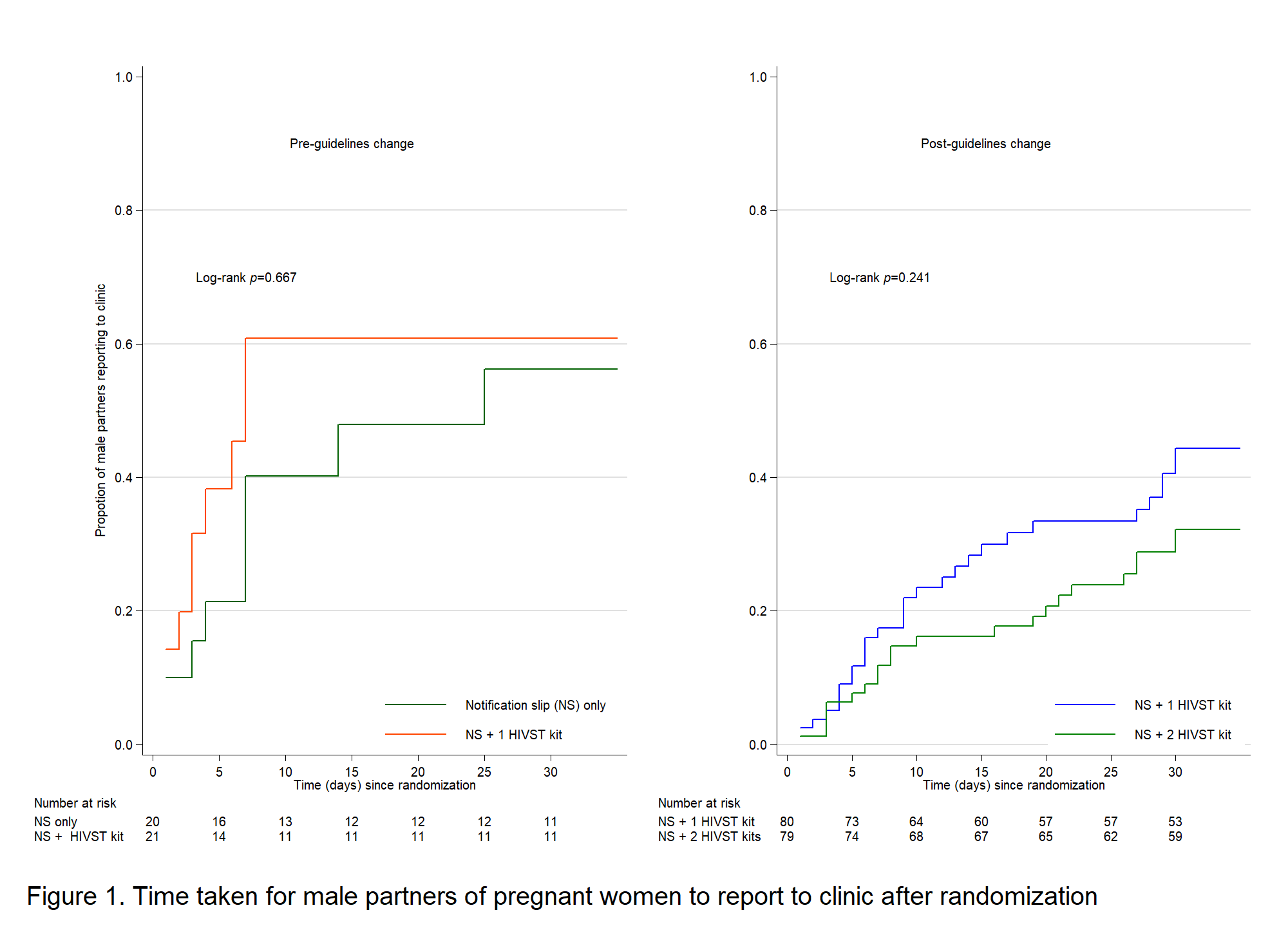
We enrolled 200 pregnant women (100 each arm); 191 (96%) were married. All 70 male partners who reported to clinic tested negative at home. The proportions of males who reported to clinic were similar between intervention and SOC arms; 1) overall: 32% vs 38% (probability difference [pd] = -0.06; 95% CI:-0.07–0.19), 2) pre-guidelines change: 45% [10/21] vs 48% [9/20], pd=-0.03; 95% CI: -0.28–0.33), and post-guideline change: 28% [22/79] vs 36% [29/80], pd=-0.08; 95% CI:-0.23–0.06). Time to return to clinic did not differ between the two arms (Figure 1). Male partners for women with at least secondary education were more likely to report to clinic (adjusted risk ratio=2.25; 95% CI:1.09–4.64) than those for women with no formal or primary education only.
Conclusions
The inclusion of HIVST kit as part of passive partner notification did not improve clinic-based HIV testing among male partners of pregnant women. To ensure that men know their HIV status, innovative approaches are needed to reach and engage them in HIV testing.
Table or Figure