Background
Frailty is an aging-related risk factor for poor outcomes in the general population, conferring up to 2.5 times higher risk of mortality compared with those without frailty. Frailty is a growing concern among people with HIV (PWH) as this population faces chronic immune activation, high rates of comorbidities, and polypharmacy. Frailty in PWH occurs up to a decade earlier than in those without HIV; therefore, it is important to understand the impact of frailty among PWH of all ages.
Methods
We assessed frailty status and all-cause mortality among PWH in the Centers for AIDS Research Network of Integrated Clinical Systems (CNICS) cohort between 1/2015-3/2024. The CNICS data repository harmonizes information on demographic, clinical, and behavioral factors, and self-reported outcomes. Frailty was defined using a validated frailty phenotype of four components (i.e., fatigue, weight loss, activity, mobility). All-cause mortality was ascertained using multiple approaches including state death certificate data and national death indexes. We used Cox proportional hazards models to estimate the association between time-updated frailty status (robust, prefrail, frail) and all-cause mortality. Models were restricted to PWH with complete case data and adjusted for age, sex, race/ethnicity, site, HIV viral load (time-updated), current CD4 count (time-updated), diabetes status, treated dyslipidemia, treated hypertension, hepatitis C virus, hepatitis B virus, liver function (FIB-4), kidney function (eGFR), body mass index, illicit drug use, smoking status, and alcohol use.
Results
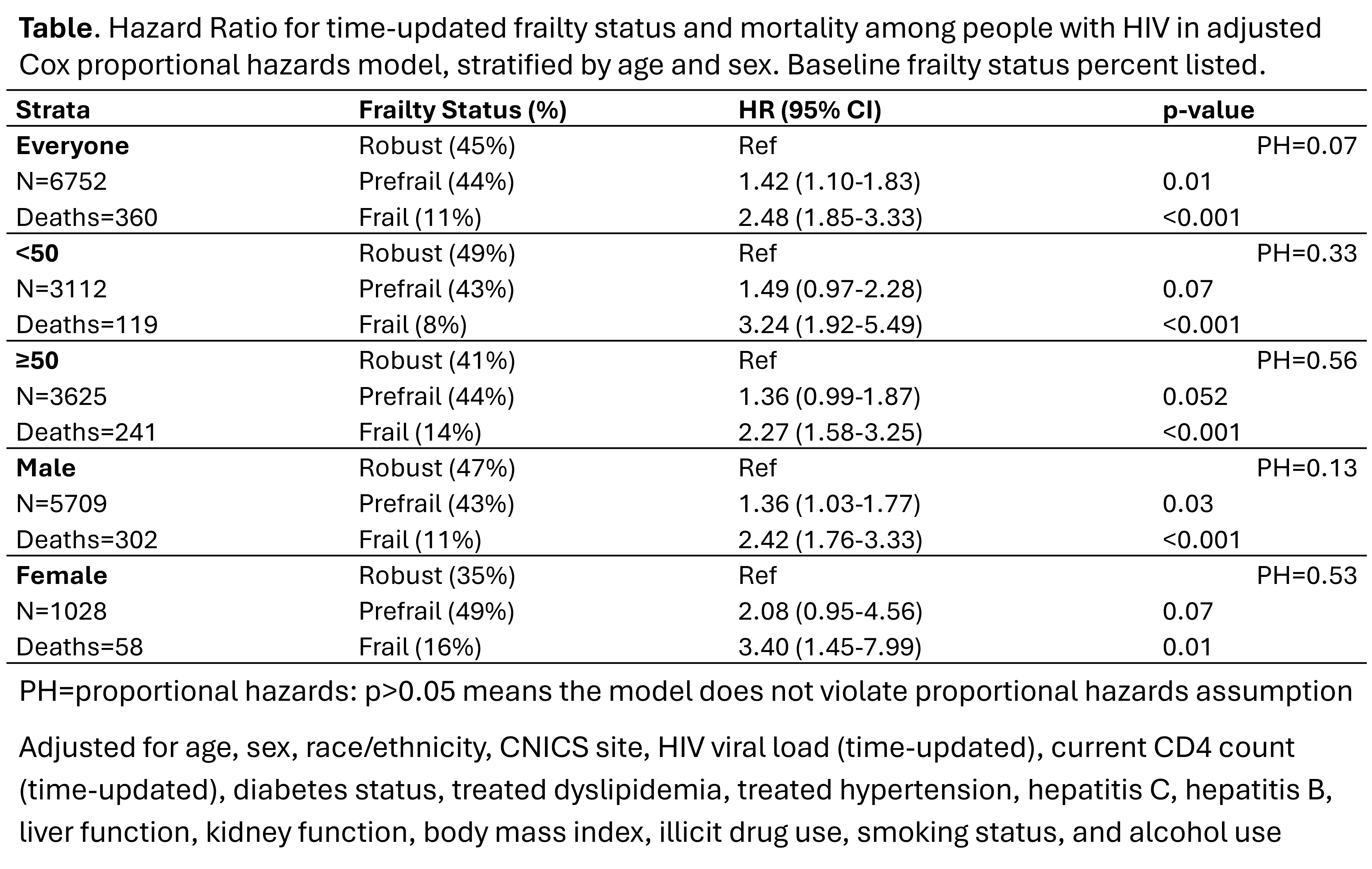
Among 6,737 PWH at baseline, average age was 50 (SD: 12), 15% were female, 45% were non-Hispanic White, 33% were non-Hispanic Black, 44% were prefrail, and 11% were frail. Over an average of 5.5 years of follow-up (median: 5.8), there were 360 deaths recorded, yielding an incidence rate of 9.7 per 1000 person-years (95% CI: 8.8-10.8). In adjusted models, frailty was associated with 2.48 times greater risk of death (95% CI: 1.85-3.33) and prefrailty was associated with 1.42 times greater risk of death (95% CI: 1.10-1.83). Prefrailty and frailty were consistently associated with an increased risk of death in models stratified by age (<50 vs. ≥50) and sex (male vs. female) (Table).
Conclusions
In a large cohort of PWH in care, frailty and prefrailty were associated with a greater risk of death; notably, this was true for PWH under 50. Understanding and preventing frailty in this high-risk population remains a priority.
Table or Figure