Background
Transgender women (TGW) have historically been grouped with cisgender men who have sex with men (CGMSM) in HIV prevention research. However, the effects of feminizing hormone therapy (FHT) on the rectal mucosal immune environment, a primary site of HIV exposure, remain insufficiently understood.
Methods
In Bangkok, Thailand, 100 TGW taking FHT for >6 months and 50 MSM without HIV were enrolled into a cross-sectional study with blood and rectal mucosal sampling. An additional 21 HIV-negative TGW were enrolled and underwent blood and rectal mucosal sampling before and 3-12 months after FHT initiation. Flow cytometry was performed on PBMC and rectal biopsies to quantify 30 and 31 immune cell subsets respectively. Three biopsies were challenged with HIV BaL ex vivo, and p24 production was quantified (Day 3-14). Cellular and p24 outcomes were compared between the groups with linear decomposition modeling controlling for multiple comparisons. Bulk transcriptomics (Illumina HiSeq3000) was performed on rectal biopsies and analyzed for differential gene expression and with gene set enrichment analysis (GSEA).
Results
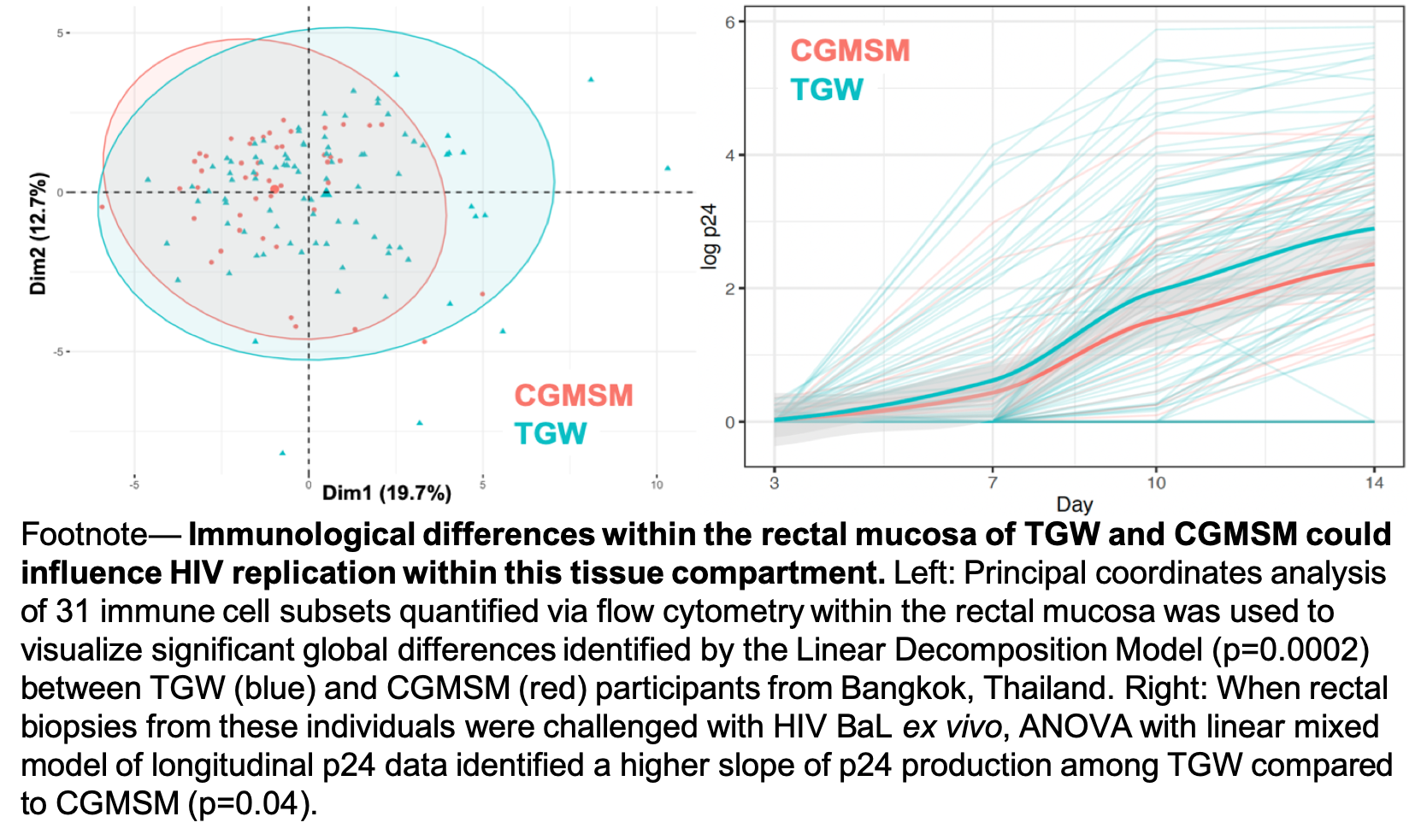
Blood analyses revealed a significant global difference between TGW and CGMSM in cellular composition (p=0.002). Several individual blood cell subsets contributed to this difference, including an increase in activated memory CD4+ T cells (q=0.004), decreases in CD56+CD16+ NK cells (q=0.028) and perforin+ cells (q=0.004) among TGW. Analyses of rectal tissues also identified a significant global difference in cellular composition (p=0.0002) between TGW and CGMSM, and an increase in CCR5+ (q=0.01), Th17 (q=0.002), and Th1Th17 (q=0.02) memory CD4+ T cells among TGW. Ex vivo challenge assays revealed a higher slope of p24 production among TGW compared to CGMSM (p=0.04). Among TGW after FHT initiation, differences in cellular composition were apparent in blood, but not the rectal mucosa. GSEA identified several highly relevant immune pathways that were downregulated in rectal mucosa among TGW compared to CGMSM, while others were increased after initiation of FHT.
Conclusions
The rectal mucosal immune environment among TGW using FHT is distinct from CGMSM and may support higher HIV replication, underscoring the need for further study of this unique population. Our data suggest that cellular changes in blood, but not rectal tissues, are apparent after short-term FHT use. Understanding the effects of FHT on HIV acquisition risk in the context of rectal exposure merits urgent investigation.
Table or Figure