Background
Following recent successes using chimeric antigen receptor (CAR) T cells for various cancer and autoimmune indications, there has been renewed interest in using CAR T cells to target the reservoir of HIV-infected cells. We have previously shown that CRISPR/Cas9 targeting of CAR constructs to the TCRa constant (TRAC) locus enables physiologic expression of the receptor, promotes CAR T cell persistence, and enables pooled screening of hundreds of different CAR binders. Here, we demonstrate the generation of functional TRAC-targeted anti-HIV CAR T cells with binders derived from either a broadly neutralizing antibody (bNAb; PGT128) or from CD4.
Methods
To produce TRAC-CAR T cells, CD3+ T cells isolated from human peripheral blood mononuclear cells were activated and electroporated with Cas9 ribonucleoprotein (RNP) targeting the first exon of the TRAC locus, followed by AAV delivery of a homology directed repair template (HDRt) encoding the CAR transgene. Edited T cells were assessed using flow cytometry to confirm both knock-out of the endogenous TCR (and CCR5 when targeted) and the knock-in rate via expression of a transduction marker (CXCR5), compared to mock- edited T cells receiving only the RNP. The in vitro killing capacity of the CAR T cells was assessed against an HIV-Env+ K562 cell line expressing the mKate fluorophore, at various effector to target (E:T) ratios over 80 hours, using an Incucyte live-cell imager to track the proliferation of the fluorescent target cells.
Results
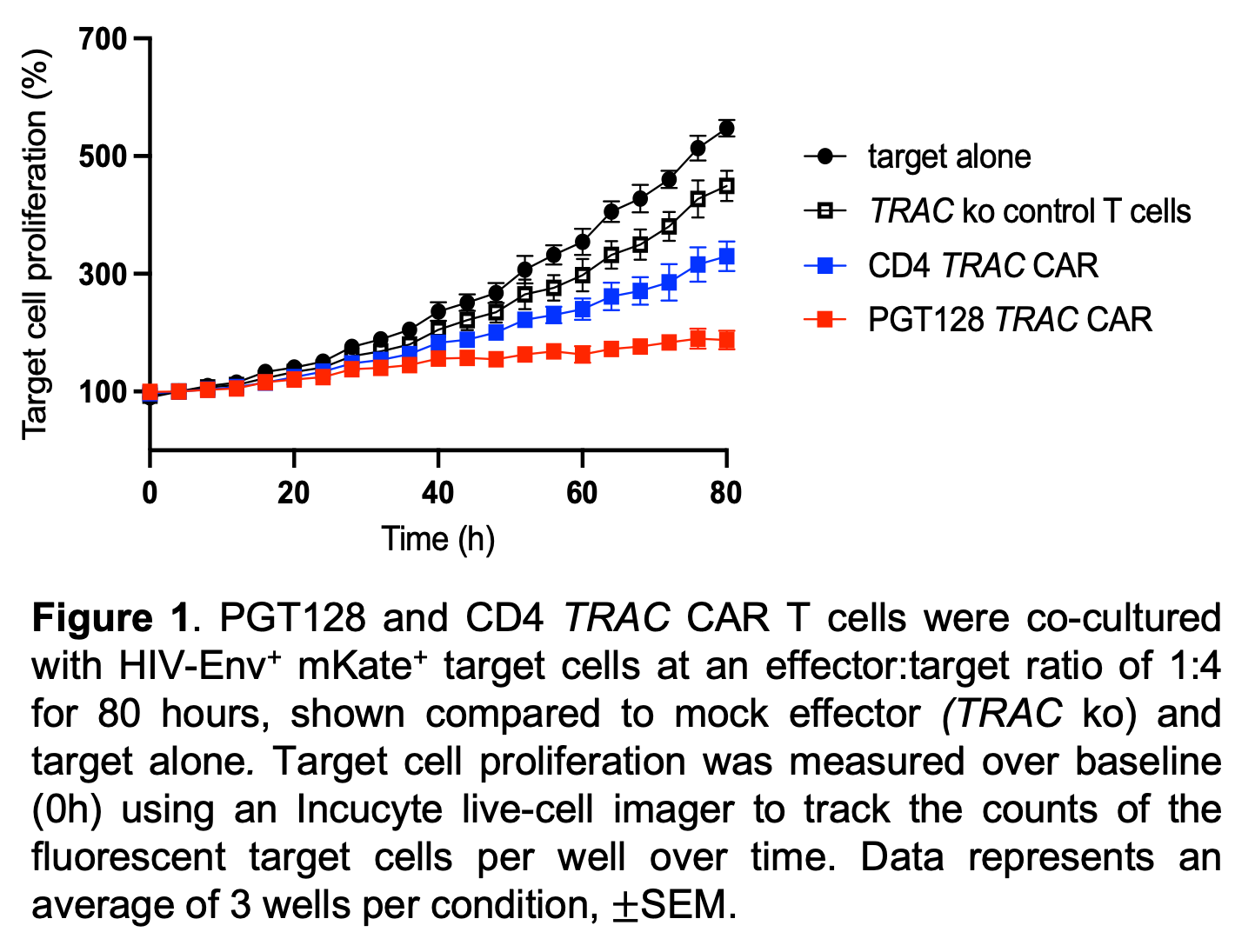
We obtained high TRAC-CAR knock-in efficiency (77.4-84.3% receptor knock-in, 2 donors tested) as well as a high rate of knock-out of CCR5, simultaneously with receptor editing (range of dual knock-out/knock-in 64.1%-74.1%). While both the PGT128 and CD4-derived binder CAR T cells demonstrated in vitro the capacity to kill HIV-Env+ target cells compared to mock-edited T cells (TRAC-ko) over multiple E:T ratios, the PGT128 CAR T cells exhibited greater control than the CD4 CAR T cells at an E:T ratio of 1:4 (Figure 1).
Conclusions
Successful generation of TRAC-CAR T cells that can recognize and kill Env-expressing cells provides proof-of-concept for functional anti-HIV TRAC-CAR T cells, with the capacity to screen hundreds of binders both in vitro and in vivo in a pooled format due to the largely monoallelic expression of the TRAC locus. We hope to leverage this design to identify optimal engineered T cell receptors for recognizing and killing HIV-infected cells.
Table or Figure