Background
CRISPR-Cas9 excision of the HIV genome is a promising strategy for an HIV cure. However, epigenetic features, including DNA methylation at the HIV integration site, may impede anti-HIV gene editing. In this study, we investigated the impact of an FDA-approved DNA methyltransferase inhibitor, 5-Aza-2′-deoxycytidine, on genome demethylation and provirus reactivation in latently infected CD4+ T cells, followed by anti-HIV CRISPR-Cas9 editing
Methods
Primary CD4+ T cells were isolated from three healthy donors and activated using CD3/CD28 activation beads. Cells were then infected with a VSV-G pseudotyped HIV NL4-3 GFP strain, and infected (GFP+) cells were purified using fluorescence-activated cell sorting (FACS). After 7 days of culture, infected CD4+ T cells were sorted again to separate GFP-negative cells (latently infected) from GFP-positive cells (productively infected). Both populations were nucleofected with anti-HIV CRISPR-Cas9 ribonucleoproteins (RNPs) targeting the viral long-terminal repeat (LTR) promoter region. After 48 hours, DNA was extracted, and the LTR region was PCR-amplified, purified, and subject to Sanger sequencing. Sequences were analyzed using Tracking of Indels by DEcomposition (TIDE) to infer editing efficiency. Additionally, HIV-latently infected J-Lat clones 6.3 and 11.1 were treated with DMSO (control) or 5-Aza-2′-deoxycytidine for 72 hours. DNA was then extracted, and the LTR region was PCR-amplified, sequenced, and analyzed using TIDE.
Results
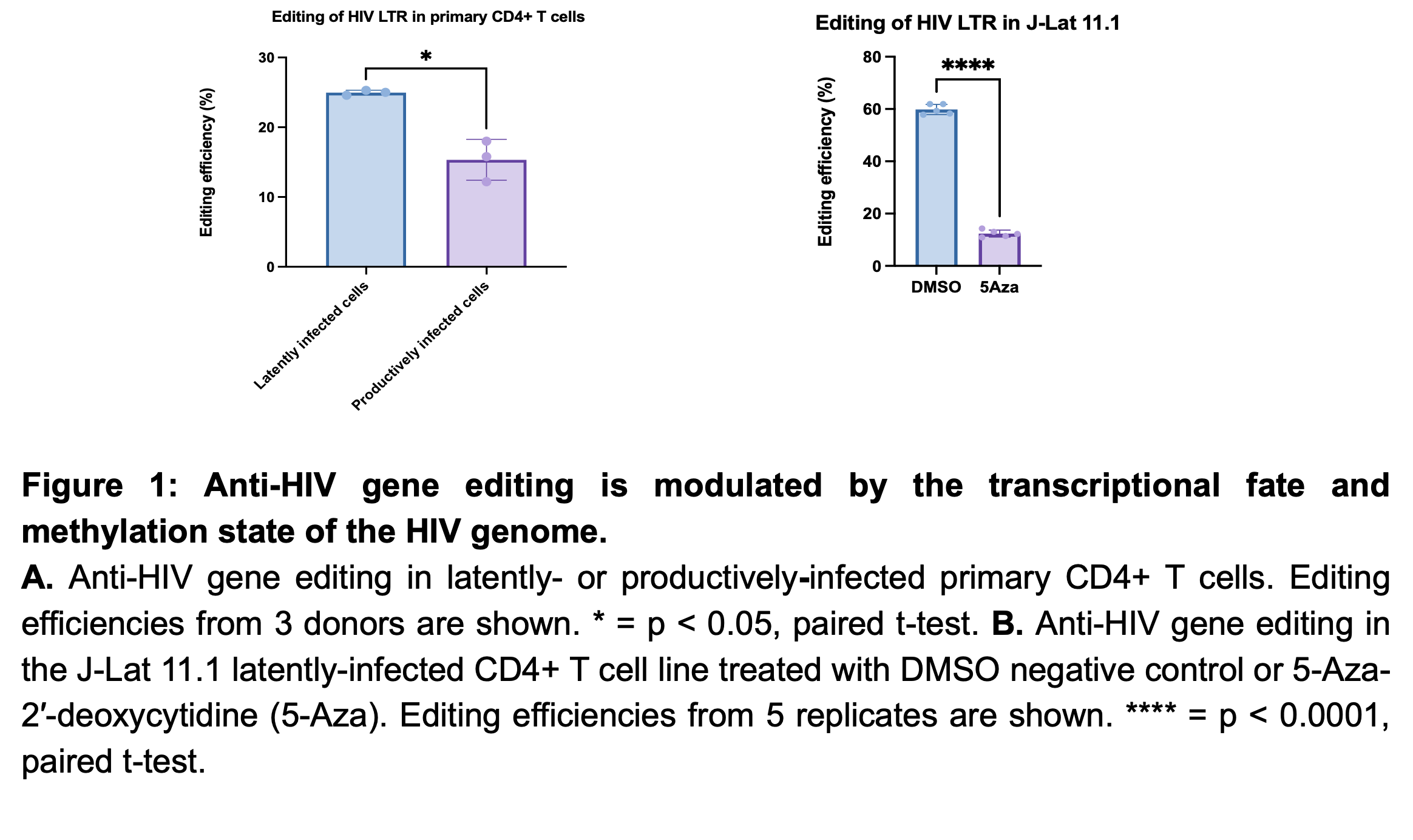
Editing efficiency was 1.6-fold higher in latently-infected CD4+ T cells as compared to productively-infected CD4+ T cells (N=3 donors, p<0.05, paired t-test) (Fig.1A). J-Lat 11.1 and 6.3 clones treated with 6.25nM 5-Aza-2′-deoxycytidine showed modest HIV reactivation (~15% GFP-positive). Editing efficiency was 4.8-fold and 3.8-fold lower in 5-Aza-2′-deoxycytidine-treated J-Lat 11.1 and J-Lat 6.3 cells, respectively, compared to their DMSO-treated counterparts (p<0.0001 and p<0.0005, respectively, paired t-test) (Fig.1B).
Conclusions
Anti-HIV gene editing efficiency is higher in latently-infected cells as compared to productively-infected cells, and anti-HIV editing is impeded by demethylation of the HIV genome. Our data suggest that the active HIV reservoir may be refractory to excision approaches, warranting investigation into the impact of epigenetic states on anti-HIV gene therapy. Hypermethylating drugs in clinical use, such as budesonide, should be explored in combination with anti-HIV gene editing approaches.
Table or Figure