Background
Given the increased prevalence of steatotic liver disease (SLD) in people with HIV, understanding its natural course and progression to liver fibrosis is crucial for guiding clinical management.
Methods
We assessed SLD and liver fibrosis in RESPOND participants from January 2012 to December 2022 using serological scores validated for people with HIV, excluding those with viral hepatitis and pregnant women. The Hepatic Steatosis Index (HSI) was calculated using gender, BMI, AST, ALT, and diabetes, and the Fibrosis-4 (FIB-4) Index using age, AST, ALT, and platelet count. Presumed SLD was indicated by a HSI of ≥36 as pre-established, and liver fibrosis by two consecutive FIB-4 scores of ≥3.25. We used multivariable logistic regression to evaluate factors associated with HSI ≥36 at first assessment. Incidence rates (IRs) of HSI ≥36 were calculated for participants with an initial HSI <36, and IRs of two consecutive FIB-4 ≥3.25 for those with HSI ≥36.
Results
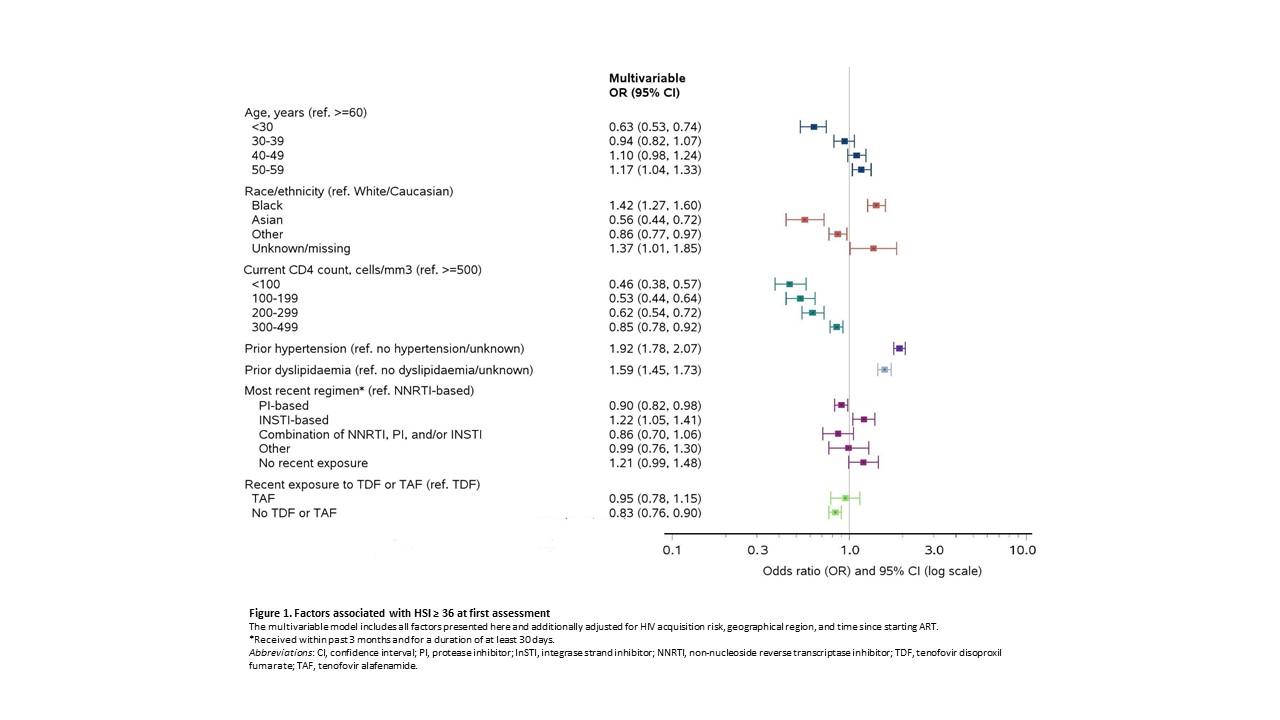
Among 16,327 eligible participants, median age was 45 years (interquartile range [IQR] 36-53), with 3,935 (24.1%) being female, and 11,438 (70.1%) white. Median CD4+ count was 549cells/μl (IQR 379-741), 6,473 (39.6%) had a BMI ≥25kg/m², and 841 (5.2%) diabetes. The prevalence of HSI ≥36 at the first measurement was 31.9%, with 1.2% showing two consecutive FIB-4 ≥3.25. In multivariable analyses, the odds of having an HSI ≥36 increased with age up to 60 years and higher CD4 counts (Figure 1). Black participants had higher odds (adjusted odds ratio [aOR] 1.42; 95% CI 1.27–1.60) and Asian participants lower odds (aOR 0.56, 95% CI 0.44-0.72) compared to white. Hypertension (aOR 1.92, 95% CI 1.78–2.07), dyslipidemia (aOR 1.59, 95% CI 1.45–1.73), and current use of integrase strand inhibitors (InSTI) (aOR 1.22, 95% CI 1.05-1.41, vs. non-nucleoside reverse transcriptase inhibitors) were associated with higher odds of HSI ≥36. Among 11,114 participants with HSI <36 at first assessment, the median follow-up was 8 years (IQR 4.3-10.1), with a 6-months interval (IQR 4.3-8.1) between assessments. During 63,161 person-years of follow-up (PYFU), the IR for HSI ≥36 was 13.3 per 100 PYFU (95% CI 13.1-13.6). For those with HSI ≥36, the IR of subsequently having two consecutive FIB-4 ≥3.25 was 0.5 per 100 PYFU (95% CI 0.5-0.6).
Conclusions
Participants aged 50-59 years, black participants, and those with higher CD4 counts, metabolic comorbidities, or exposure to InSTI were more likely to have HSI ≥36. The progression to liver fibrosis was rare.
Table or Figure