Background
HCV elimination targets for 2030 require that 90% of people with HCV (PWHCV) are diagnosed, and 80% of those diagnosed are treated, alongside measures to reduce primary infection and reinfection in groups like people who inject drugs (PWID) who bear a disproportionate burden. We characterize changes in HCV burden, awareness of HCV status, treatment uptake, and aviremia among PWID across 6 Indian cities over 12 years.
Methods
We conducted 3 population-based surveys in each of 6 Indian cities using respondent-driven sampling (RDS) to recruit 750-1000 PWID/city/survey in 2012-2013, 2016-2017 and 2023-2024. In 2017, we scaled community-based integrated care centers in each city that delivered HIV and harm reduction services alongside rapid HCV antibody testing; HCV RNA testing and on-site treatment with direct-acting antivirals were integrated in 2021. In 2016, the government launched free HCV treatment in government centers. We characterize temporal trends in HCV prevalence, treatment uptake among diagnosed, and aviremia (no detectable HCV RNA at survey visit) among treated. Correlates of diagnosis and aviremia were explored. All analyses incorporated RDS-2 weights.
Results
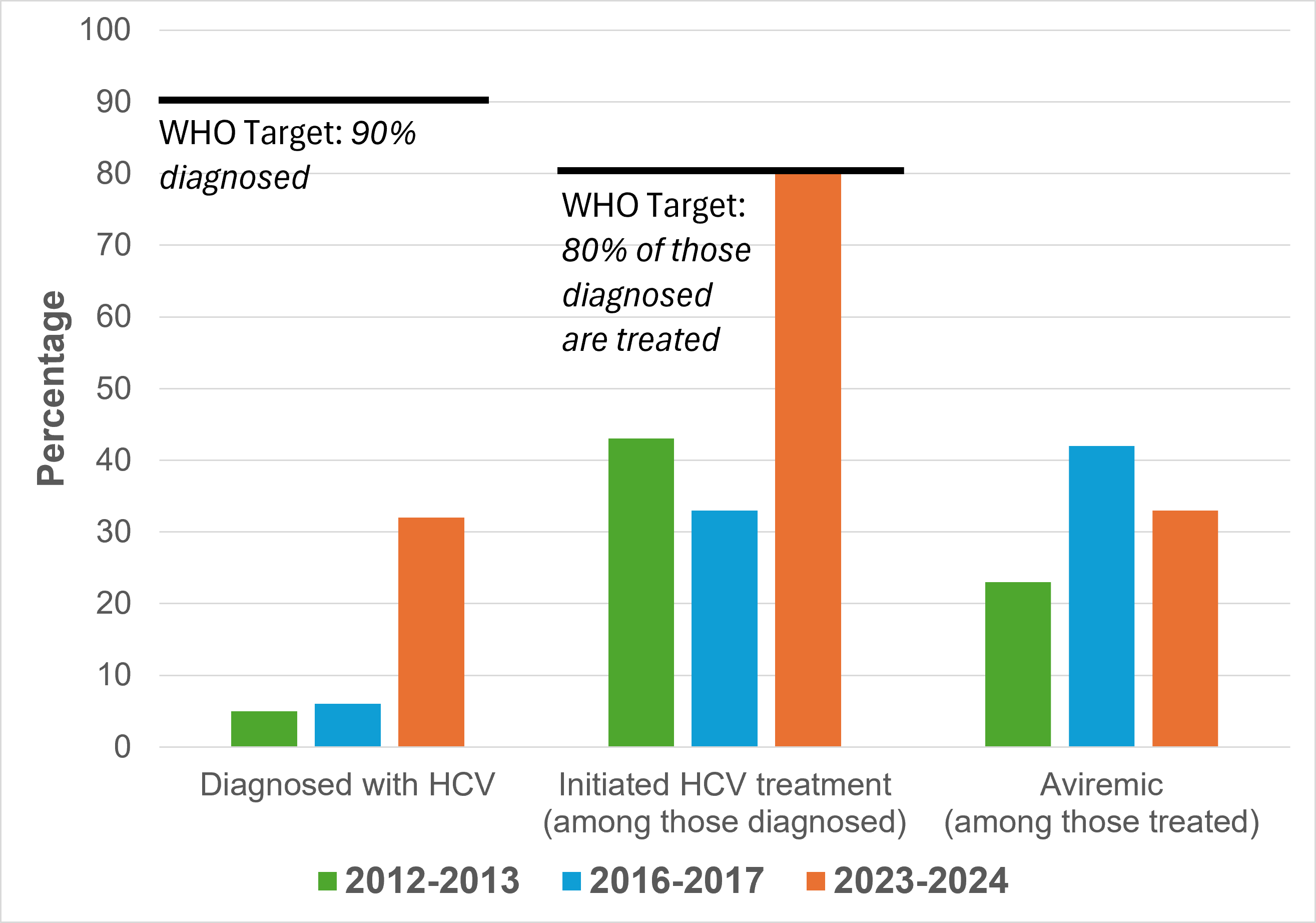
Across 3 periods, the median age was 28, 30 and 29 years with 91%, 91% and 99% reporting injection in the prior 6 months. 18%, 24% and 42% were living with HIV. HCV antibody prevalence increased from 40% to 56% to 82% with increases in all sites. Among those with current or prior chronic infection (detectable HCV RNA or self-reported treatment), the proportion diagnosed increased from 5% to 6% and 32% and the proportion initiating treatment among those diagnosed from 43% to 33% and 80% (Figure). The proportion aviremic among those treated increased initially from 23% to 42% but then decreased in 2023-2024 to 33%. In 2024, only 8% of those with prior chronic infection were aviremic. Among PWHCV, correlates of diagnosis were older age, higher education, recent HIV testing, suppression on ART and MOUD use. Among those treated, correlates of aviremia were higher education, stable employment and suppression on ART.
Conclusions
Despite increases in diagnoses and achieving WHO targets in HCV treatment uptake among those diagnosed, we observed no change in aviremia among those treated or at the population level. These findings, alongside concerning increases in HCV antibody prevalence, suggest that this level of treatment scale up was not sufficient to prevent primary infection or reinfection among actively injecting PWID.
Table or Figure