Background
People with HIV (PWH) appear to be 2-4x more likely to develop long COVID after SARS-CoV-2 infection than people without HIV (PWOH). This is potentially linked to the heightened immune activation and inflammatory state typical of chronic HIV despite effective antiretroviral therapy. Here, we evaluated whether the shifts in monocyte and T cell populations typical of chronic HIV are exacerbated in long COVID, and how the immune features of long COVID in PWH compare to PWOH.
Methods
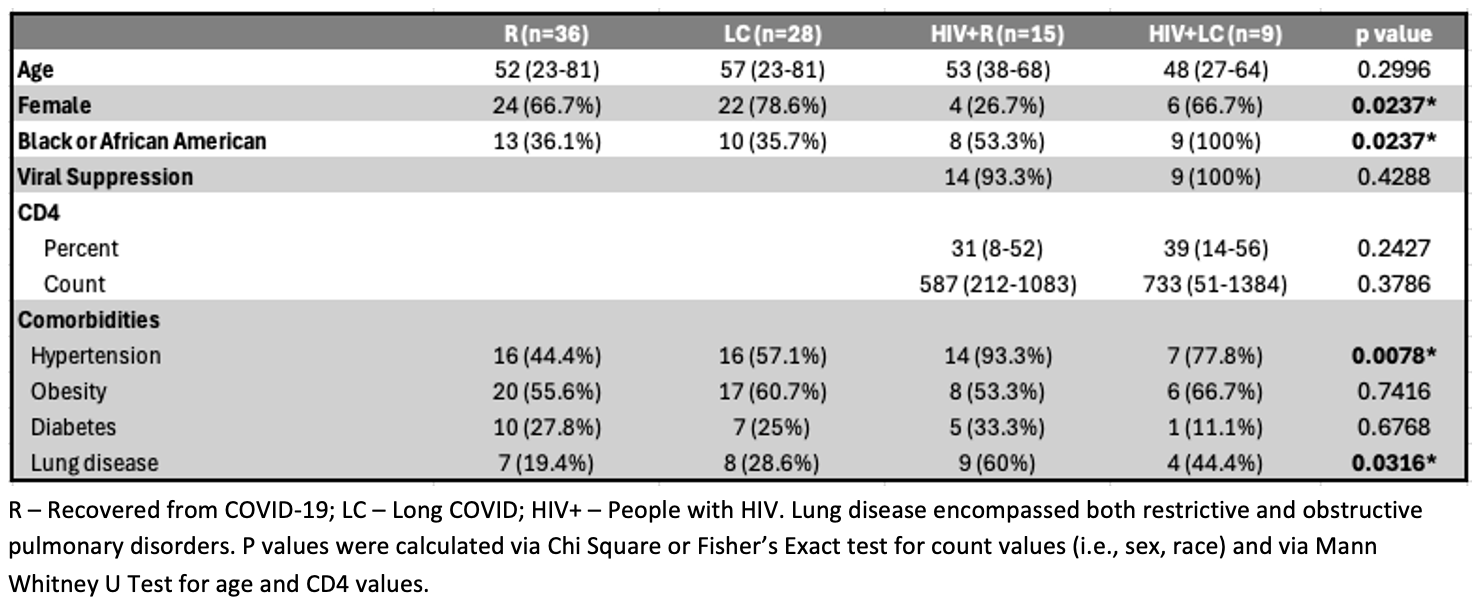
We performed flow cytometric analyses on peripheral blood mononuclear cells from PWH with (n=9) and without (n=15) long COVID and groups of PWOH with (n=28) and without (n=36) long COVID. Participant clinical and demographic features were blinded prior to data collection, leading to a skewed racial and gender distribution. Samples were collected an average of 30 months after participants’ first reported COVID-19 infection. Cells were stained for surface markers of activation/exhaustion (with and without SARS-CoV-2-specific antigen stimulation) and for monocyte subsets (CD14+ classical, CD14+CD16+ intermediate, CD14-CD16+ nonclassical). Electronic health record data including acute COVID-19 infection history, SARS-CoV-2 vaccination history, and long COVID symptom burden were collected.
Results
PWH had increased expression of activation markers OX40 (p=0.034) and PDL1 (p=0.035) on CD4+ T cells as compared to PWOH who recovered from COVID-19. Regardless of long COVID status, PWH had increased CD14+CD16+ intermediate monocytes as compared to PWOH (p=0.048). When stimulated with a SARS-CoV-2 peptide pool containing membrane, nucleocapsid, and envelope proteins, the majority of PWH with long COVID had an antigen-specific CD4+ T cell response, whereas few responses were detected in PWOH with long COVID (p=0.016). When comparing post-COVID symptom burden, PWH with long COVID reported higher frequencies of shortness of breath (p=0.044), bladder incontinence (p=0.499), dry mouth (p=0.0475), excessive thirst (p=0.047), and problems with their teeth (p=0.031) as compared to PWOH with long COVID.
Conclusions
Our findings demonstrate that PWH with long COVID exhibit increased CD4+ T cell activation and an increase in intermediate monocyte frequencies as compared to PWOH with long COVID. Our research explores potential differences in long COVID pathogenesis and provides evidence for potential diagnostic markers and therapeutic targets for patients with inflammatory phenotypes of long COVID and other post-viral syndromes.
Table or Figure