Background
High blood pressure (≥90mmHg/140mmHg) is associated with ~35% of sub-Saharan Africa deaths. In Mozambique, 3% of hypertensive adults achieve controlled blood pressure (BP). Systems engineering strategies applied at the health facility level, like the Systems Analysis and Improvement Approach (SAIA), have been shown effective in improving quality and continuity of health service delivery in resource-constrained settings. We present results of a trial designed to assess SAIA’s application to optimize hypertension (HTN) care quality and continuity for HIV-infected individuals in Mozambique.
Methods
A hybrid type III cluster randomized controlled trial compared HTN outcomes between intervention and control facilities (n=16), where intervention sites implemented SAIA – a bundled, clinic-led strategy of cascade analysis, process mapping, and monthly continuous quality improvement cycles to identify, prioritize and iteratively test context-appropriate, low-cost solutions. Control sites delivered care as usual. All clinics received BP machines, batteries and educational tools reflecting national norms and used patient-level forms to report HTN care. A three-month baseline period (07-09/2020) preceded a 24-month intensive phase of the trial and a 12-month sustainment phase without study team support. Generalized Estimating Equations assuming an exchangeable correlation structure and a log-binomial regression model in R statistical package estimated the risk ratio of controlled BP between study arms, adjusting for study phase and whether clients were newly recruited or retained from a previous phase.
Results
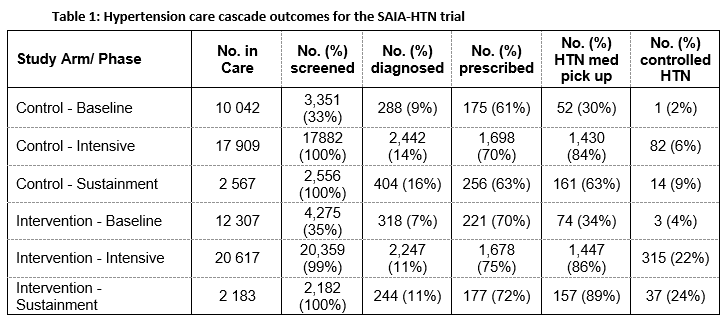
The study included 65,625 unique clients (53% in intervention sites). HTN Screening rose from 34% at baseline to ~100% in intensive and sustainment phases in both arms. In intervention sites 74% (vs. 68 in control) HTN clients received a prescription, 81% (vs. 77%) accessed the prescribed medication and 21% (vs. 6%) attained controlled BP. The risk ratio of controlled BP was 1.88 (95% CI: 1,75 – 2.02) intervention:control sites, and was higher in intensive (2.7, 95% CI: 1.9 – 4.1) and sustainment (3.41, 95% CI: 2.38 – 5.16) phases, compared to baseline. Retained clients experienced 29% (95% CI: 1.18 – 1.42) higher risk of controlled HTN compared to newly recruited.
Conclusions
The SAIA-HTN strategy improved performance of integrated HIV-HTN services, resulting in a significant and sustained increase in controlled BP among PLHIV with HTN.
Table or Figure