Background
Achieving an understanding of T-cell dynamics and distribution of proviral DNA within T cell subsets is of critical importance in achieving a better understanding of the relationships between effector memory, central memory and naïve CD4 cell subsets. In this study, we investigated the relationships between these subsets utilizing the natural “barcoding” provided by replication-incompetent defective HIV-1 proviruses. The provirus-barcode gives each single cell a unique identity, which is passed on to daughter cells without the signal being diluted during somatic cell division.
Methods
Cryopreserved cells were obtained from 2013 to 2023 from a 54-year-old white male with HIV-1 infection. During this time, his plasma HIV-RNA levels remained <20-40 copies/mL with transient viral blips below 454 copies/mL, and his median CD4 count was 651 cells/µL (range: 434-756 cells/µL). CD4 cell subsets were isolated by flow cytometry sorting with a combination of CD45RO and CD27 antibody staining to identify naïve (NA, CD27+CD45RO-), central memory (CM, CD27+CD45RO+) and effector memory (EM, CD27-CD45RO+) subsets. HIV-1 proviruses in CD4 cell subsets and unsorted PBMCs were characterized by 5’LTR-to-3’LTR PCR single-genome amplification and direct amplicon sequencing.
Results
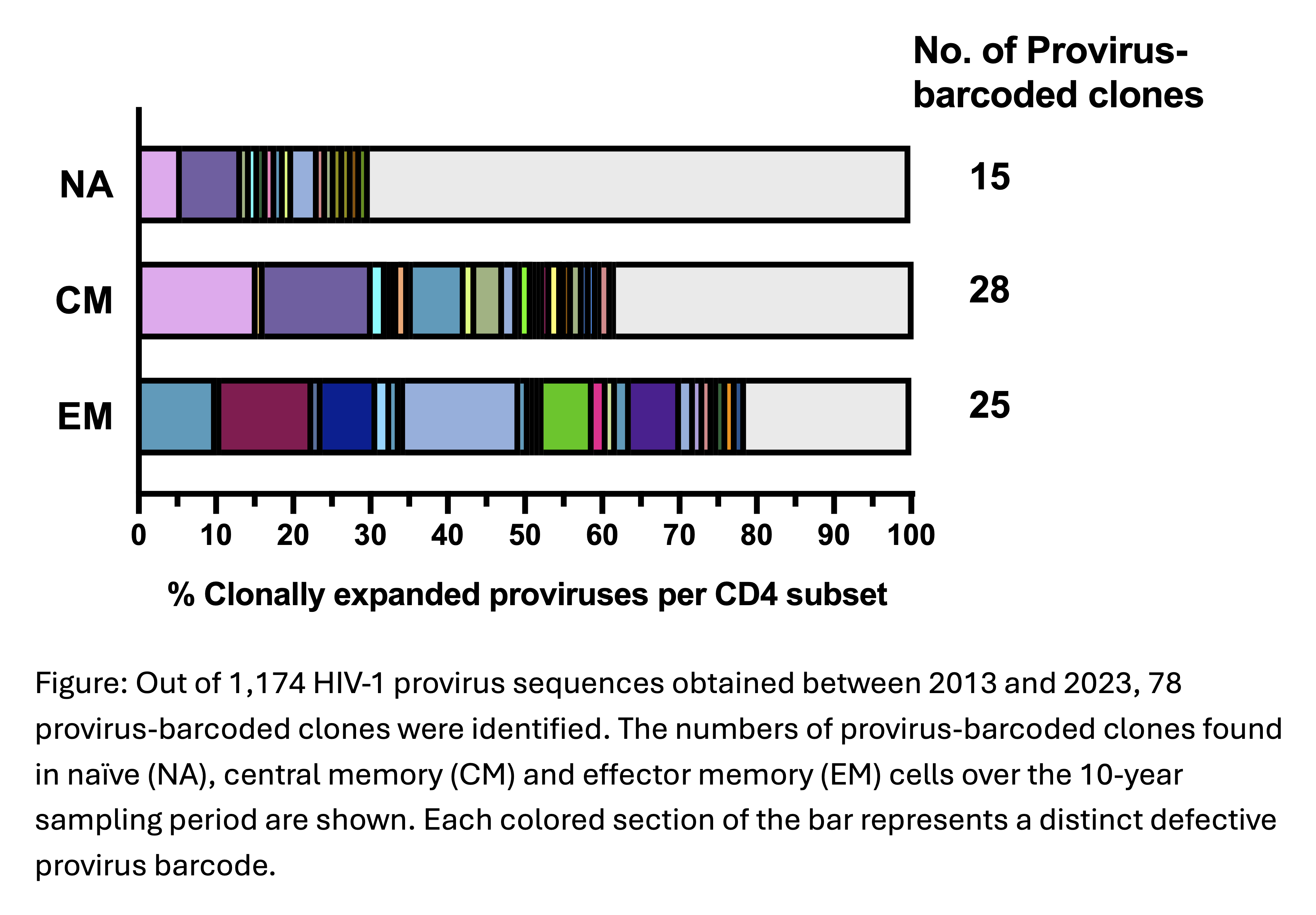
Sequencing of 1,174 HIV-1 proviruses in the three CD4 cell subsets and PBMCs identified 78 expanded defective HIV-1 provirus clones, each harboring distinct defective provirus barcodes. 23 of the 78 clones persisted for ≥3 yrs (median: 6 yrs, range: 3-10 yrs). The highest number of provirus-barcoded clones was found in the CM pool (n=28) followed by the EM (n=25) and NA (n=13) pools, corresponding to 61%, 79%, 30% of the total provirus sequences detected in CM, EM and NA cells, respectively (Figure). One of the dominant clones (the pink-colored sections of the bars in the figure) is a 6 kb HIV-1 provirus with hypermutations. It was first detected in CM cells and 3 yrs later in NA cells. In addition, clonal conversions from EM to CM (2 provirus-barcoded clones) and reversions from CM to NA (5 provirus-barcoded clones) were observed.
Conclusions
The strategy of using expanded defective HIV-1 provirus clones as a novel “barcode” enables high-resolution insights into T-cell dynamics and demonstrates the durability of clonal populations in each subset. In contrast to the current dogma of effector memory populations being short-lived, these data demonstrated that they are able to persist in vivo for several years or more.
Table or Figure