Background
Congenital syphilis (CS) is an urgent threat; cases are at their highest rate (102.5/100,000 live births) since 1991. The only treatment (tx) for late latent syphilis (LLS) in pregnancy is 3 doses of benzathine penicillin G (BPGx3), given at 7-day (d) intervals. If intervals exceed 9d, US guidelines recommend restarting the full tx series, implying intervals up to 9d are acceptable. We previously demonstrated CS is not more likely with prenatal BPGx3 at 6-8d vs strict 7d intervals (OR 1.0, 95%CI 0.4-3.0), but there are no studies of 9d.
Methods
Using California surveillance data, we leveraged an existing cohort of all mother/infant dyads wherein the parent had LLS in pregnancy from 1/1/16-6/30/19. Since only 5 dyads in this cohort received BPGx3 with a 9d interval, we enriched the study population with additional dyads who received BPGx3 with at least one 9d interval (and no intervals outside 6-9d), from a later period (7/1/19-12/31/23). We divided all dyads into 3 groups: adequate tx (Atx: BPGx3 at strict 7 or 6-8d intervals, started 30+d before delivery); BPGx3 at 6-9d (at least one 9d interval, no intervals outside 6-9d, started 30+d before delivery), and no/inadequate tx (NAtx). We compared clinical/demographic characteristics and infant CS incidence proportions via chi-squared/Wilcoxon rank sum, then estimated odds of CS by group via logistic regression.
Results
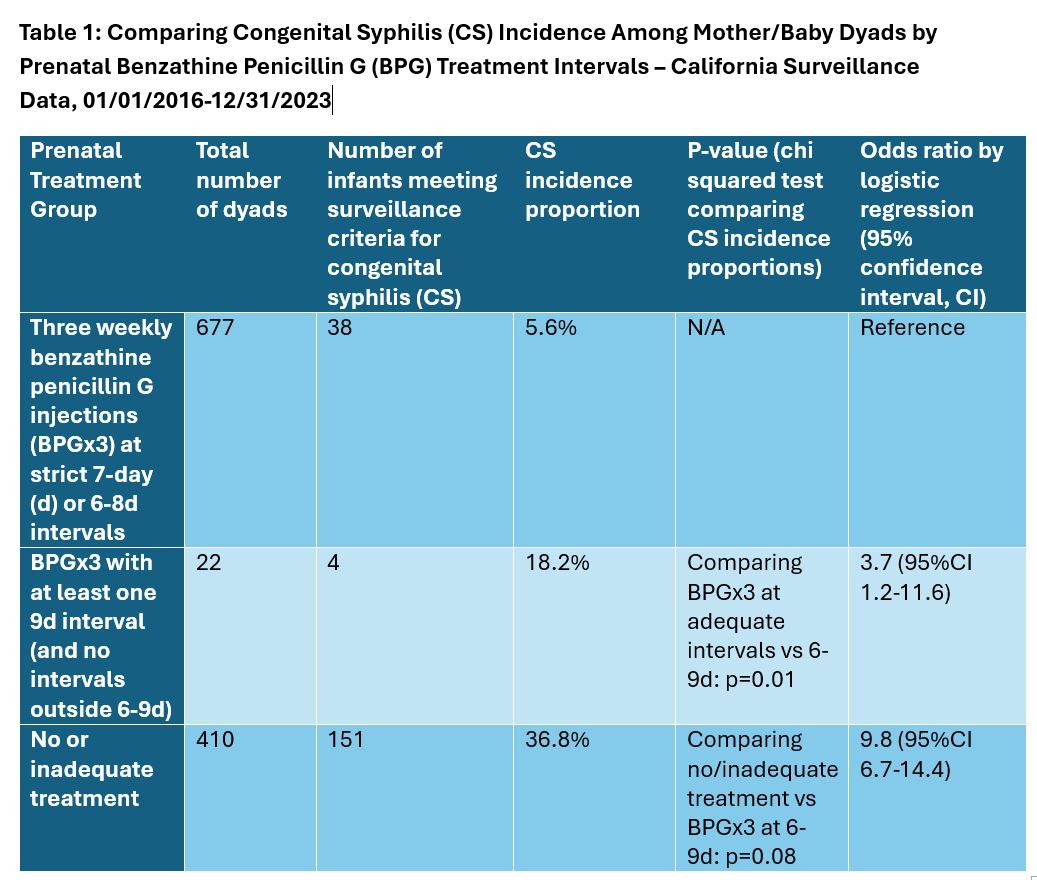
We analyzed 1109 dyads: 677 Atx, 22 BPGx3 at 6-9d, and 410 NAtx. Comparing Atx vs 6-9d dyads, there were no differences (p>0.05) in maternal HIV (0.5 vs 0% positive), maternal RPRs 1:32+ (45.1 vs 40.9%), prenatal care (97.3 vs 95.5% received care), or gestational age at syphilis tx (median 16 vs 21 weeks). CS incidence proportions were 5.6% (38/677) for Atx, 18.2% (4/22) for 6-9d, and 36.8% (151/410) for NAtx (p=0.01 for 6-9d vs Atx). With Atx as reference, odds of CS were 3.7 (95%CI 1.2-11.6) for 6-9d and 9.8 (95%CI 6.7-14.4) for NAtx (Table 1).
Conclusions
Compared to Atx, odds of CS approached 4-fold higher among dyads who received BPGx3 with 9d interval(s). These findings question current guidelines, suggesting CS may be more likely when BPG intervals are extended to 9d. Limitations include small numbers (preventing controlling for confounders) and the fact that most 6-9d dyads were from a later period than the comparator dyads. Still, given lack of data otherwise and while awaiting larger studies with higher statistical power, clinicians should consider erring on the side of caution, avoiding intervals outside 6-8d.
Table or Figure